


Rainer Wiege
Considering a trip to Central America this summer but concerned about the so-called rainy season? The rainier months of May to October are in many ways the best months to see the country. Here is why.
There Are Still Sunny Days
Traveling during the rainy season in Central America does not mean you miss out on sunny beach time. Mornings and early afternoons are usually sunny and beautiful with showers in the afternoon or evening. The rain can actually be a welcome reprieve from the heat of the sun, cooling everything off. September and October are the rainiest months of the year, but May through August offer plenty of sunny days.
Everything Is Greener
One of the best reasons to travel to Central America is to experience the stunning forests and flowers. During the dry season there is little to no rainfall on the Pacific Coast. Consequently the jungle becomes dry and the land becomes arid making everything dusty and brown. Dust can become a serious problem causing many locals to wear masks when driving down or cycling on the road. The rainy season is locally called “the green season” because it is when the jungle becomes the most lush and beautiful. With afternoon or overnight showers in the green season, the entire landscape comes to life. The habitat flourishes which makes wildlife more abundant and easier
Less Crowds
Possibly the best reason to travel to Central America in the rainy season is because there are so many less tourists. Laying on the beach, hiking up a volcano, swimming in hot springs, and spotting animals in the jungle is much more enjoyable without crowds of people. Peak season runs between December and April, so the rest of the year it’s not uncommon to find your own private stretch of beach.

MD Verde
Less Expensive
Green season also means slow season which means great deals! Hotels, housing rentals, and flights are at significantly discounted prices, often cut in half, during this time which boosts your budget for adventure tours. A trip that you may not be able to afford in the winter may be below your budget in the summer.
Rushing Waterfalls and Rapids
Swimming in waterfalls and white water rafting are big tourist draws in Central America. Pacuare, Costa Rica in particular is a worldwide rafting destination and during the rainy season the higher water levels offer faster, more thrilling rafting. With more rainfall the waterfalls also become more dramatic and rushing.

Mike Beard
Easier to Connect with Locals
If you are considering relocating to Central America, the rainy season is a great time to come visit. It’s often much easier to befriend and gain insight from locals and expats during this time because there are significantly less tourists. Restaurants and cafes are quiet and usually frequented by residents or long-term travelers.
Whale Watching and Turtle Nesting
Humpback whales migrate up the Pacific coast in Costa Rica beginning in August which is an incredible time to take a whale-watching tour. This time of year is also when the leatherback turtles on the Caribbean coast begin to hatch which brings tourists from all over the world to witness the incredible event. You can even volunteer to help the baby turtles make their journey into the ocean.
Prime Surfing
Epic surf put Costa Rica on the map for tourism, and rainy season lends some of the best swells all year. While the Northern Nicoya Peninsula and the South Caribbean coast experience their best surfing conditions between December and March, the Central and Southern Pacific peaks from May until November. With less tourists you will also have less competition for catching world-famous Costa Rican waves. Check out Dominical and Pavones for world-class surfing during the rainy season and little to no crowds.
There are plenty of reasons to come to Central America in the rainy season, but if you really do not want to risk the rain, consider heading to the Caribbean coast which tends to be driest and sunniest in August and September with calm seas for snorkeling. No matter the time of year there is somewhere beautiful to enjoy in Central America.


Net Efeckt
Could the North American lifestyle be sending you to an early grave? It sounds a bit dramatic, but the truth is that factors like stress, a poor diet, overstimulation, a sedentary lifestyle, and not spending enough time outdoors (all of which are rampant in North American culture) have been proven time and time again to have devastating effects on your health.
For that matter, so have some other surprising contributors like sitting behind a desk all day and using too much hand sanitizer. Study after study has shown that these kinds of practices can actually take years off your life.
The good news is it is entirely possible to reduce, and in some cases even reverse, the harmful side effects of a lot of these lifestyle choices. In fact, there’s just as much research out there that shows how living an active life, free of modern distractions and full of meaningful interaction with nature, can improve your health and wellbeing.
Here are 10 easy steps you can take today to help you begin living a happier, healthier, and more vibrant life.

Sarah444
1. Turn off your electronics.
In a recent study of employees at the Boston Consulting group, led by a Harvard Business School professor, 26% of those surveyed say they sleep with their smartphones within reach. A majority of that same group (51%) check email while they’re on vacation. North Americans just can’t seem to let go of their devices.
And their kids are picking up on the same behaviors their parents are modeling. In a 2010 study by the Kaiser Foundation, North American teens spent 7.5 hrs per day texting, using social media apps, and streaming videos.
This constant overstimulation leads to problems with concentration and difficulties recharging our brains. In one Chinese study, overstimulated subjects showed signs of atrophy of the connective tissue in areas of the brain responsible for behavior and emotions.
By contrast, however, powering down your devices can allow your brain to recover and refuel, increasing your creativity, attention span, and cognitive function. Learning to unplug will take some getting used to, but the benefits will be well worth it.
2. Get off the couch.
Many North Americans spend their days working at sedentary jobs and then come home only to resume equally sedentary activities, like watching TV and sitting around talking. Even for those who do exercise, even say 30 minutes 5 times a week, that’s still a lot more sitting than moving, an average of 15.5 hours per day.
The problem with this is that when you’re sitting you’re using very few muscles, especially big ones like those in your legs and back. As a result, your metabolism slows down. Those who sit a lot often have unhealthy levels of cholesterol, blood sugar, triglycerides, and waist size…all which increase the risk for diabetes, heart disease, and other serious health problems.
In addition to the cardiovascular and other physical benefits associated with exercise, physical activity has also been shown to help people relax and improve their mood. And we’re not just talking hard-core weight lifting here. And any and all kinds of activities are beneficial. Even things like gardening or working around the house are great ways to keep your body in motion.
Recent studies at England’s University of Essex have also shown that exercising in nature, otherwise known as “green exercise,” offers even more benefits for your mental health. Not to mention the fact that those who spend time outdoors are approximately twice as likely to be active than those who spend almost all of their time indoors. So, forget heading to the gym to get your heart rate up. Just head to the back yard or the park and let it happen naturally.
3. Go outside.
As we mentioned, today’s North American lifestyle involves an unprecedented amount of time spent indoors. Even for those who do have an interest in nature, there’s still the temptation to read about it online or simply kick back in the recliner and watch the Discovery Channel.
However, none of these offer the same positive benefits as actually BEING in nature, which studies have shown to have a positive effect on both attention and memory.
Nature has an uncanny way of capturing our awareness, giving us a break from artificial attractions that constantly vie for our attention. Just merely looking at nature, not even actively participating in it, heightens activity in the anterior cingulate gyrus (responsible for emotional stability) and the basal ganglia (which helps recall happy memories), per a study at South Korea’s Chonnam National University.
Studies also show that the benefits increase with prolonged exposure to nature. Even 5 minutes outside can produce some positive effects. However, one study showed that participants improved their cognitive performance by 20% following a 3-hour hike. Those who spent 4 days in nature upped their scores by 50%.
4. Soak up the sun.
Most North Americans have less than optimal levels of Vitamin D, among a number of other nutrient deficiencies. Just another result of our underutilization of the great outdoors, this situation can be rectified by a mere 5 to 30 minutes of UV exposure per day, according to a University of Wyoming study.
The benefits of adequate amounts of Vitamin D? Better defense against conditions ranging from cancer to osteoporosis to depression to heart attacks and stroke. In addition, the right amount of exposure to natural light helps the pineal gland regulate its output of melatonin, the hormone responsible for sleep. So getting plenty of sunshine may actually help fall asleep faster and stay asleep longer.
On the flip side, too much artificial light at night can have the opposite effect on our internal clock. For instance, staring at a backlit screen before going to bed can decrease melatonin production and disrupt sleep.
Note: Of course, care should always be used to protect your skin from the harmful effects of the sun. Using sunscreen can block UVB rays, but unfortunately those are the same ones that provide beneficial Vitamin D. Professionals are split on this issue, but in general it seems that a limited amount of unprotected exposure can be beneficial, while too much can certainly have serious consequences.
5. Just add water.
Not only are many North Americans lacking in their exposure to the great outdoors. Many are also missing out on another important benefit of nature: water. A study by the University of Exeter Medicine School found that being near water improved subjects’ moods to an even greater degree than merely being in just any old natural setting.
In a separate study, they also showed that good health seems to be more prevalent the closer you live to the coast. Living near the seaside has been proven to reduce stress, and it also seems to encourage physical activity, a known stress reducer.
Researchers at Columbia University also identified the fact that negative ions–which are in high concentration near moving water such as waterfalls, breaking waves, and river rapids–actually act as natural antidepressants. A study by Indoor Air saw its participants improve their energy levels by 33% after breathing negative ions for an hour.
6. Play with your kids.
As North Americans are living increasingly inactive lifestyles, perhaps no one is suffering the consequences as much as their children. Most young people spend more than 7 hours a day in front of an electronic screen and less than 30 minutes in unstructured outdoor play.
As a result, childhood obesity rates have doubled in the past 20 years. Pediatric antidepressant prescriptions have skyrocketed. And the U.S. is the world’s largest consumer of ADHD medications. As kids are missing out on the essential connection with nature, they’re becoming out of shape, unfocused, and mentally stressed.
Playing outside builds active, healthy bodies and prevents a number of future health issues. It also raises vitamin D levels and improves distance vision, lowering the chance of nearsightedness. It has also been shown to improve concentration and critical thinking skills and has been linked to a reduction of ADHD symptoms.
Being in nature also causes children’s stress levels to fall almost immediately. It also reduces the anxiety associated with a hurried lifestyle. So, do the whole family a favor and stay outside and play until the sun goes down.
7. Get your hands dirty.
This may sound counterintuitive, but many North Americans have become too clean for their own good. Known as the “hygiene hypothesis,” this problem has arisen as humans have decreased their exposure to helpful microbes, like gut flora, probiotics, parasites, and good bacteria.
Without these usual suspects for our immune systems to fight, they’re instead forced to attack harmless substances like pollen and pet dander. In essence, our overuse of bleach, anti-bacterial sprays, and hand sanitizers has left us in a sterile environment where we’re more susceptible to allergies, asthma, and other serious conditions.
A new study in Finland showed that the skin of young people who lived near forests and farms had a different composition of microbes than that of their counterparts who lived in more urban areas. The rural kids also had healthier immune systems and a significantly lower occurrence of allergies.
The solution? Get outside. Let your kids play in the dirt, and maybe even eat a little of it.
The good news is that a few recent studies, conducted on laboratory animals, have shown that by reintroducing bacteria you can actually reset your immune system and its capacity for certain allergens.
8. Eat fresh fruits.
Many North Americans fail to eat their recommended daily amount of fruit. And often what they do get is genetically modified or doused in harmful pesticides or other chemicals, rendering them almost a net zero in terms of nutritional value.
A few fruits that you can introduce into your diet for an immediate boost in nutrients are coconuts, avocados, and mangos. The increasingly popular coconut water has a wealth of health benefits. It also makes a great sports drink, since it’s lower in sodium and sugar and higher in potassium than most commercial brands. The coconut’s flesh and oil are also good for you.
Avocados pack a double punch when it comes to nutritional value. Not only do they lower cholesterol and provide folic acid, which can prevent cancer and birth defects, they also help you absorb the nutrients of other vegetables that you eat alongside them. So, add a few slices to your salad for an added benefit.
Eating one mango gives you half your daily recommended allowance of Vitamins A and C, as well as Omega-3 fatty acids, beta-carotene, some B-Vitamins, and more. These and other fresh fruits should be important staples in your daily diet.
9. Don’t forget about your brain.
Mental deterioration is just as much, if not more of, a problem in North America as physical atrophy. In fact, the U.S. currently ranks 3rd in the world for Alzheimer’s deaths, up 68% over the past decade.
Some contributors to this trend include lifestyle factors, like some of those we’ve already mentioned, but a lack of mental stimulation can also be to blame.
Want to know one easy way to improve your mental ability while also broadening your horizons? Learn a foreign language.
Becoming bilingual has been proven to delay Alzheimer’s disease in at-risk individuals by as much as five years. That’s a higher success rate than any Alzheimer’s drug currently on the market.
Speaking multiple languages also improves listening skills, focus, and one’s ability to adapt. The benefit to your kids will also be a positive one, as children raised in bilingual environments have stronger working memories and are better at mental calculation, reading, and many other skills.
10. Allow for plenty of down time.
Overworked and highly stressed North Americans aren’t exactly famous for knowing how to slow down and take it easy. But doing so is essential to optimal health and wellness.
Studies have shown that those who spend the most time enjoying leisure activities report the most positive emotions and the lowest occurrence of depression. Other benefits include lower blood pressure, lower stress hormones, and smaller waist sizes.
Even the good old fashioned nap has its place in a healthy, active lifestyle. According to the National Sleep Foundation, a 20-30 minute nap can do wonders for your physical and mental stamina. It can help restore alertness, enhance performance, and reduce mistakes and accidents.

Viva Tropical
These Principles Are the Driving Force Behind Our Adventure Colonies.
Because we truly believe that these are essential strategies for living a healthy, well-balanced life, we make every effort to put them into practice in our own lives. However, we saw firsthand how hard it was to do that living in the North American culture.
Yeah, you can get exercise at the gym, and you can make the six hour drive to take your family to the beach every now and then. But what we were looking for was a scenario where all of these ten lifestyle choices just came a bit more naturally.
That’s what’s so great about our Adventure Colony concept. Adventure Colonies are the ideal setting for those of us who want a place where we can unplug, recharge, and live our lives more in tune with the way nature and our bodies intended us to.
If these healthy choices sound like the much-needed change you’re looking for, learn more about how you can live the Adventure Colony lifestyle. Download our free informative ebook today and see how you can reset your routine and experience a whole new way of living.

Stephanie Sykora
There are a lot of options for what your life as an expat in the Latin tropics could look like. Maybe you envision yourself growing fresh fruits and veggies in the back yard of your garden home situated in a gated community full of other expats.
Or maybe your dream involves watching monkeys swing overhead as you lie in a hammock on the porch of your private cabana on a sparsely populated island.
No matter what your setting, you’re eventually going to find yourself in need of some equipment to handle basic tasks around the house.
And whether it’s chopping down an orange tree in your yard or blazing a trail through the jungle in an attempt to find undiscovered Aztec ruins, a good machete is all you need for the job.
Don’t Try to Overcompensate with Fancy Gadgets
When people aren’t familiar with how to live and function in tropical surroundings, they often try to make up for their lack of experience by wielding really complicated or scary-looking contraptions. These might range from a Swiss Army-type gadget with 17 accessories, including a corkscrew and a toothpick, all the way to a large rigid-blade knife with sharp saw-teeth. And those both certainly have their appropriate uses.
But when it comes to Central American adventure and exploration, there’s no better choice than the simple, inexpensive, multi-function machete. Its design allows it to be used for numerous purposes, making it an appropriate substitute for probably a dozen of the knives and saws you have hanging in your garage right now.
Anyone who’s spent some time in the area will tell you how useful these things are. Their long, thin blade allows them to cut easily through brush and undergrowth. They can also be used to swiftly split open a coconut or chop up some wood for a fire pit. Due to their sword-like design, they can also be used as a weapon in the unlikely case of an unexpected encounter with the wrong kind of critter.
Sound pretty tough? You betcha. It should come as no surprise that the word “machete” is a form of the word “macho.”
The locals are certainly well aware of the machete’s value. They never seem to leave home without one. They’re as ubiquitous in Central America as tattoos are among hipsters.
So, since you’re likely going to have to use one at some point or another during your time in Latin America, you’d better know what you’re doing. It’s all in the technique.
Step One: Get a Grip.

Sustainable Harvest International
This first step is by far the most important. If you don’t hold the machete properly your efforts will be less effective. Plus you’re likely to get blisters and tire out sooner. With the wrong grip, you also run the risk of losing a toe or, even worse, a traveling companion.
Start by wrapping your thumb and forefinger (pointer) around opposite sides of the handle and pinching them together tightly, as if you were making the “OK” sign. Then just let your other three fingers wrap loosely around the base of the handle.
The handle should be able to wiggle around in your hand a small amount, so don’t put a death grip on it (a common beginner mistake). If you’re concerned it might slip out of your hand, especially given the heat and humidity throughout much of Central America, you can wear a glove or even attach the handle to your wrist by slipping a lanyard through the hole in the base (Think Wii controller.).
Step Two: Use Proper Form.
Don’t let the machete’s thin, rudimentary construction fool you. It’s a powerful tool when used correctly. This is largely due to the fact that using a machete does not require the strength of your wrist or even your shoulders.
When you swing a machete, you rely on the momentum of your core.
You do this by dropping your shoulder and allowing your core to whip your arm and the machete around for maximum thrust. As your arm comes around, let your elbow lead. Your wrist should hang back until the last second when you’ll give it a flick just before you make contact.
If it helps, pretend you’re trying to skip rocks across a body of water. Then put your whole body into it. Using proper form will save you a lot of wasted energy and also prevent unnecessary strain on your wrist.
Step Three: It’s All About the Angle.
Nothing says “gringo” like a guy trying to hack perpendicularly through a log or fallen tree. If you do that, several things are going to happen. 1.) You’re going to be there all day. 2.) Your machete is going to get stuck, probably a number of times, and 3.) Any locals or seasoned expats nearby will probably start laughing. Hopefully to themselves.
Instead of a perpendicular approach, use at least a 45 degree angle. And adjust your method to whatever it is that you’re cutting. If you’re slashing through vegetation like grasses or vines, use swift strokes with an upward flick. For thicker or woodier stuff, slash downward.
To tackle tougher, thicker tasks (like branches or small trees), cut a V-shaped notch alternating upward and downward strokes. Keep chopping slivers off each side, widening the notch until you get through the entire trunk.
Safety Tips: Because Common Sense Isn’t All that Common
Machete’s can be just as dangerous as they are useful, especially if your inexperience causes you to overlook any important precautions. Here are a few general tips to protect you and your fellow explorers from harm.
Some of these probably go without saying, but we’re going to say them anyway.
-
Always make sure the area within range of your swing is clear of anything or anybody that could either be injured or damaged by the machete, or that might deflect the blade.
-
When clearing trails, make sure to cut far enough away from your body that you don’t endanger your own legs and feet.
-
If you get tired, take a break. Fatigue can lead to accidents and injuries. You can also switch to your weaker arm, but only if you’re reasonably coordinated with it.
-
Always have a well-stocked first aid kit handy.
So, while machetes may not look like much alongside some of those widely marketed North American knives with all the bells and whistles, in the right hands they can be far more effective and versatile. Pick one up and start practicing. Then when you grab one to start chopping down that orange tree, you’ll look like you’ve been doing it all your life.

For would-be expats looking to relocate to Central America, Costa Rica and Panama are natural front runners.
And for good reason.
Located adjacent to one another at the southernmost end of Central America, the two are quite similar in many ways. Both consistently top the lists of best places to retire in Latin America, and the world for that matter.
They both boast amazing vistas, near-perfect climates, modern amenities with a low cost of living, excellent health care, and some really great options for how you can spend your free time. However, there are a few areas where one nation has a slight advantage over its neighbor.
While many areas of consideration depend largely on personal preference, we lined up Panama vs. Costa Rica in a head-to-head cage match to see which one comes out on top.

Use the Infographic on Your Own Site
Round #1: Lifestyle Hacks
Advantage: Costa Rica
Both Panama and Costa Rica offer the opportunity to simplify your life by hiring out a number of services that, quite frankly, you’d just rather not have to do on your own. You can easily enlist the help of a gardener, a driver, a tutor for your children, or even a full-time maid who cleans your house, buys your groceries, does your laundry, and prepares your meals six days a week (for less than $15 per day).
While the costs are fairly close, domestic help can be a bit more expensive in Costa Rica. Why’d we pick it as the winner if it’s the more expensive of the two? Easy.
When comparing Panama vs. Costa Rica, Costa Rica has a much more customer-oriented service culture. So, while you may pay a few more dollars per day for domestic help in Costa Rica, the extra money is totally worth it in terms of the quality of personal service you’ll receive.
Round #2 – Connectivity
Winner: Panama by a Landslide
Due in part to a long-standing U.S. military presence, Panama is one of the most connected countries in Latin America. Broadband internet service is available in most cities and is very affordable. There are also numerous free wi-fi hotspots nationwide.
In fact, Panama was recently named #2 in all of Latin America for technology and internet penetration. It also earned the #1 spot for wireless availability. That’s why so many multinational companies like Dell, 3M, and Philips are choosing to establish regional headquarters there.
By contrast, Costa Rica is light years behind its Central American neighbors in terms of internet speed. Although its average connection speed has increased 43% percent in the past year, it’s still only 2.1 megabytes per second. (Streaming a movie requires 1.5 Mbps, or 4 Mbps in high definition.)
Brian Gratwicke
Round #3 – Living Options
Outcome: Varies by Region
This category is a hard one to call. Both Costa Rica and Panama have such varied topography and eco-climates. Not to mention all the other factors that can vary greatly from one region to the next, such as climate, infrastructure, and proximity to attractions.
For comparison’s sake, we’ll compare Panama vs. Costa Rica in four subcategories and examine the top cities expats are choosing for each type of area.
-
Mountain towns…Winner: Panama A popular mountain destination for North American expats in Costa Rica is Atenas. Located in the Central Valley, it enjoys mild weather year-round, great views of the surrounding mountains, proximity to San Jose, and an established expat community. Boquete, Panama, offers all those things plus cooler temps, better roads and infrastructure, and a million things to do nearby, from ziplining through cloud forests to climbing volcanoes to sport fishing off the coast.
-
City living…Champion: Panama Again Panama City, the nation’s capital, is a vibrant cosmopolitan city that caters to residents and travelers looking for both business and adventure. It offers world-class shopping and dining, as well as a 655-acre rain forest that’s within its city limits. On the other hand, San Jose, Costa Rica, is much smaller, much less attractive, and much more limited in terms of anything interesting to do.
-
Beach communities…Advantage: Costa Rica Beach living is right in Costa Rica’s wheelhouse. Towns like Nosara and many, many more have been drawing nomads and expats for decades, and the country caters very well to this genre. Costa Rica’s beach towns have everything you need, from aquatic adventures to quaint accommodations. Panama has a few good options, such as Coronado near the capital, but none can hold a candle to the laid-back coastal cities of Costa Rica.
-
Island retreats…No Contest: Panama Costa Rica was almost a no-show for this match. There just simply aren’t many island living options available for comparison. Cano Island offers a serene natural setting among the reefs, but with such slim pickings island ownership is pretty much out of the question. However, in Panama, you can own your own piece of paradise on our own Boca Chica Island, a 400-acre private island offering lots ranging from 5 to 50 acres. It’s just off the coast in an area that’s surrounded by a multitude of land and sea adventures.
Round #4 – Green Living
Winner: Costa Rica, Hands Down
Both Panama and Costa Rica have great options for living in harmony with nature. However, Costa Rica is committed to protecting its natural environment, due largely to its importance in the country’s eco-tourism industry. Almost ¼ of its total area is dedicated to parkland.
Over 90% of the country’s electricity comes from renewable energy sources, with a plan to increase this to 95% by 2014. It’s also on its way to becoming the first carbon-free economy in the world.
Both countries have tons of options for eco-tourism, from jungle tours to mangrove exploration to scuba diving.

Smilla4
Round #5 – Cost of Living
Slight Edge: Panama
Panama and Costa Rica both boast a cost of living that is a fraction of that of the U.S. or Canada. However, from the cost of property to the cost of a bunch of bananas, prices are a bit lower in Panama on average.
It’s true that in both countries there are certain regions or cities (typically the most developed or heavily-touristed areas) where everything from rent to a three-course meal runs close to North American prices, but in general you can find more places in Panama where those expenses are considerably less.
One of the largest contributing factors to Panama’s affordability for many expats is its Pensionado Program. Available to “retirees” of any age, those who meet the income requirements can qualify for discounts ranging from 15-50% on everything from health care to entertainment.
Round #6 – Ease of Access
Verdict: It’s a Tie
Panama and Costa Rica are fairly neck and neck in this category, each for their own reason. Panama takes the prize for international arrivals and departures. Its Tocumen International Airport has flights to several North American cities, as well as various points in South America, making Panama a great destination for those who want easy access to faraway places.
Costa Rica wins for being a great jumping-off point for other adventures throughout Central America, due to its more central location and affordable travel options.
Round #7 – Business Climate
Advantage: Panama
The International Finance Corporation ranked Panama 55th in the world for ease of doing business, compared to a rank of 102 for Costa Rica. Their findings are based on an examination of 10 factors to determine which countries are most conducive to the startup and operation of a local business.
And the difference is obvious if you’ve experienced the business climate of the two nations. Panama’s government is extremely pro-business and pro-investor. It’s also something of a tax haven. Costa Rica on the other hand is much more bureaucratic, with slower processes and higher taxes and fees.

Arturo Sotillo
Round #8 – Banking
Winner: Costa Rica (For Now)
With changing regulations, in both the U.S. as well as Costa Rica and Panama, this category tends to fluctuate greatly over time. However, for the past few years at least, banking for North Americans has typically been easier in Costa Rica.
This is mainly in terms of opening and holding a bank account. Both countries share many of the same requirements (identification, proof of residence and income, etc.). However, Costa Rica only requires a $25 minimum deposit (vs. Panama’s $1,000). Panamanian banks may also ask for additional documents such as proof of employment or reference letters from one or more North American banks.
One difference worth noting is that Panama’s official currency is the dollar, while Costa Rica uses the colon. Because it’s so thinly traded, the colon generally follows the dollar. However, in the event of a financial crisis, this could mean problems for Costa Rica.
Round #9 – Investment Opportunities
Our Pick: Panama
To put this showdown into perspective, let’s use the analogy that Panama is basically the Costa Rica of twenty years ago. When North American retirees began to get tired of the overcrowded expat communities and rising costs of Mexico, they turned to Costa Rica. Now that Costa Rica has reached mega-expat status, people are looking to Panama.
Costs are still lower and, as a result, there is much more capacity for growth. In addition to those factors, the Panamanian government is and has been placing heavy emphasis on tourism investment, largely in the form of tax incentives. It’s also possible for foreign residents to obtain financing in Panama, something they can’t get in Costa Rica.
Round #10 – Healthcare
Outcome: Too Close to Call
Healthcare is excellent in both Costa Rica and Panama. The two countries both have inexpensive public health care, with Costa Rica’s being touted as one of the world’s best low-cost medical programs. In fact, the quality of its health care system is ranked 36th in the world by the WHO, with the U.S. in 37th place.
Both countries also have private hospitals available, where many of the doctors speak English and trained in the U.S. Panama has several state-of-the-art hospitals that are affiliated with world-renowned facilities in the U.S., such as Johns Hopkins.
Panama’s only drawback is the accessibility of its modern private medical facilities. They’re often found only in the largest cities, specifically Panama City and David. Those in rural areas may have trouble finding the care they need, as often only first aid is available in the most remote areas.

World Bank
Round #11 – Consumer Goods
Winner: Panama
We mentioned that the cost of living is slightly higher in Costa Rica. This is especially true when it comes to consumer goods, like groceries–for instance–which generally run about 15-20% higher than in Panama. Exports are also taxed more heavily in Costa Rica, so as a result a lot of products are much harder to find.
Costa Rica also has a higher value added tax (VAT), 14% vs. 7% in Panama. It also has a lot more taxes on luxury items like cars, electronics, and appliances. Compare this with Panama which has lower taxes and even a number of duty-free zones.
These factors have made Panama quite the shopping hub for folks in Latin America. In fact, on one of our last trips to Ecuador we met some people who were on their way back from Panama City where they’d gone specifically to buy several flat screen TVs, due to the country’s lower prices and better selection.
Round #12 – Foreign Land Ownership
Undisputed Champ: Panama
Panama has virtually no restrictions on the ownership of property by foreigners. In fact, there’s only one, and here it is. Foreigners, or foreign owners of Panamanian corporations, can’t own property within 10 kilometers of the country’s borders. That’s it. Also, under Panamanian law, foreigners have all the same protections as citizens.
By contrast, Costa Rica’s land ownership laws are not as liberally applied to foreigners. Land considered restricted or concession areas, including 95% of all beachfront property, is not eligible to be owned by foreign residents (unless they’ve lived in Costa Rica for at least 5 years). The only option for use of this kind of property is through 49% ownership in a corporation with a native Costa Rican.
The buying process is also much easier in Panama, where a good attorney can help to simplify things like title searches, purchase agreements, and the registering of the deed.

Coco Lime Monkey
Panama vs. Costa Rica…Which is the Grand Champion?
Were you keeping score during that match-up of Panama vs. Costa Rica? If so, we would advise you to take our recommendations with a grain of salt. Panama and Costa Rica both offer a host of great places to live as an expat. And determining which one is right for you depends 100% on your values and what you want out of your life in a new location.
Want to Learn about Residency Options?
Each one of these countries has different strengths, but you can listen to our interviews with the experts and find out what it takes to become a resident or if you need to do it at all. The Costa Rica residency interview is here and the Panama residency discussion can be found here.
Our best advice? Plan a trip down to Central America. Check out both of these amazing expat destinations and choose for yourself which one is right for your family.

Viva Tropical
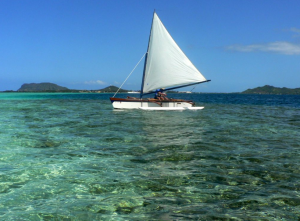
Meet Gary Dierking, specialty outrigger sailing canoes designer and builder who calls Coromandel, New Zealand home. Gary acknowledges that while catamarans and trimarans are now the norm in ocean racing, cruising, and charter fleets, the characteristics of the sailing outrigger canoe are still unknown to most sailors. Read on, as Gary helps explain the different designs and benefits of outrigger sailing.
1. What is an outrigger sailing canoe?

Viva Tropical
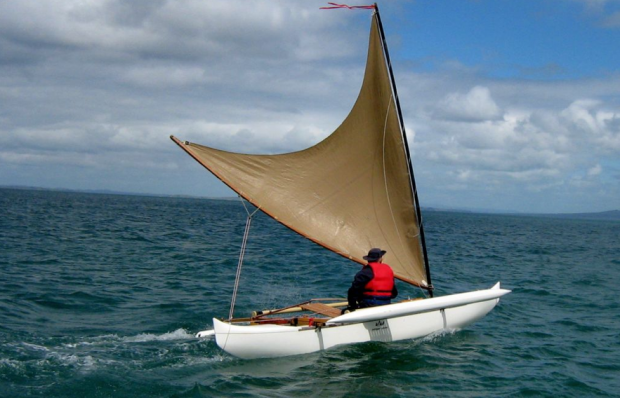
An outrigger canoe is a very narrow canoe that would not be stable without the addition of a float on the end of a pair of beams to stabilize it. The advantage of making it very narrow is the ease with which it can be driven through the water and especially waves. An outrigger canoe can be paddled, sailed, or powered with an engine. A sailing model requires a bigger ama and stronger crossbeams to counter the forces of the sail. Over half of the earth’s surface, from Madagascar to Easter Island, was originally explored and settled with this type of vessel. An outrigger canoe can range from twelve foot in length to over one hundred feet.
2. What are they used for?
Today most outrigger canoes are used for fishing by indigenous people in the Pacific or for recreation all over the rest of the world. In Hawaii they are used for surfing and racing between the islands.
3. Can you use them on the open ocean?
Viva Tropical
Outrigger sailing canoes can be safely used on the open ocean if they are designed and built for that purpose. An 18 foot outrigger with a windsurf sail crossed 700 miles of open Pacific several years ago. One of my T2 designs cruised for over 1000 miles from Northern Mexico to Panama. The success of a voyage like these depends on good workmanship, water tight compartments, and an experienced sailor. Take baby steps first; don’t finish a canoe and immediately take off into a long voyage. Learn to sail it in light winds and calm seas until your instincts are developed. Capsize it on purpose and learn to right it. Then imagine doing that in a big seaway.
4. Are there different designs?
There is a wide variety of outrigger sailing canoes. The most important published work, “Canoes of Oceania” is 1000 pages long. There are a limited number of plans available for modern builders but I have been trying to interpret traditional designs so that they can be reproduced with modern materials. The sailing rigs and the resulting differences in hulls and structure can be divided into two types. Shunting rigs allow the canoe to be sailed with either end as the bow and always keep the ama (outrigger float) on the windward side where it acts as floating ballast. Tacking rigs sail like normal Western sailing boats and will have the ama to windward or leeward depending on the tack being sailed.
5. How do the differences of the design affect performance?

Viva Tropical
Some hulls like the classic Hawaiian were optimized for landing in heavy surf due to the lack of protected harbors. All boat design involves compromises and a canoe optimized for surf with buoyant ends and plenty of rocker will not be the best performer sailing on a lake. Traditional outriggers never had centerboards or leeboards but I have added them to greatly improve their performance to windward. Some traditional sailors would use their paddles as leeboard when sailing to windward but this is poor substitute for a good deep high aspect foil.
Steering can be accomplished with a large paddle, a long steering oar, or a rudder mounted either on the stern or on the side like a Viking ship. All of these methods were used in Oceania. Modern recreational sailors can use any of these methods but the paddle and oar are more difficult if you are sailing alone.
6. How quickly could you build one using your plans?
The big hull can usually be completed in 100 hours or less, but there are many additional parts to an outrigger sailing canoe that can take another 200 hours to complete. Much is determined by the standards of finish and ability of the builder.
Wa Kuk Wa Jimor – Marshallese Canoes Today from Rachel Miller on Vimeo.
Editor’s Note:
Gary Dierking specializes in building Outrigger sailing canoes, you can see more at his blog, Outrigger Sailing Canoes.


Jonny Ueda
You get off the plane and immediately catch her eye. The hot, sticky air compels your body to sacrifice more moisture as it attempts to claw back to homeostasis against the tropical sun. You follow her entranced to the luggage carousel. The crowd magically opens to reveal a place to wait for your bags, right next to the gorgeous Latin goddess.
She turns, smiles, bats her enormous lashes surrounding her milk chocolate, larger-than-life eyes, and says the following, “Hola guapo. ¿Cómo te llamas?”
It is at that point that you wish with every fiber of your rapidly pounding heart that you had invested your time in those Spanish classes when you had the chance.
“I’m sorry, I don’t speak Spanish,” you blurt out in a pitchy, trembling voice. “Do you speak English?”
Not your best pick up line. She gives you a quizzical smile, cocks her head to the side to study the terrified whites of your eyes, and says very simply, “No.”
She then grabs her luggage from the carousel, turns, and walks out of your life forever, leaving you only with the memory of the most amazing legs you’ve ever encountered.
Don’t let this happen to you!
Do I have your attention yet? Good. Do you see why knowing Spanish is important? Excellent!
It’s no secret that breaking through the language barrier can be intimidating, even downright scary. I mean, it’s hard enough for us to communicate in our own language sometimes, right?
Is this how you feel? Are you scared of moving to the Latin tropics because you find the idea of the nuances of a new language about as overwhelming as teaching a burro how to catch a sombrero like a frisbee? Don’t worry! Your brain is much less stubborn and inclined to be distracted by the flowering weeds than your attempt at equine to canine translation education.
It’s actually very easy to become fairly proficient in Spanish in less than three months. In fact, you really only need to learn 1% of the roughly 100,000 words to unleash your own Antonio Banderas impersonation and speak about 90% of the spoken word. Don’t believe me? Read on dear doubter!
Many people feel intimidated by learning a new language and moving to a place where trying to convey your pressing need to use the restroom is not immediately apparent. While Google Translate is a great app in a pinch, it really betrays any attempt you make to not look like a gringo.
If you want to gain a certain comfort with a new language, it’s time to dive in. You’ll be impressing that saucy hot local you just met with your talented tongue’s linguistic skills in no time, instead of watching her walk away!
Bilingual benefits
If the advantage in the ability to communicate well enough to order a burrito instead of chicken feet doesn’t convince you to give a new language skill your time investment, there are more subtle ways learning Spanish, or any language, can be worth your time.
For one thing, it just makes you smarter. It has been shown that the act of learning a new language increases cognitive benefits such as concentration and the ability to tune out distractions. Studies also show that it can delay diseases such as Alzheimer’s.
Of course, there are the obvious social benefits of being able to communicate with people, create new friendships, get driving directions, find clean bathrooms, and in general be the life of the party. And, the best part is, once you learn how to grasp a new language, it makes conquering your next foreign dialect that much easier.
Let Dr. Seuss make you feel better!
I’m a huge Dr. Seuss fan. Did you know Dr. Seuss’ vocabulary for “Green Eggs and Ham” was written on a bet that Dr. Seuss (a pen-name of Theodor Seuss Geisel) couldn’t write a book using only 50 words? Thankfully, children everywhere benefit from the successful outcome of that bet. This was after the completion of Dr. Seuss’ book, “The Cat in the Hat,” which was written on only 225 words.
So, if Dr. Seuss could effectively communicate a book with just 50 words in the English language, when the Oxford English Dictionary states that we have 171,476 English words, it stands to reason that you also don’t need to learn all 100,000 words in the Spanish Diccionario de la Real Academia Español.
Why Spanish lingo math translates better than the Pareto (80/20) Principle.

LexnGer
Many people are aware of the Pareto Principle. It simply states that for any effort exerted, 80% of the results will come from just 20% of the effort. Now, while this translates well for business endeavors, the results for learning a new language actually show an even easier equation.
You see, in order for you to be able to understand about 90% of the spoken word and 77% of the written word, you really only need to know the 1,000 most popular Spanish words.
If you feel like getting even more adventurous and double your learning to 2,000 Spanish words, you would increase your knowledge to 85% of all written and 93% of spoken Spanish.
With a 3,000-word Spanish vocabulary, you would be close to 90% of all written and 94% of conversational Spanish.
Do you see how your return on your investment goes down after the first 1,000 words?
Doubling your knowledge base only increases your linguistic talents by 8% in reading and 3% in speaking.
Adding an additional 1,000 words will only give you a 5% return on reading and a 1% improvement in speaking.
Therefore, learning the additional 97,000 words to know every Spanish word that you could possibly encounter, which would take you years to accomplish, will only give you a 10% return on reading and a 6% return on speaking.
If you just want to be able to talk to people and have a working knowledge of the language, it makes sense to focus on your first 1,000 words, and then pick up others as you become more immersed in the culture. After all, if you hear a word you don’t understand, you will have the language skills to ask for clarification and learn on the go.
Essentially, learning just 1% of the Spanish dictionary yields a 90% efficacy rate on understanding the Spanish channel on your T.V. or trying out your pick up lines at the nearest watering hole. Those ratios should encourage you and remove all fear of the Spanish dialect.
Now, let’s break this down even further.
Just focus on learning 100 of the most common Spanish words. Then, set a goal to learn 100 new words every week, while also brushing up on your previous words from past weeks so you don’t forget them.
Learning 100 new words per week translates to just about 15 words per day. If you keep up this schedule, in 10 weeks or about 2.5 months, you will have gained a working knowledge of the 1,000 most commonly-used Spanish words and will be able to comprehend 90% of any Spanish conversation.
To get you started, here’s 100 of the most commonly-used words to commit to memory this week.
1. el / la (def. art.) the 2. de (prep.) of, from 3. que (conj.) that, which 4. y (conj.) and 5. a (prep.) to, at 6. en (prep.) in, on 7. un (indef. art.) a, an 8. ser (verb) to be 9. se (pron.) -self, oneself [reflexive marker] 10. no (adv.) no 11. haber (verb) to have 12. por (prep.) by, for, through 13. con (prep.) with 14. su (adj.) his, her, their, your (fam.) 15. para (prep.) for, to, in order to 16. como (conj.) like, as 17. estar (verb) to be 18. tener (verb) to have 19. le (pron.) [3rd pers. indirect object pronoun] 20. lo (art.) the (+ noun) 21. lo (pron.) [3rd pers. masc. direct object pronoun] 22. todo (adj.) all, every 23. pero (conj.) but, yet, except 24. más (adj.) more 25. hacer (verb.) to do, make 26. o (conj.) or 27. poder (verb) to be able to, can 28. decir (verb) to tell, say 29. este (adj.) this (m); esta (f) 30. ir (verb) to go 31. otro (adj.) other, another 32. ese (adj.) that (m); esa (f) 33. la (pron.) [3rd pers. fem. direct object pronoun] 34. si (conj.) if, whether 35. me (pron.) me 36. ya (adv.) already, still 37. ver (verb) to see 38. porque (conj.) because 39. dar (verb) to give 40. cuando (conj.) when 41. él (pron.) he 42. muy (adv.) very, really 43. sin (prep.) without 44. vez (noun, f.) time, occurrence 45. mucho (adj.) much, many, a lot 46. saber (verb) to know 47. qué (pron.) what?, which?, how (+ adj.) 48. sobre (prep.) on top of, over, about 49. mi (adj.) my 50. alguno (adj.) some; (pron.) someone 51. mismo (adj.) same 52. yo (pron.) I 53. también (adv.) also 54. hasta (prep.) until, up to; (adv.) even 55. año (noun, m.) year 56. dos (num.) two 57. querer (verb) to want, love 58. entre (prep.) between 59. así (adv.) like that 60. primero (adj.) first 61. desde (prep.) from, since 62. grande (adj.) large, great, big 63. eso (pron., n.) that 64. ni (conj.) not even, neither, nor 65. nos (pron.) us 66. llegar (verb) to arrive 67. pasar (verb) to pass, spend (time) 68. tiempo (noun, m.) time, weather 69. ella (pron.) she; ellas them 70. sí (adv.) yes 71. día (noun, m.) day 72. uno (num.) one 73. bien (adv.) well 74. poco (adj.) little few; (adv.) a little bit 75. deber (verb) should, ought to; to owe 76. entonces (adv.) so, then 77. poner (verb) to put (on); get (+ adj.) 78. cosa (noun, f.) thing 79. tanto (adj.) much 80. hombre (noun, m.) man, mankind, husband 81. parecer (verb) to seem, look like 82. nuestro (adj.) our 83. tan (adv.) such, a, too, so 84. donde (conj.) where 85. ahora (adv.) now 86. parte (noun, f.) part, portion 87. después (adv.) after 88. vida (noun, f.) life 89. quedar (verb) to remain, stay 90. siempre (adv.) always 91. creer (verb) to believe 92. hablar (verb) to speak, talk 93. llevar (verb) to take, carry 94. dejar (verb) to let, leave 95. nada (pron.) nothing 96. cada (adj.) each, every 97. seguir (verb) to follow 98. menos (adj.) less, fewer 99. nuevo (adj.) new 100. encontrar (verb) to find
So, what do you need to be a Spanish rock star?

Edward Kimmel
There are many programs to help you learn Spanish. Just make sure when choosing them, that they have a strong rating to help you learn the language effectively, quickly, and easily. You should evaluate the program carefully to decipher if this is something you can stick with for a few months.
You can have the best material in the world, but if it doesn’t suck you in like a black hole and keep you consistently coming back for more, than you may as well use the books for an expensive door stop.
There is no better way to learn a new language than to immerse yourself fully in the culture. If you can, choose a private tutor and begin actively learning over passively sitting in the classroom. I mean, honestly, how much Spanish do you remember from high school? If it’s anything like my experience, it’s about enough to ask where the bathroom is and sing “La Cucaracha.”
Another way to ensure you pick up your Spanish quickly is to become an active vs. passive learner. Don’t allow yourself to be taught at. Instead, ask questions, get engaged, and really relate to the material covered.
To keep yourself entertained, find ways to read about things in Spanish that you already enjoy reading about in English. If you hate reading about knitting in English, getting through an article about it in Spanish will make you want to stick knitting needles in your eyes to stop the boredom. But, if you love parasailing, then grab a Spanish article about it and take off into that world. You will enjoy the learning experience so much more.
The best way to learn is to actively converse with native speakers. You will learn better talking with someone, and being humble enough to let them correct your pronunciation, than staring blankly at a book.
Just remember to keep your sense of humor through it all. They are allowed to laugh when you mix up the Spanish phrase for “I am hungry” and “I am a man.” Being a women and having this happen, laughing with them was my only option at that moment.
So, why is Spanish one of the easiest languages to learn?
First, many of our English words originated from the Spanish language. You will encounter words that make sense to you, just because you have seen a similar version of them in your mother tongue. Here is a list of English words of Spanish origin that will help you immediately feel smarter about your grasp of Spanish.
Second, most people in Spanish-speaking countries are extremely helpful and will patiently guide you, so that you can pick up on their language. If you can learn a few common phrases that you can utilize to gain further knowledge, you can certainly broaden your base just by befriending a few locals.
I used the phrase “¿Cómo se dice?” which means “How do you say?” along with pointing my finger at an object for which I didn’t know the Spanish name many times in my travels through Spanish-speaking countries. While I may have annoyed my local friends after the tenth question, they certainly were gracious enough not to show it.
If you can get a few of these phrases under your belt, this works like a charm for times when you can’t remember what something is called. And, you will make great friendships just reaching out and asking for help.
Third, the Spanish language only has about 100,000 total words. People actually only use a fraction of this number in daily conversation. While this amount of words may seem intimidating, when you consider that the Japanese or Korean dictionaries have 5 times that amount, you begin to realize that as far as languages go, there could be a much larger learning hurdle to overcome.
Besides, as we already mentioned, learning 1,000 to 3,000 words will get you all the linguistics you need to be conversational.
Don’t let the language barrier stop your adventure!
OK. For all of you doubters who feel you still can’t learn Spanish after reading this, I will play “worse case scenario” with you. Even if you never can roll the romantic “r” sounds of the Spanish language and find it impossible to learn a new skill, you actually don’t have to become bilingual to visit the Latin Tropics. Many people know English and can help you get around quite well.
Not knowing the language is not an excuse to limit yourself to English-speaking countries in your travels. So embrace your pioneering spirit and don’t ever let your lack of language stop you from tasting ever corner of this globe. While I would recommend learning the local lingo to enrich your travel experience, we all know a smile can still speak louder than words anyway.
And, for times when it doesn’t, it’s OK to use Google Translate and embrace your inner gringo. I just can’t promise that you will impress many Latin goddesses.

Cliff Miller
Being an expat in Panama affords me many luxuries I never had back in the U.S. One is the ability to distance myself from the seemingly never-ending political debates that increasingly plague the country I once called home.
It’s not that I keep my head in the proverbial sand. Far from it, actually.
I certainly try to stay abreast of what’s going on back in the States, and the world for that matter. I’m just able to do it from a different perspective now. One that doesn’t cause my blood pressure to rise every time I hear about the government making a decision that takes even more hard-won freedoms and hard-earned dollars away from its constituents.
My North American friends are facing tough times ahead.
But I read something the other day that really made me realize how bad things have gotten.
It wasn’t a news story. It was a Facebook post.
I logged on to see what was happening in the lives of friends I keep in touch with through social media, since moving to Central America several years ago. I was shocked to read my buddy’s status update which stated that the health insurance for his family of four was increasing from $450 per month to a whopping $923. He wondered what others in his same boat were doing to combat similar rate hikes.
That’s a 105% increase just since last year!
Almost as shocking as his post were the comments in the thread. Friends shared stories about how they were experiencing the same increases. Not only were their premiums rising, but deductibles had doubled. Co-pays and out-of-pocket limits were increasing.
Most of the comments had to do with abandoning insurance all together and just paying the fines.
Triple and quadruple the premiums for less coverage?
I decided to research further and found that the implementation of Obamacare will cause the underlying insurance rates for young Americans to increase by 55 to 62 percent for women and 97 to 99 percent for men.
Those numbers are even higher in some areas, such as North Carolina where rates will triple for women and quadruple for men.
Of course these rates vary based on location, as well as the age and health of the individual. Americans who are youngest and healthiest will help foot the bill for sicker individuals or those who’ve been previously denied coverage.
And these increases don’t even take into account the fact that America’s middle class will not only pay higher premiums for their own coverage, they’ll also pay higher taxes to help fund the subsidies for those in the lower income group. They’re also not always comparing apples to apples, as most calculations use the second-cheapest option of the Obamacare plans.
I didn’t realize how good I have it!
Holy cow! Maybe I am a bit behind the times, living in Panama, but I honestly had no idea just how good of a thing I have down here!
I just paid my health insurance premium for my family of six. (Yeah, we have 4 kids!) It was $1,385…for the year. That’s right. THE YEAR.
What’s more is that our plan actually covers us in the U.S. too–as long as we spend at least 180 days abroad each year. That’s not a benefit we plan on using–because the health care here is fantastic–but it’s nice to have that peace of mind in knowing that we could travel back to the States for treatment if a really serious situation arose.
I’m saving over $14k per year by living here.
So, let’s do a little comparison here.
By the administration’s own estimation (so take that with a grain of salt), the average monthly cost for health insurance in the U.S. will now be $328 per person (according to Department of Health and Human Services data). That’s a broad average across the board. Regardless of age, health, location, blah-blah-blah.
Since that estimate is very general, it’s hard to know exactly what my family would pay. But let’s assume it’s the $328 average for my wife and myself and half that ($164) for each of our 4 kids. So my family would pay $1,312 per month, or $15,744 per year for health insurance.
That means my family is saving over 90% on health care by living abroad (not to mention all the other amazing benefits that you just can’t put a price on). I don’t really think that’s apples to apples either, since research shows that U.S. health care dollars don’t necessarily get its residents the best bang for their buck.
So can you!
There has never been a better time to consider moving your family overseas. Even if it’s just for a “gap year,” a trend that’s gaining popularity among many North American families.
Ever-improving technology is making working remotely and homeschooling your children simpler than ever. And an ever-flattening globe is making the ability to speak another language and interact with other cultures almost necessary requirements for the future generation of employees.
And, since health care isn’t the only thing that costs less in Central America, you could work a whole lot less and still live better than you ever dreamed. Consider the invaluable benefits to your children and the memories you could make together as a family. In short, the cost savings isn’t the only reason to consider a move. It’s not even in my top 5.
More places you can save…
But, since health care is the topic at hand, here are a few more places in Latin America where you can score a bargain on insurance.
-
Panama: I mentioned the cost for my family. But there are a lot of different plans available. A fellow expat friend of mine only pays $450 per year for her family of 4. Many doctors are U.S.-trained, and most speak English.
-
Ecuador: One of the cheapest places to live in Latin America, premiums are less than $40 per person (per month) for someone in their 50’s. Much less for younger adults and children.
-
Costa Rica: While it’s one of the pricier destinations in Latin America, health insurance can still be had for as little as $60 in Costa Rica. Its health care system also consistently outranks that of the U.S. when it comes to the quality of care and health of its citizens.
More reasons to give it a try…
I mentioned that the cost of living wasn’t a top priority in my family’s decision to move to Panama. So you might be wondering what was.
In actuality it was a lot of things. Namely the opportunity to have the freedom to live life on our own terms. The ability to simplify our lifestyle and shed the expectations of the North American culture. To teach our children what we believe is important, not what society dictates. To expose them to new things and people they might never have otherwise known about. And to allow them to have fun just being kids.
Was it scary at times? Absolutely. Especially in those first few months. But then again, so is logging onto Facebook these days.
There are lots of resources available for families considering moving abroad, including a guide that we compiled based on our experiences. If you’re one of the thousands of Americans currently considering becoming expats, you can find out more here.

Guy Buchmann
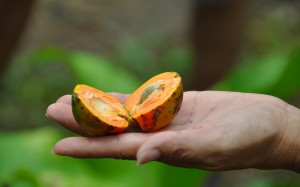
An influential factor for some North Americans who decide to move further south to Central America is the desire to lead a healthy lifestyle. However many residents in Central America consume high concentrations of pesticides and processed foods. Without a gym or a Whole Foods nearby it can be difficult for those moving abroad to be as healthy as they would like to be.
Here are some of the towns in Central America where expats and locals have created health meccas where organic food and healthy activities abound. People who are dedicated to healthy, sustainable living will find themselves connecting with the like-minded communities that exist in these towns.
Puerto Viejo, Costa Rica
Ana Munevar
Once the infamous party town of the South Caribbean, the gorgeous Costa Rican beach town of Puerto Viejo is making a name for itself in the health community. In addition to hiking, surfing, biking, and other physically healthy activities there are over five yoga studios which offer daily classes for those in need of some centering.
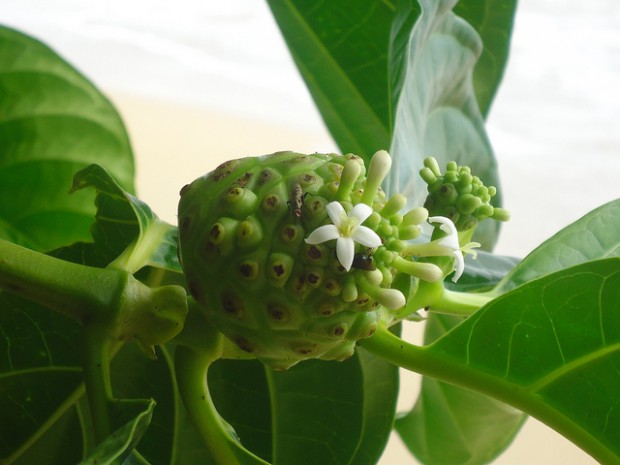
Residents enjoy healthy boxes of farm fresh organic produce twice weekly and access to incredible superfoods like noni juice, kombucha, and raw cacao at the farmers’ markets. There is also a farming cooperative in Playa Cocles in Puerto Viejo for those who want to get their hands dirty and help grow their own produce. There are also a few organic healthy cafes, even an entirely raw foods cafe. This makes it very possible to eat organic and healthy in Puerto Viejo.
The Tierra de Suenos health center in the Playa Chiquita neighborhood offers unique health opportunities for visitors and residents. The center works to heal individuals from all over the world suffering with chronic disease. There is an onsite holistic health consultant who works with community members on an as needed basis as well. Many residents in Puerto Viejo visit this center for a basic health analysis, to purchase vitamins and herbs, and for assistance with cleanses.
Lake Atitlan, Guatemala
This gorgeous lake surrounded by rainforest, mountain trails, and volcanoes is one of the top destinations for nature lovers in Guatemala. The clean mountain air and abundance of outdoor activities make it easy for residents to lead a clean, active lifestyle.
Some of the outdoor enthusiasts who fell in love with Lake Atitlan’s natural beauty decided to move here and contribute to the healthy lifestyle. Atitlan Organics is not only providing organic produce for much of the community, they also support local farmers with the intention of building a cooperative of farmers. They sell produce at the local farmers’ market and offer tours of their farm.
The La Voz organic coffee farm grows organic fair trade local coffee. Coffee lovers can enjoy some of the healthiest and best coffee in the world here and even take a tour of the farm.
The town of San Pedro de la Laguna is an expat’s health mecca with international restaurants ranging from all organic to Asian to vegetarian and vegan. They have daily yoga classes as well as retreat centers for those interested in a deeper immersion or a cleanse. The local hot springs are a great way to relax after a work week and you can dine on organic food while soaking.
Playa Gigante, Nicaragua
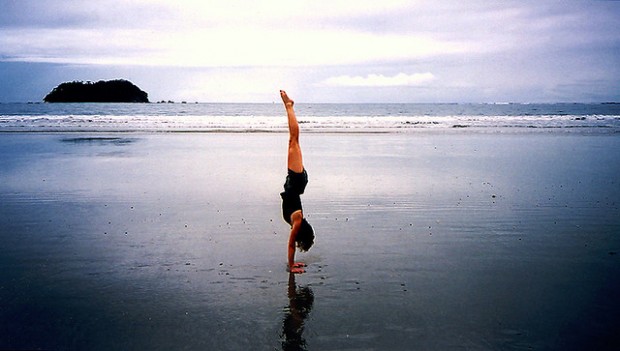
G. Gill
The Pacific coast of Nicaragua is an ecological paradise and most of the coast enjoys quiet serenity with no crowds and few tourists. Playa Gigante, known by travelers for its surfing, is a quiet little town that some expats looking for a laid-back lifestyle in an authentic surf and fishing town call home.
Many centers have opened that gear specifically towards health and wellness tourism, which presents the opportunity for those with plans to open a wellness-focused business or healthy restaurant. Residents can also enjoy many of the yoga classes and wellness packages offered at these centers.
Papaya Wellness has all kinds of yoga classes, pilates, and qi gong as well as Ayurvedic consultations, nutrition classes, and raw food preparation courses. Aqua Wellness Resort offers body work as well as healthy vegetarian meals.
Nosara, Costa Rica
Possibly the healthiest town in all of Central America is Playa Guiones in Nosara in Costa Rica. The town sits on a stunning white sand beach with perfect surf waves surrounded by jungle.
Costa Rica has the highest concentration of wellness businesses and eco tourism, so it’s not surprising that one of the healthiest towns resides here. Nosara first became a popular destination decades ago when the Nosara Yoga Institute opened its doors and began the yoga revolution in Costa Rica.
Today expats enjoy an incredibly healthy lifestyle. There is an abundance of physical activities like stand up paddleboarding, kick boxing, pilates, yoga, and even stand up paddleboard yoga.
Raw cafes, juice bars, and even an organic grocery store are available to keep residents from missing their former lives of shopping at Whole Foods. You can order from the community farm cooperative, frequent the farmer’s market, or stop by the organic grocer any day of the week for organic produce.
Being healthy abroad is easier than many people realize. Towns with health-focused expat communities tend to have healthy options already, but if you find the town you want to relocate to is missing something perhaps that’s your opportunity to open your own wellness business.

Central America has become a tourist hotspot for those looking to surf epic waves a short plane ride away. Some surfers fell in love with the beautiful landscape, the warm people, and the excellent surf and decided to create a home for themselves.

Mark Veraat
There is plenty of undiscovered stunning coastline and great surfing all over Central America. But for those looking to live or invest, what are the surf towns that you could actually live in?
We’ve compiled a list of the towns that have strong communities and basic amenities for those who enjoy a side of comfort with their morning surf.
Tamarindo, Costa Rica
Tamarindo is Costa Rica’s top destination for surf tourism. Surf schools are aplenty and surfing has become integral to the local culture. All skill levels can surf here as there are beach, rivermouth, and reef breaks. It is also located near many other beaches for surfing day trips. Just north of Playa Tamarindo are Witch’s Rock and Ollie’s Point, which became world famous from the film Endless Summer II.
Located a short one hour drive on a paved road from the Liberia International airport, Tamarindo is highly accessible from North America. As a result it is one of the most tourist frequented towns in Costa Rica and the tourist businesses thrive. There are also many more amenities here than in other parts of Costa Rica, including plenty of restaurants, shopping, and bars. This gives the area a fairly North American feel, which some people may enjoy while others may not. However outside of town it is still possible to find peace, tranquility, and even waves all for yourself.
Santa Catalina, Panama

Guillermo Duran
Until recently Santa Catalina was a secret kept by the locals who enjoyed its excellent surf. While still a small, quiet town, Santa Catalina is the top surf destination in all of Panama. It is now bringing surfers from all over the world and actually hosted the 2010 ISA World Master’s Surfing Championship.
The influx of health conscious surfing expats in recent years has developed an overall health conscious attitude in the area. It is one of the few towns in all of Panama that has health food and yoga.
The town is still difficult to access which has kept it quiet and relatively undeveloped. Consequently land prices, even beachfront, are quite low. However Santa Catalina is rapidly paving its way as the next big surf destination in Central America which makes investing now an excellent opportunity.
Playa Guiones, Nosara, Costa Rica
Playa Guiones (sometimes called Nosara after the region it’s in) is one of the most beloved towns in all of Central America by expats, and in large part due to the surf. It has some of the most versatile surf in the country with waves surfable at any tide level.
At the shore are clean rows of white water for beginners, further out is an intermediate break, and on the outside are expert level waves. There is also a volcanic reef break at Playa Pelada as well as rivermouth break near the Nosara River for experts. Plenty of other nearby beaches have great surfing as well.
The town itself boasts two exceptional private schools, several world class yoga retreat centers, delicious international cuisine, raw health food cafes, kickboxing, pilates, and tons of other activities. There is an organic grocery store in town as well as a farmers’ market and local organic produce delivery service. The town is known for its strong expat community and dedication towards health and sustainability.
San Juan del Sur, Nicaragua

Jeff R.
This crescent-shaped bay surf town is the gateway to many of Nicaragua’s best beaches. Just across the border from Costa Rica’s famed Nicoya Peninsula, San Juan del Sur enjoys similar weather, landscape, and surf. Playa Maderas is a twenty minute drive from the center of San Juan del Sur and picks up most of the swells that hit Nicaragua. It is a fun spot for surfers of all levels.
San Juan del Sur is the most popular tourist destination in Nicaragua because of the incredible surfing opportunities. As a result there are many hotels, restaurants, bars, yoga studios, and plenty of other North American luxuries. It can become touristy and crowded at times, but the nearby beaches are often completely deserted.
Central America is a great place for surf lovers with the desire to live among world class waves. These are just a few of the best spots for those looking to relocate. What are some of your favorites?


Wouter Van Doorn
One of the biggest perks of moving to Central America is the overwhelming prevalence of nature. Undoubtedly the breathtaking vistas and endless opportunities for exploration have been the driving force behind many expats’ decisions to move here.
But recent studies suggest that the benefits of being in close proximity to natural environments may include more than just a nice view.
Researchers have studied both the short- and long-term effects of exposure to nature, and–based on their findings–it’s no wonder that people living in Central America enjoy a quality of life that rivals any area on the globe.
Being Outside Combats Two of the World’s Largest Contributors to Disease
People who spend more time in a natural setting have been proven to be healthier overall than those who don’t. Period. Among the specific improvements in their health were lower blood pressure and cholesterol, an improved outlook on life, and a reduction in stress levels.
Most notably, spending time in nature provides improvement in the areas of mental health and cardiovascular disease, which are projected to become the two biggest worldwide contributors to disease within the next few years.
Other indirect benefits cited include decreased feelings of depression, greater satisfaction with life in general, increased self-esteem, and a reduction in negative emotions such as anger and anxiety. People who spend considerable time outdoors also tend to be less aggressive and violent, less likely to procrastinate, and better able to solve problems.
It Has Nothing to Do with Exercise
You may be surprised to learn that the benefits gained from being in nature don’t even take your activity level into consideration, although people who spend more time outside do tend to be more active. Instead, it’s the mere contact with nature that seems to do the trick.
Several studies even used photographs of serene natural settings to achieve the same outcome, (but–don’t worry–you won’t need to resort to that when the beautiful landscapes of Central America are all around you). As little as 20 minutes per day spent in nature was enough to increase participants’ vitality levels by as much as 90% and eliminate feelings of exhaustion.
So, forget hiking or rock climbing. All you really need to do to improve your overall health and wellness in Central America is spend some time bird watching in a nearby nature preserve or taking in the sights, sounds, and smells of your own garden.
photo by Bill Tacular
“Clearing Your Head” Isn’t Just a Figure of Speech
The mechanics behind what actually happens when you spend time in nature really aren’t all that complex. And, when you consider the fact that humans have lived in rural settings for centuries but only in urban environments for the past few decades, this really shouldn’t have been such a hard conclusion for scientists to reach.
Urban environments, where we’re surrounded by things like traffic and technology, serve as a continual drain on our mental resources. We’re bombarded by stimuli, making it increasingly difficult to focus, rest, or recharge.
Nature, on the other hand, has an innate ability to capture our attention. When we focus on the natural world around us, our brains are given a break from all of the artificial attractions that normally compete for our awareness. By contemplating nature, we involuntarily shut off a large part of our nervous system activity, giving our brain the time it needs to refuel.
By isolating the part of the brain that performs more focused introspection, we also increase our creativity, attention span, and performance on a number of cognitive tests. And the longer the better. Participants of one study improved their scores by 20% after a 3-hour hike. However, those who were gone for four days saw an improvement of 50%.
Contact with Nature Is Even More Crucial for Expats
In one particular study, the benefits of being in nature were found to be even more important for those in an unfamiliar setting, such as expats living abroad. It gave these individuals a greater sense of identity and oneness with their new country. They tended to feel more integrated, rather than isolated. They also reported a greater sense of possibility and empowerment.
Being in nature has also proven to benefit entire communities, as it often lends itself to increased social contact and cohesion. Parks and community gardens provide opportunities to socialize. Environmental volunteer opportunities allow locals and expats to bond through social connections and a shared sense of commitment to the local environment.
How Moving to Central America Can Be Beneficial to Your Children’s Health
Increased time spent in nature has been linked to the reduction of many of the chronic health conditions that increasingly plague America’s youth, such as obesity, asthma, ADD, and ADHD. Not to mention mental health concerns like depression and anxiety.
A growing problem in the U.S. is vitamin D deficiency, which has been linked to cardiovascular problems later in life. Vitamin D is produced by the skin after sunlight exposure. This nutrient is important for a number of bodily functions and is essential for the proper absorption of calcium.
With an abundance of natural settings to choose from in Central America, your children could benefit from the scientifically-proven increase in good health and happiness that comes from free and unstructured play outdoors. Research has shown that it improves children’s independence and sense of self, their cognitive development, and their overall well-being.
Want to improve your ability to focus and your children’s ability to cooperate? Find out more about the benefits of moving your family abroad.


Jessie Harrell
Living on a tropical island is an incredible fantasy shared by many people. Being surrounded by water, drinking out of fresh young coconuts, and bathing in the ocean are some of the alluring images that come to mind.
Some people have actually chosen to make the fantasy of island life a reality. Many once deserted islands in Central and South America are becoming more and more inhabitable with building development, electricity, and even wifi.
However how does the reality truly live up to the fantasy?
Island life is not always paradise. With power shortages, few or often no roads at all, and a limited supply of goods it can be challenging at times living on an island.
Here are the pros and cons of living on an island for you to consider before moving to your own private paradise.
Pros of Living on an Island
They Are Beautiful

Caneles
There is no denying that tropical islands are absolutely stunning. Depending on the size of the island, there may be very little development and consequently nature everywhere. While some islands, like Isla Bastimentos in Bocas del Toro, Panama have incredible surfing, many like the Bay Islands in Honduras have completely flat water that is perfect for diving and snorkeling.
They Can Help You to Relax
Far from the mainland, islands offer the chance to truly get away. Life moves at a slower pace on islands and you will likely find yourself in a deep state of relaxation. Some islands have no cars and electricity for only part of the day. This makes relaxing and unplugging that much easier. If you are looking to really slow down your lifestyle, living on an island may be a great fit.
They Have Strong Communities
Small islands in particularly tend to have strong communities. People don’t leave islands as often as towns so living on an island you usually find yourself around most of the same people. This helps the community to work together. Most people living on islands do so for the same reasons and this shared love and respect of the island bonds people together.
They Are Easy to Navigate
Some islands are so tiny, like Caye Caulker in Belize, it’s possible to walk their perimeter in under an hour. Going to and from work, getting together with friends, and plenty of other everyday activities can be dramatically simplified when living in such a small place. Driving can be impossible or unnecessary and living on an island you may get around by foot, bicycle, canoe, or golf cart.
With all of these incredible aspects of island life it’s easy to see why many fantasies are built around them. But what are some of the difficulties of island life?
Cons
There Is a Limited Supply of Goods

Anoldent
Islands tend to be much more expensive than mainland towns for a very important reason: there is a limited supply. Gasoline, first aid supplies, even fruits and vegetables can become scarce commodities and the prices will often reflect that. Depending how far the island is from the mainland, it can become costly and time consuming to have goods sent. You may notice that at the end of the week the markets lack most produce and fueling your car can be quite expensive.
There Is Limited Access to Medical Care
Most islands lack hospital facilities and some do not have medical care at all. In emergency situations this can be concerning as you may have to fly, or even take a boat, to access proper medical care. If you suffer from a medical condition in general this may be a big factor for you to consider.
A Slow-Paced Lifestyle Has Its Frustrations Too
The slower-paced lifestyle on islands is one of the wonderful benefits that helps its residents truly relax. However sometimes this slow pace can actually lead to stressful situations. If you own a business on the island you may struggle with the speed that the builders construct your space. You may struggle with training your employees to offer prompt service to tourists. Electrical outages may go on for days while you wait for the utility companies to come to the island. These are especially important considerations for those who plan to open a business, but they affect anyone who lives on the islands.
Living on an island could become the most magical experience of your life, fulfilling your every tropical fantasy, or it could be an incredibly difficult frustrating experience. Nowhere is perfect, so weigh the pros and cons and decide if island living is right for you. If you do decide to move to an island, take a deep breath and learn to adapt to this different lifestyle.


Karan Jain
Many people dream of one day retiring to somewhere sunny in Central America. But what about those who want to invest or live abroad before retirement?
Individuals from all over the world have created lives for themselves in Central America by starting an expat business. In fact it typically requires much less start up investment to open a business in Central America; land and labor are inexpensive and few permits are required.
Tourism is an area that expats may gain interest in as most towns with established communities of foreigners have a solid influx of tourists bringing business.
Here are some of the most popular tourism-based businesses that expats have been running in Central America for years. Perhaps one of these businesses could offer you the lifestyle you long for abroad, before retirement.
Vacation Rentals
Opening and managing vacation rentals is a popular and often highly profitable business in Central America. Properties or land sell for a fraction of the price of those in the United States and can often be rented at slightly discounted U.S. rates.
During the high season it’s not uncommon for vacation rentals to completely book up. Sites like VRBO.com, Airbnb.com, and even Craigslist make marketing your properties much more straightforward.
Managing the properties themselves can be a lot of work, but for those passionate about real estate this is a great fit.
Restaurant/Cafe
Expat-owned restaurants, cafes, and bars are a much appreciated luxury for locals, other expats living in the area, and travelers of all kinds.
Most expat towns in Central America have a least a few offering anything from fair trade lattes and French pastries to green smoothies and Thai fusion food.
Owning this type of business in another country can be challenging with the different language, laws, and culture, however it’s an incredible opportunity to really connect with the community.
Some become more like local institutions that serve as a gathering place bringing locals, tourists, and expats together.
Tour Company

Lance Gardner
Are you a passionate traveler, outdoor enthusiast, or adventure lover? Opening a tour company could be a great fit for you. Designing tours based on your favorite experiences is a way to share your passion with other travelers.
If you decide to work as one of the guides you have the added advantage of being able to experience the adventure with your groups. This is also a great way to give back to the community by employing locals, using sustainable practices, and educating tourists on local environmental and social concerns.
Hostel
As long as there are backpackers there will be a demand for hostels. The prices for board may be low, but the capacity can be high and plenty of other businesses can be rolled in.
Most hostels have some sort of bar or restaurant that guests frequent often. They also arrange tours and transportation which provides them with a commission. Special events hosted in the onsite bars enable hostels to earn an additional income as well.
Hostels can range from small and privately owned for a more bed and breakfast type of experience, to large and managed by an entire staff. Some open additional locations in towns in other countries which expands their presence and also helps them receive repeat customers who are traveling to multiple locations.
Yoga Retreat Center

Bettina N.
Central America, Costa Rica in particular, is a popular place for those looking to study yoga or transform themselves on a retreat. For decades expats have been running these kinds of businesses and find their lives take on a new level of joy.
There are many opportunities for multiple sources of income including drop-in yoga classes, full yoga retreats, yoga teacher trainings, and bodywork sessions.
Surf School
Central America is known worldwide as a destination for incredible surfing. Costa Rica, Panama, and Nicaragua are particularly frequented by surf enthusiasts from all over the world.
Many people come to these countries with the intention of learning to surf and enroll in immersion surf schools. Most travelers to these locations plan to at least take a lesson and try standing on a board. Surf schools are an essential tourism business in this part of the world and surf lovers can combine their passion for surfing with a business that earns them an income.
There is plenty of income to be made by surf schools which often combine other services like full retreats and board rentals. Some even open hostels, stores selling surf clothes and other merchandise, and onsite restaurants.
These are just a few of the popular businesses in tourism other expats have opened in Central America. Get creative and use your passions to start a business that makes your life abroad even richer. Investment is often significantly less than at home and many people find they experience a great deal of fulfillment running a business abroad.