


 International living is an adventure that most of us have on our bucket list. Choosing to live overseas, either short or long term, is a huge adventure: and those who’ve done it usually say it was the best thing they’ve ever done.
Not only does becoming an expat open your mind to more of what the world has to offer, it can also remind you about the most important things in life.
The benefits of international living are wide and varied. If you’re thinking about making a big move overseas, some of our favorite expat benefits might encourage you to take the plunge.
The chance to start afresh
One of the things that attracts people to the idea of moving overseas is the chance it offers to start afresh. Many people give up stressful jobs, huge social networks, and large expenses when they leave the U.S., and giving up all these things is a brilliant opportunity to simplify your life.
Becoming an expat gives you the chance to get back to basics and really learn what’s important to you. Often, expats find that they get to know themselves better in the first year they spend abroad than they did in a whole lifetime of living at home.
The chance to own less and do more
When you live in the U.S. it’s so easy to get caught up in a cycle of endless bills. Things like gym memberships, cable subscriptions, and active credit cards seem like vital parts of life: but they don’t have to be. Moving overseas breaks the cycle of these bills, and gives you a new way to spend your money.
Expats tend to travel, explore and do so much more than the rest of us. They know that in the long run, experiences are much more valuable than belongings, and they remember this as they trek through the jungle, visit ancient ruins, and take part in exotic celebrations.
The chance to learn new things
When you live internationally, learning new things becomes a key part of everyday life. It’s likely that there will be huge differences between your home country and the country you decide to emigrate to. Holidays, celebrations, behavior, social customs, and language will all be different, and learning about and experiencing all those differences can be great fun.
Learning these new things can also be one of the more challenging parts of international living. Settling into a new lifestyle can take time, but it can also be incredibly rewarding. You may also find that you’re much stronger and more capable than you thought.
The chance to get inspired
When you move overseas, you can expect to open yourself up to all sorts of new opportunities. Doing this is always incredibly inspiring. If you are a creative, the benefits of being inspired in this way will be immediate. Seeing and learning new things on a daily basis will encourage you to create like you have never created before!
If you’re not a creative, you’ll still find this kind of inspiration valuable. You probably won’t be tempted to start a blog or pick up your camera… but you might find yourself dreaming up new business ideas or trying your hand at a new hobby.
Is there a downside to expat life?
Of course, even the most wonderful adventures aren’t wonderful all the time. There are some downsides to expat living, and it’s important to weigh these up against the positives and decide if it is really right for you.
- When you decide to emigrate overseas, you will be opening yourself up to exciting new adventures; but you’ll also be missing things back home. Expats sometimes find it hard to spend long periods of time away from friends and family. It can also be hard to return home after a prolonged period overseas, as it can be hard to adjust to the changes that have occurred while you were away.
- The constant flow of new things and opportunities you will face as an expat can be exhilarating, but it can also be frightening. Living a successful life overseas will involve conquering that fear!
- Holidays that you are used to at home may not be celebrated in your chosen country, or they may be celebrated in a very different way. This can result in some interesting new experiences, but missing out on your favorite holiday the way you are used to it can make you feel homesick.
Is international living for you?
Of course, there are downsides to the expat life, but for most people they are well outnumbered by the positives. Cheaper and more regular flights as well as the growth of the internet and services like Skype have made communicating with people back home much easier.
If you’re hungry for a new adventure, moving overseas could be the right choice for you. Becoming an expat is likely to change your whole perspective on life for the better. It can enable you to reduce your spending habits, embrace change and really get back to basics.
The biggest benefit of international living and the expat life is that you never know where it might take you.


Panama Pensionado Visa: Savings and Benefits
Panama has a lot of extremely attractive features that beckon expats to its beautiful beaches and lush mountain havens. It is a nation that is extremely welcoming to foreigners and perhaps never more so than when it offers to retirees a whole host of discounts, on everything from airfare to home phone service.
These benefits are part of Panama’s Pensionado Program, a neat little package of perks tailored to retirees of all ages. Depending on where you choose to settle, the cost of living in Panama is already extremely affordable. However, the benefits offered to pensioners can make retiring to this Central American destination all the more lucrative.
Panama’s Pensionado Program’s Benefits
The discounts and advantages of the pensioner’s visa are quite numerous. Here they are in a nutshell:
-
50% off on recreation and entertainment such as movies, theaters, sports, etc.
-
50% off hotels Monday through Thursday (30% off on weekends)
-
50% off passports
-
30% off public transportation like buses, trains, and boats
-
25% off airfare
-
25% off restaurants (15% off fast food)
-
25% off electrical, telephone, and water service
-
20% off doctors and specialists
-
20% off prosthetics and other personal assistance devices
-
15% off hospitals and private clinics
-
15% off dental and optometry services
-
10% off prescription medications
-
tax-free importation of household goods, up to $10,000
-
tax-free importation of a vehicle, or tax-free purchase of a local vehicle, every 2 years
In addition, retirees are now able to obtain a cedula, the national identification card issued to residents of Panama. While participants in the retirement program can easily get by with merely their pensionado card and a passport issued from their home country, the cedula allows for greater ease of getting around and transacting in Panama. Locals feel a bit more comfortable when dealing with someone they know is “documented,” so to speak. While holding a cedula doesn’t grant you any additional benefits, it’s just one more step towards diving headfirst into your new culture.
The Qualifications Required for the Pensionado Visa
While it sounds like, and is often referred to as, a “retirement” program, the pensionado visa is actually available to expats of any age who meet the specified criteria. Even better, recipients are grandfathered in under the law and can never lose their benefits, as long as they continue to meet the requirements. To qualify you must have the following:
-
Monthly income of $1,000 for life from a guaranteed source such as a pension or annuity
-
Or income of $750 per month and a $100,000 minimum investment in Panamanian real estate
-
An additional $250 monthly income for each dependent child
The $1,000 per month is a total amount for a married couple. In other words, it isn’t necessary for both spouses to meet the income requirement. Dependent children cannot be over the age of 18, unless they are attending college. Exceptions can also be made for adult children with disabilities. The $250 can also be obtained in the form of interest earned on deposits in a Panamanian bank.
How to Get a Pensionado Visa?
The process of applying for and obtaining your pensionado visa is a fairly straightforward one. The whole shebang takes about six months and costs between $1,500 and $2,000 per person, including attorney fees. If you’re applying for yourself, your spouse, and your dependents all at the same time, you can sometimes save a few pennies on the legal fees. A good bit of paperwork will be required, and it will all need to be properly authenticated. A reputable attorney with experience in immigration issues will be an invaluable tool as you navigate this process. In general, you’ll need to be prepared to provide the following:
-
Certified letter from the appropriate organization or entity guaranteeing your monthly pension for life
-
Government certification that the source of your income is in good standing, if your pension comes from a private company
-
Proof of prior pension payments (e.g. check stubs, bank statements, etc.)
-
Certificate of public registration of Panamanian real estate in your name, if applicable
-
Police record from the country where you resided the past 5 years
-
Marriage and/or birth certificates, if applicable
The Fine Print
While the program no doubt has some great benefits available to expats, there are some who question whether or not it’s all it’s cracked up to be. Take, for example, the discounts on utilities. Water in some areas may be as low as $7. So 25% off of that isn’t a whole heck of a lot. Then again, it all adds up. Another criticism of the program is the fact that exclusions often apply. So, pensioners shopping for airline tickets may end up finding another flight that is actually less than the discounted rate they could get on what was already a higher priced ticket. And, understandably, the entertainment discounts aren’t available on events such as charity functions. Would-be expats who know little Spanish will want to quickly learn this phrase: Por favor, deme mi descuento de pensionado. Which means “Please give me my pensioner’s discount.” Benefits aren’t automatic. You have to ask for them, and some small businesses may even be reluctant to grant them. It’s also important to note that, for those of retirement age (women over 55 and men over 60), you are eligible for most of these benefits anyway. It’s up to you whether you want to jump through the additional hoops to obtain the pensioner’s visa, or just opt for another type of visa.
The Breakdown
So, we said it all adds up. But just how much could you really save in a year with the benefits offered by the pensioner’s visa? Here’s a theoretical breakdown that shows how a hypothetical couple could easily save as much as $10,000:
|
Movie tickets |
$2.75/person x 2 per month |
50% |
$66 |
|
Dinner theater |
$20/person x 2 per month |
50% |
$480 |
|
Three-night hotel stay |
$375 total x 6 per year |
30-50% |
$1,125 |
|
Bus ride |
$6/person round trip x 15 per year |
30% |
$54 |
|
In-country flight |
$175/person round trip x 4 per year |
25% |
$350 |
|
Flight to US |
$450/person round trip x 3 per year |
25% |
$675 |
|
Dinner for two |
$30 total x 2 per week |
25% |
$780 |
|
Mid-range meal |
$12/person x 4 per week |
25% |
$1,248 |
|
Fast food |
$7/person x 2 per week |
15% |
$218.40 |
|
Home phone bundle |
$70/month |
25% |
$210 |
|
Water |
$7/month |
25% |
$21 |
|
Electric service |
$80/month |
25% |
$240 |
|
Doctor visit |
$40/person x 3 per year |
20% |
$48 |
|
Dentist visit |
$40/person x 2 per year |
15% |
$24 |
|
Specialist visit |
$45/person x 1 per year |
20% |
$18 |
|
Medications |
$7/ea x 2 per month |
10% |
$33.60 |
|
Vehicle import |
18% of value (e.g. $25,000) |
100% |
$4,500 |
|
Total |
$10,091 |
*Amounts given are examples based on our experience and are for two people.
Whether it’s the Pensionado Visa, or one of Panama’s many others, you’re certain to find the visa that’s right for you. Start your search today!


The Future Is Turning Green
Our budding future is evident in all stages of policy making, in the classroom, and in public opinion. Some of the top degree programs securing a rewarding future are for MBA students specializing in resource economics, sustainable agriculture, and environmentally compatible architectural design.
Public interests continue their shift toward renewable energy resources and organic foods. Developing countries are favoring infrastructure that uses natural resources wisely for sustained growth and healthy populations.
Panama is no exception. Its law-making body has crafted policies that allow for modest investments by international interests for the purposes of owning and developing real estate for private or business use. The opportunities for retirees and for entrepreneurs have been tempting. For half the capital needed, they can place their savings in an enterprise, take up residency in Panama, and become citizens within five years.
The Law 24 Reforestation Investment
The pensioner plan is advantageous primarily to retirees and business owners. An alternative course for international investors is participation in the teak reforestation program. Enacted as Law 24 of the year 1992, the design includes an incentive for foreign investors who would like to obtain a permanent visa residency in Panama.
The package deal comes with two options: A minimum small reforestation investment of $60,000 or a minimal large business reforestation investment of $80,000.
There are also legal fees delivered in three phases. These are the Provisional Residency fees and costs (US $2,000), the second renewal (US $1,000) and the Permanent Visa (US $2,000).
The reforestation of teak is critical for Panama’s environmental plan and sustained resource use. Soil erosion from large-scale farming, clear cutting, and ranching projects resulted in a nearly 70% loss of its forests. Because teak grows quickly and easily in tropical areas, and can be harvested through rotation, this seed producing tree provides a sound environmental background for the restoration of renewable resources.
Documentation Requirements
You must pass a police clearance report before you can apply for immigrant status into Panama. All necessary documents are to be issued no more than four months before submitting the visa application.
You must have at least three months remaining on your passport before its expiration date. You must appear in person to the Department of Immigration for the initial visit and all renewals.
All legal requisites are to be handled by a Panamanian lawyer. Your investment must be through a certified teak reforestation program.

Teak Reforestation Is a Long-Term Investment
Teak is one of the most commodious of the hardwood trees. Favored not only for its constructive qualities, its handsome texture and grain make it desirable for cabinetry, framing, and furnishing. Teak resin is typically water-resistant, which contributes to the beauty of the wood and helps protect it from decay, bacteria, fungus, and insects.
Be cautious of companies that offer quick and easy returns. Quality teak requires 20 to 25 years for maturity. Profit margins can be low, particularly in the beginning years of your investment.
However, as one of the world’s leading hardwoods, the demand for teak is high. An investment of $80,000 into five hectares of land will yield approximately $125,000 per hectare by its 25th year.
Tax Benefits
Some of the benefits are immediate.
- Teak reforestation is a tax-deductible investment.
- The equipment needed for the development of a teak reforestation project can be imported free of tax.
- Exports to the U.S. are tax-exempt within the United States.
- Investments in reforestation projects provide tax exempt interest payments, exemption on dividend payments, and on capital gains.
Investment Alerts
There are many companies that offer investment into the teak reforestation program. Most of them study all the requirements and obtain the certification necessary for visa applicants to fulfill their residency credentials.
You will find that the average Panamanian company invested in teak demonstrates responsible management and yield roughly the same amount of teak per hectare. The differences are in the packages offered.
Management charges can vary greatly. Commonly, land is measured in hectare in Panama. A hectare consists of 2.5 acres. Without knowing the difference in measurement, you could buy into a package that requires more in management fees per acre than you would be charged per hectare.
Read the fine print. Some companies will sell you the trees but not the land. Your ownership ends with the completion of the final harvest. Make sure you know exactly what you’re buying. Figure the cost of your investment over time, and how much land you’ll be receiving.

Sustainable Teak Production
The key word to modern investment is sustainability. Teak production originated in Asia, primarily in Indonesia, Burma, India, and Thailand. About 28 million hectare of this area is covered by natural teak. Additionally, about 90% of teak plantations worldwide are in Asia.
However, all production of natural teak, except in Burma, has been restrained. Illegal timber poaching is high and there is a constant battle between teak production and land for cattle grazing. In its native soil, teak is plagued by pests that inhibit both growth and quality. Throughout Asia, teak forests are shrinking, with no solid reforestation plans in effect for nurturing renewed growth.
Panama’s Future in Teak
Although teak is able to grow under a variety of soil conditions, its habitat is limited to tropical regions. Typically, it prefers areas with a heavy rain season and accompanying 3-5 month dry season.
Panama’s climate is favorable to teak, and is relatively free from insects that harm teak production. As teak production in Asia wanes, the attention of investors shifts to Central America and its own teak-producing countries.
The uses for teak are numerous. Its natural oils help to keep it from warping, and eliminates the need for protective coating. This unique trait also gives it a great deal of desirability for boat decks and for outdoor furniture.
The demand for the strong, durable wood is expected to reach 135 million cubic meters by 2050. Without vigorous teak cultivation, there will be a deficit.
Responsible Harvesting
Teak plantations are the responsible use of renewable resource management. Teak is one of the only plantation species that is resistant to termites and fungi. Trees are grown and harvested according to rotation. In this manner, they are allowed to reach full maturity, delivering a quality product while maintaining a healthy environment.
Invested Residency
Law 24 was designed to allow a smooth transition into Panama citizenship while partaking in a program with positive future impact. The world cannot afford the continued dwindling away of forests that provide us with an oxygen rich atmosphere, shelters wildlife, prevents erosion, and generously gives us the products we use in our daily lives.
By investing in teak, you are investing in a quality wood with uses ranging from decorative to practical purposes, such as ship decks, door frames, and furniture. You are investing in a product that analysts predict will not be able to meet the demands of supply by 2050 if Asian production continues its downward trend. You are investing in the greatest favor you can do for your community; you are contributing to the greening of Earth.
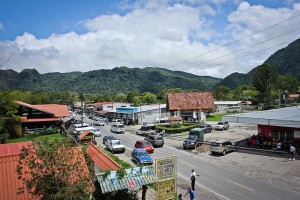
A tourist friendly country with pristine beaches, majestic mountain views, and an affordable cost of living, Panama has so much to offer expats, including the mountain towns of Volcan, Cerro Punto, Boquete, El Valle, and Santa Fe.
While each of these towns has spectacular views, year round spring-like weather, and expat friendly communities, they each have something special that makes them unique.
First Stop, Volcan

Rich Young
Famous for its “eternal spring” climate, Volcan sits atop a plateau at 4,200 feet. And it’s not surprising that Volcan means volcano, since the large green mountain that provides the amazing backdrop for Volcan is in fact the dormant peak of Volcan Baru (the highest peak in Panama).
This quaint mountain village was first settled by indigenous people thousands of years ago and artifacts are still found in farmer’s fields to this day. While some Ngobe Bugle people still reside in Volcan, expats can mainly expect to find the same relaxed and laid-back way of life that you can find across the country.
There is an established expat community in Volcan and over the years many have opened hotels and restaurants, further expanding Volcan as a prime retirement spot.
Only twenty minutes from David, the third largest city in Panama, Volcan is perfect for those who are seeking the quiet, mountain town way of life, with urban amenities close by.
On to Cerro Punta
Celen Aper
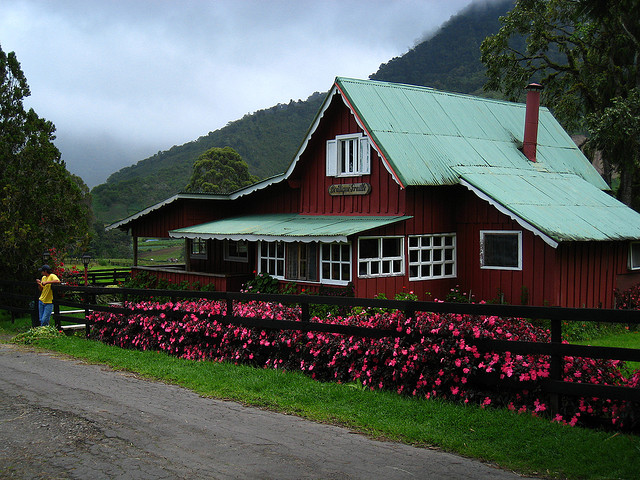
Located in the highlands above Volcan, 2000 meters above sea level, Cerro Punta is the agricultural center of Panama. The hypothetical bread basket of Panama, Cerro Punta produces nearly 80% of the fresh produce for the entire country, and due to the high altitude, Cerro Punta has a slightly cooler, some might even say cold, temperature.
The friendly people and the relaxed farming atmosphere provide Cerro Punta with that small village feel that is sought after by many expats and as you stroll through Cerro Punta you will see many local farms, gorgeous mountain ranges and Ngobe families dressed in colorful traditional garb.
Next, Boquete

Boquete- roaming the planet – doors
Arguably the most popular expat spot in the province of Chiriquí, Boquete was rated by the AARP as one of the world’s top retirement spots. This popularity began in 2001 and as a result, you will find a well-developed expat community in Boquete today.
Only a 45 minute drive from David, Boquete is known for its misty rain (bajareque), coffee, and flowers, especially orchids.
Boquete is actually considered the flower capital of Panama and upon entry, you will be greeted by buildings simply covered with magenta and coral bougainvillea.
With fresh produce and seafood in abundance, Boquete promotes a healthy lifestyle for all who live there, and because of the low cost of living, a delicious dinner for four can be purchased for around $10.
Boquete also has a strong arts community with a yearly jazz festival and even an English language theater group.
Consider El Valle

Orban Lopez Cruz
The world’s only inhabited volcano, this mountain village remains close to the urban metropolis of Panama City while keeping its coveted small town atmosphere.
Known for its wind, water, rich volcanic soil, and perfect spring climate, El Valle attracts many people interested in eco-tourism and wellness vacations.
And even though the volcano has been dormant for 5 million years, many volcanic hot springs have surfaced, providing proof that there is definite volcanic activity happening underground.
Relaxed during the week, El Valle is alive with activity on the weekends as people come out of the woodwork to visit El Valle’s famous arts and crafts market. There is much to be seen at this massive market as the locals and the Kuna Yala Indians come out to sell their colorful wares.
Last Stop Santa Fe

Jerry W. Lewis
Expats come to Santa Fe to experience a truly authentic taste of Panamanian living.
Because Santa Fe is smaller and not as developed, you can really experience the serenity of Panama mountain life. Sitting at an altitude of 1350 feet, you will find the same year round spring weather and sweeping mountain views in Santa Fe, but with fewer expat additions.
The expats here don’t tend to participate in as many group activities as they do in the other mountain towns, and while there are still many outdoor activities to experience, there are not as many tour groups.
In addition, housing in Santa Fe tends to cost less, and although it will be equipped with cable and internet, the facilities will definitely feel more traditional.
Which Panama Mountain Town is right for you?
Rich with all the wonders that drew you to Panama in the first place, but with little differences that make each town a unique experience, any of these five towns could be the perfect place to set up shop.
A land covered in volcanoes, rivers, and lush forests, with a laid-back way of life and a low cost of living, Panama and its mountain towns are definitely an expat friendly treasure to behold.
So plan a trip and hop around to each town as you search for that ideal place to call home.
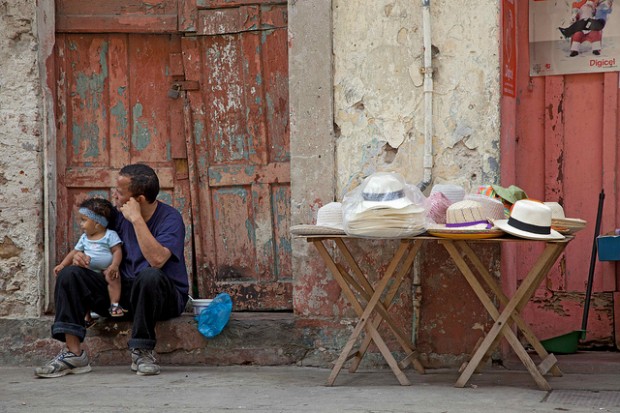
Martha de Jong
If you’ve done much reading about the state of the Panama economy, you probably already know that it’s “stable” and “growing” and “pro-business” and maybe even “foreigner-friendly.”
But what’s the basis for these types of claims? What is it that really drives Panama’s economy, and how is it performing during some globally tough economic times?
Panama Economy Overview
Panama has a dollar-based economy that is heavily dependent on the services sector. Namely logistics, banking, tourism, and of course the Panama Canal. In fact, services account for over ¾ of the nation’s Gross Domestic Product (GDP).
With an estimated GDP of $30.68 Billion as of the end of 2012, Panama’s economy is the third largest in Central America and the fastest growing, racking up a whopping 10.7% increase last year (its second consecutive double-digit growth rate). GDP per capita is around $9,444 and has more than doubled over the past decade.
The general composition of Panama’s GDP is 79.1% services, 16.6% industry, and 4.3% agriculture. Transport and communications make up the biggest chunk of the service arena, followed by property and services, commerce, and financial services. Here’s a breakdown of all areas and the percentage of GDP they represent:
Private Education .7%
Social Services/Private Healthcare .8%
Fishing 1.1%
Mining/Quarrying 1.4%
Utilities 2.8%
Farming, cattle ranching, hunting, and forestry 3.2%
Real estate, corporate, and rental activities 5.2%
Manufacturing 5.6%
Construction 5.8%
Financial intermediation 8.2%
Banking 8.6%
Wholesale and retail 14.6%
Transport, storing, and telecommunications 26.4%
The Panama Canal
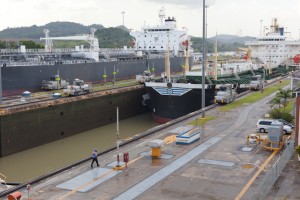
It’s interesting to note that the Panama Canal itself accounts for only 4% of the nation’s GDP. However, due to the multiplier effect, its impact is much farther-reaching. Take into consideration, for example, expenditures by canal employees. Their income in turn fuels businesses such as grocery stores, restaurants, schools, and other businesses. As a result it’s estimated that the existence of the canal generates approximately 30% of the country’s GDP.
The Canal is currently undergoing a $5.5 billion expansion that will more than double its capacity. Begun in 2009, this expansion has already contributed greatly to the nation’s economic growth. Transport, storage, and communications increased by 15.3% in 2010. Port operations during that same time frame also rose by 25.2% due to the increased movement of 20-foot containers.
With the completion of the expansion scheduled for 2014, additional growth is anticipated. Some estimate that 40% of the $5.5 investment will be recouped in the next 5 years.
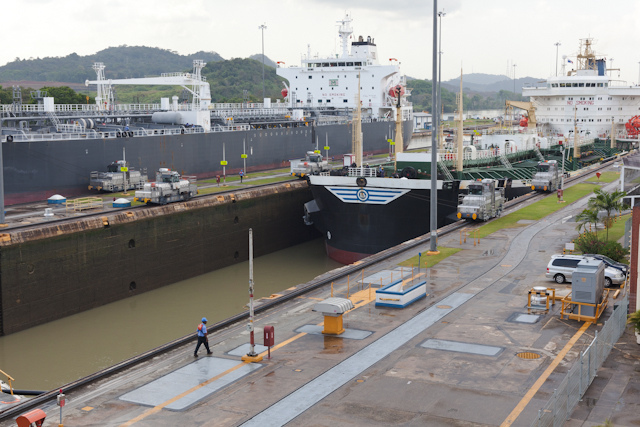
Tom Geibel
Imports/Exports
Approximately 65.2% of Panama’s GDP is exported, in the form of both goods and services. The $12.52 billion that is exported annually is made up of bananas, shrimp, sugar, coffee, and clothing which ship mainly to the U.S. (13.1%). Other recipients of these goods include South Korea (12.5%), Honduras (10.2%), Japan (9.3%), India (7%), Canada (4.4%), and Mexico (4.2%).
Panama imports roughly $15.18 billion each year, which includes fuel products, medicines, vehicles, iron and steel rods, and cellular phones. These come from Japan (23.5%), China (23%), Singapore (18.1%), the U.S. (13%), and South Korea (6%). Because it imports more than it exports, Panama has a negative trade balance, or trade deficit, of -12.7%.
Debt
Panama’s ratio of public debt as a percentage of GDP is a relatively low 39.2%. This number is down drastically from 66.2% in 2005, due to fiscal consolidations by the current administration. Panama’s Standard & Poor’s bond rating is BBB. It also received a Moody’s credit rating of Baa2 with an outlook of Stable. This positions Panama among the highest ranking emerging markets, alongside Mexico, Brazil, and Peru.
Inflation
Panama’s inflation rate, which has been as high as 6.82% several months ago, was down to 4.1% as of March 2013. This rate fluctuates greatly in Panama’s dollarized economy, since the country lacks the ability to implement policy or adjust exchange rates to counteract rising consumer prices. Panama’s inflation rate has generally averaged around 5.24% for the past 5 years.
Unemployment
Panama’s unemployment situation is a unique one. Although generally low (it’s hovered around 4.2% for the past 3 years), it’s also unbalanced. While Panama experiences a surplus of unskilled labor, it also has a shortage of skilled labor.
Efforts are currently underway to address this problem. Millions are being invested into education to build a strong, skilled labor pool. In the interim, the country is welcoming business professionals from other “friendly” countries to come to work or start a business in Panama. This is quite a shift, since Panama has historically taken great care to prevent foreigners from taking jobs away from Panamanians.
Business Climate
Panama continues to rank higher and higher on surveys citing the best places to do business. It recently appeared at #57 on Forbes’ list of Best Countries for Business. Panama also ranked 40th (out of 144 countries) for Global Competitiveness per the World Economic Forum.
World Bank and the International Finance Corporation ranked it #72 (out of 183 countries) on a list of Best Countries for Doing Business. The same survey scored it as #11 for Trading across the Border, #23 for Starting a Business, and #32 for Getting Credit. However, it fell to #113 in the same survey for Registering Property and #119 for Enforcing Contracts.
Panama was also given a rank of #71 by the Wall Street Journal and the Heritage Foundation on its Index of Economic Freedom. It scored a 62.5 on the index, where 100 = totally free and 0 = totally repressed. This survey measured freedom in a variety of areas. Panama’s lowest scores were the result of governmental corruption and political interference in the judicial system.
Economic Challenges
Like any developing nation, Panama has and will continue to face a myriad of economic challenges. Many are merely the flip side of the same coin that has led to its economic growth. For instance, Panama’s economy is extremely open. As a result, it is highly susceptible to external factors. Fluctuations such as a decreased demand for exports to the U.S. or a smaller flow of capital into Panamanian banks could have huge implications for the nation’s economy.
Panama is also plagued by high poverty and inequality of income distribution (the second worst in Central America), so it has a tremendous need for sustained growth that is socially inclusive. As previously mentioned, the country has begun to address the issue and is currently investing heavily in its educational and vocational programs.
This brings us to the issue of government spending. As it grows, Panama will continue to struggle with the need to strike a balance between investing in more and better improvements while also maintaining good fiscal management and eliminating corruption from the projects it undertakes. While these enhancements are warranted if Panama expects to keep up with other major players in the areas of tourism and banking, the nation will have to be prepared to take measures to sustain its economy, such as raising taxes.
Outlook
In terms of its economic outlook, Panama has a lot of good things going. Its recent $15 billion investment into infrastructure has and will continue to fuel many investment opportunities. Airport expansions will bring more visitors to the country. Better roads and methods of transportation will ease companies’ ability to do business within the country. Additional utilities, such as water, power, and phone service, will add value to real estate.
Panama recently signed Free Trade Agreements with the U.S., Canada, and the European Union. Proposed mining projects will also give the economy a boost. Not to mention the Canal, which will more than double its capacity with the current improvements.
If Panama continues to post 10%+ growth, it could soon be poised to earn its slot as the largest economy in Central America. If you’re considering investing or starting a business in Central America, find out more about Panama and the options it offers.
More Numbers
Just in case there’s some other piece of information you’d like to know, that we haven’t already covered, here are a few more statistics on Panama’s economic profile (as of 2012):
Gross Domestic Product (Purchasing Power Parity) $55.8 billion
GDP per capita (PPP) $15,300
Population 3,571,185
Population below poverty line 29%
Investment 30.1% of GDP
Taxes and other revenues 26.5% of GDP
Budget Deficit or Surplus -2.9% of GDP
Commercial bank prime lending rate 6.6%
Market value of publicly traded shares $10.68 billion
Industrial production growth rate 10.9%
Current account balance -$4.191 billion
Reserves of foreign exchange and gold $3.314 billion
External debt $13.13 billion
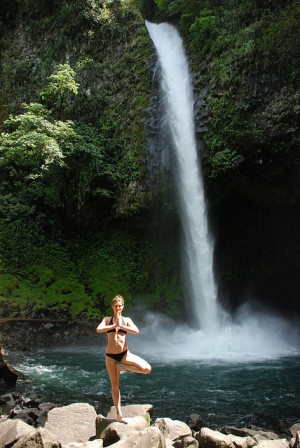
Living in Central and South America is a dream many Northerners hold but simply do not know how to make a reality. Financially supporting your life and travel abroad in Latin America is surprisingly simple and actually common among many travelers. You do not need a work visa and you do not need a resume. Get savvy and explore these options, which offer valuable work and life experience while funding your time abroad.
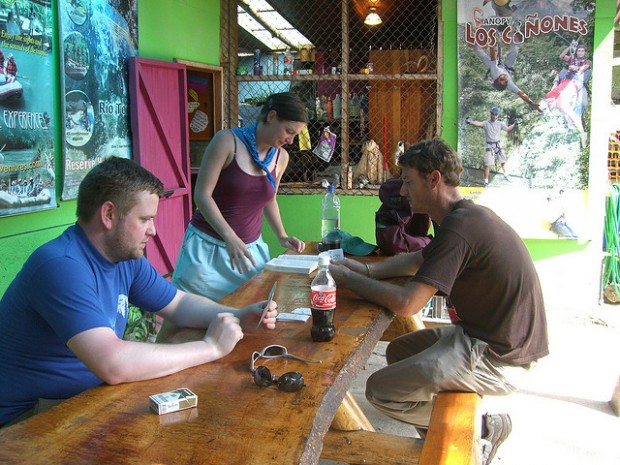
Live for Free in a Hostel
Hostels all over provide free food and lodging for volunteers who contribute to the upkeep of hostels. Meet other travelers and get a taste of what it would be like to own and run your own. Consider where you would like to live, then contact hostels with good reviews on sites like TripAdvisor or Hostel World. Better yet, build relationships while backpacking and circle back to the hostels that made you feel at home.
Work in a Local Café
Expat-owned cafes tend to hire foreigners who can speak English fluently with tourists. Wages tend to be low but if you work in places frequented by North Americans you will likely make enough in tips to get by. This is an excellent experience in learning what it takes to run a café in a developing country.
Volunteer on a Farm
Contact permaculture and organic farms which usually operate with the help of local and expat volunteers. Learn how to grow your own food while living for free. Some farms may even pay you based on how much you yield. Research areas near National Parks with farming and expat communities. In Costa Rica many opportunities exist on the Osa Peninsula and in the mountainous region of Panama surrounding Boquete.
Become a Divemaster
Providing dive lessons in tourist towns can be lucrative and it’s a great way to dive for free. It takes some investment to get your certification through PADI, but if you love to dive it is an ideal job.
Teach English
It may not be as lucrative as teaching in Japan or Korea, but opportunities exist in Latin American cities for foreigners teaching English. Seek out cities looking for native English speakers.
Give Massages
Many spas in beach and tourist towns all over Latin America employ foreigners certified to practice massage. Prices are geared towards tourists which can offer a pretty decent income. It is also possible to avoid the overhead expense of working in a spa by setting up your own shop on the beach. Be aware that this is often illegal but the law is rarely enforced.

Teach Yoga
Like massage therapists there is a demand for yoga instructors, particularly in Costa Rica which tends to have at least one studio in every town. You can also offer private lessons to tourists in their homes or hotels or teach your own public classes on the beach.
Manage Rental Properties
Many foreigners who own homes abroad choose to live elsewhere for a good part of the year. This is so common that a demand exists for rental agents advertising and managing vacation rentals. If you have a background in real estate or property management this is a great way to make first world wages abroad. It is possible to represent yourself or become part of a local company.
Invest in Your Own Business
This is the most common path expats tend to take when deciding to live abroad. Is there a business you have always dreamed of running? Perhaps a hotel and spa? An organic café? A hip wine bar? A shop selling artisan goods? A tour company showing the best of the country you love? Your options are endless and investment tends to be much less expensive than in Western countries. If your business is geared towards tourists you can charge first world rates and make a good livable income.
Work Online
You can find incredible freedom to live and work anywhere in the world at any given time when you are able to work online. Depending on your skill set you can create a freelance business online likely makes the same wages you made in your home country. Look on job boards for freelance writing opportunities, develop a client base for web and graphic design, or find a way to make your other skills work online. There are Interior Designers, Nutritionists, Project Managers, Marketers, and others who have shifted their careers to be entirely based online.
Get creative and find a way to finance living abroad if you feel called to do so. It is more than possible.

If you thought Captain Morgan was just the name for a bottle of popular rum, you were wrong. Morgan was not a legend, but a Welsh admiral named Sir Henry Morgan. What was believed to be his ship was recently found off the coast of Panama.
From 1663-1671 Captain Henry Morgan pillaged the sea ports of Latin America and sacked Panama City, one of the wealthiest in the area. He lost many vessels during his years as a privateer, one of which was his flagship ‘Satisfaction’ during the raid on Panama City.
340 years later, archaeologists from Texas State University have discovered a large section of the hull from what they believe is Morgan’s flagship, The Satisfaction and are beginning to retrieve artifacts from the vessel and surrounding sea floor.
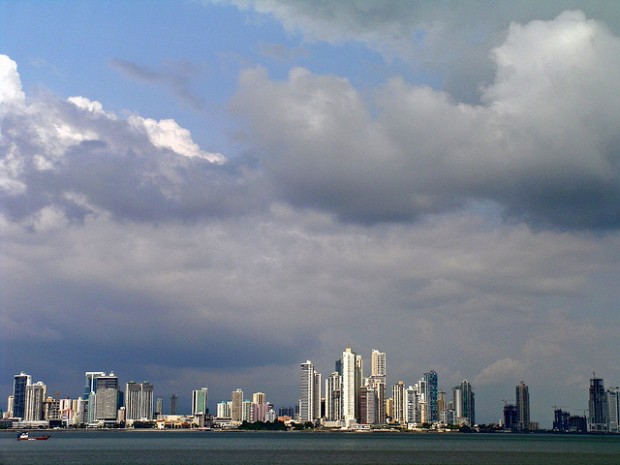
Panama City, Panama
At the heart of Central America, which ties together North and South America and the Pacific and Atlantic Oceans is a small, quirky country being hailed as the next “Singapore of Central America” – Panama.
Panama is the fastest growing economy in 2013 for Latin America
This that has many experts comparing it to Singapore, another rag-to-riches success story.
But Panama isn’t booming just because of lucky geography, it’s booming because of smart free-market, investment-friendly policies which have sharpened its advantages:
- Panama’s currency is the U.S. dollar. This makes investing in the country easy.
- Banking and communication services are world class.
- Panama launched a five-year, $13.6 billion investment plan, focusing on schools, hospitals, sewerage, roads, and metro transit system.
- Panama’s import tariffs are among the lowest in Latin America. Also, the country has received foreign direct investment worth nearly 9% of GDP.
- Panama is a well-regarded tax haven and its banks offer a high degree of privacy.
- There is no tax on interest earned from bank accounts for locals or foreigners. There are no corporate or personal taxes on offshore activity. Residents pay no local taxes on their foreign-earned income.
- The result: an economy that’s grown at an 8% or more clip over the past five years.
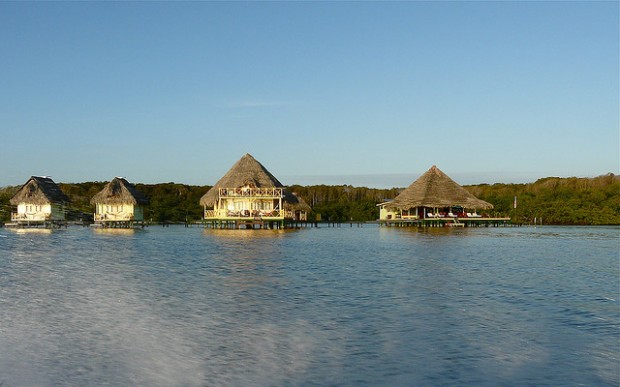
Bocas del Toro, Panama
Booming Expat Paradise
Panama earned the number 2 spot on Forbes’ The 10 Best Countries to Retire to in 2013 who say:
“Panama is just plain easy, Panama City is a vibrant, cosmopolitan city with great restaurants, and excellent hospitals. It’s a banking and commercial hub so you find a real international community there. Panama is committed to attracting foreign retirees and offers the world’s best incentive program to do so, making it convenient and easy to get residence there.”
Things will cost you significantly less in Panama than what you’d expect back home. “A budget of $1,700 to $2,500 a month, housing included, would see you eating out, perhaps with a housekeeper a couple days a week, movies a few times a month, and so on.”
Panama Canal and Ports
A construction boom is also changing the landscape of Panama City. Office towers go up as fast as men can build them, including the Trump Ocean Club and Latin America’s first Waldorf Astoria hotel. But let’s not forget the work being done to double the capacity of the Panama Canal.
The Canal’s annual revenues have grown to over $2 billion (7.5% of GDP). Traffic and revenue were up about 25% in 2011. This produced a ripple of growth in many related businesses, such as insurance, ship maintenance and repair, trade finance, and banking. The canal and Panama’s business-friendly regulations have expanded big insurance, finance, and legal offshore industries.
Last year, the free-trade zone in Colón – on the Atlantic end of the canal – and Balboa, Panama’s Pacific-side trade gateway, became Latin America’s two busiest ports. These two ports are set to explode soon after the canal’s $5.25 billion expansion project is completed in 2014. This is one reason Colón’s become the regional base of firms like Procter & Gamble (NYSE: PG)… Two-thirds of the traffic through the canal is coming from or going to America.
Get ready for more growth. Panama is booming.
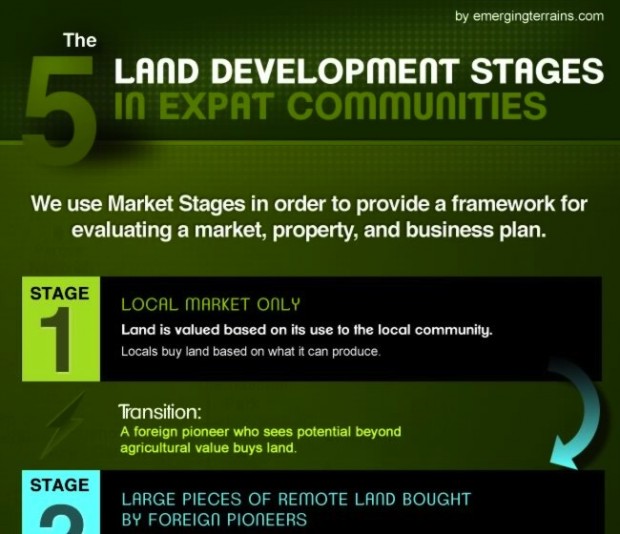
Market Stages are crucial for real estate investors to make sense of property prices in Central America.
Especially when those prices seem so irrational.
It took me a long time to wrap my left-brained, over analytical, where-are-the-market comps? mind to wrap itself around property values and markets in Central America.
How did I finally get a grip on the apparent chaos?
Market Stages – The Missing Link
We wrote in a more boring and detailed way about market stages over on our investor blog. Then we decided to make an infographic to help you first understand the stages.
Once you understand what the stages are, there are all sorts of ways they can help you and we’re going to write about those.
Things like:
- Pricing: How to value properties in Central America
- Business Plans: What should I build?
- Customers: Who is going to buy my real estate?
- Timing: What in the world drives the timing of real estate markets in Central America?
We’ll get to that. But first, use this infographic to learn the stages.

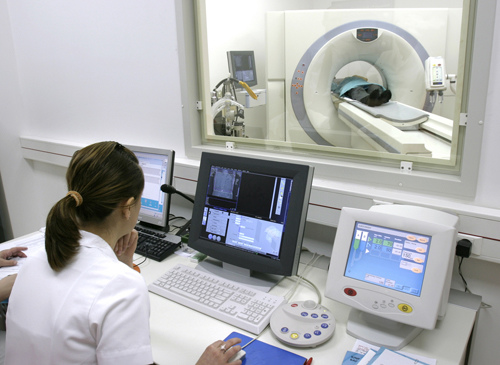
Healthcare is just one of the many aspects that a would-be expat might, and should, take into account when researching the retirement destinations they’re considering. Those hoping to relocate to Panama can go ahead and breathe a cautious sigh of relief.
While the country’s healthcare system is certainly not without its flaws, many expats have actually cited it as one of the best things about living in Panama. However, like almost anything else in Central America, it can vary greatly depending on where you go.
As a general rule, the best facilities and physicians are located in Panama City. However, some other areas are starting to catch up. For instance, Hospital Chiriqui, which treats many expats from the mountain haven of Boquete, provides an even better level of service than many in the city.
It is a smaller facility and may not be equipped to treat certain specialized cases, but is quite capable for most procedures.
Private Hospitals’ Healthcare
Panama boasts several state-of-the art private hospitals, many of which are associated with renowned facilities in the U.S. Punta Pacifica, located in Panama City, is considered the most technologically-advanced hospital in Latin America and is affiliated with the Johns Hopkins Hospital in Baltimore, Maryland.
The hospital is equipped with features such as videoconferencing capabilities to allow for information sharing and education.

Punta Pacifica Panama – photo by Maleg
Panama City is home to three other major hospitals, and there are two modern facilities in David as well. Still others are scattered throughout the country. Because the nation is small, it’s difficult to find yourself more than one to two hours from a modern hospital. The more heavily populated areas are also home to other health care providers such as dentists and eye doctors.
Public Hospitals’ Healthcare
Panama also has a number of public hospitals, which are funded by the Ministry of Health and the Social Security System. (Read: They’re nearly free.) However, those who can afford private health care often choose to go that route for various reasons.
The reason many expats do not opt to obtain services from public hospitals is because they can be a bit of a toss up. At best you may have to wait a few extra weeks for an appointment and may not get the same specialized attention you receive at a private facility. At worst you may wait hours to be admitted to an ER, only to deal with staff members who are tired, overworked, or rude.
But don’t let the few negatives turn you away from this viable option. For every understaffed facility with outdated equipment, there is another public hospital with modern technology and physicians who will take as much time with you as you need. Our recommendation is that, if you plan to take advantage of Panama’s public hospitals, check them out in advance. Make sure you understand what you’re getting into before you find yourself in a situation where you need urgent care.
Medical Professionals
One of the highlights of the Panamanian healthcare system is the quality of its medical professionals. The doctors are well trained, often in the U.S., and most are bilingual. The quality of medical care you’ll receive rivals that of many hospitals in the U.S., Canada, and Europe. This isn’t due to any regulatory standards being imposed by the government. But it doesn’t seem to matter.
While nurses do not receive the same level of training as those in the U.S., expats describe both them and the physicians as having an attitude of compassion that is not often seen in their first-world counterparts. In fact, the personal attention they receive from their doctors often comes as a shock to those unaccustomed to such dedicated care.
As opposed to U.S. physician visits where you’re usually worked over by a nurse and then visited briefly by a doctor who whisks in for two minutes before rushing off to see another patient, it’s not uncommon for a Panamanian doctor to spend 30 minutes to an hour with you in his office.
In addition to this one-on-one attention, you may be given your doctor’s home or even cellular phone number, as well as his or her home email address. While this easy access shouldn’t be abused, it’s not at all uncommon for a physician to allow patients to contact him or her after hours for pressing issues.
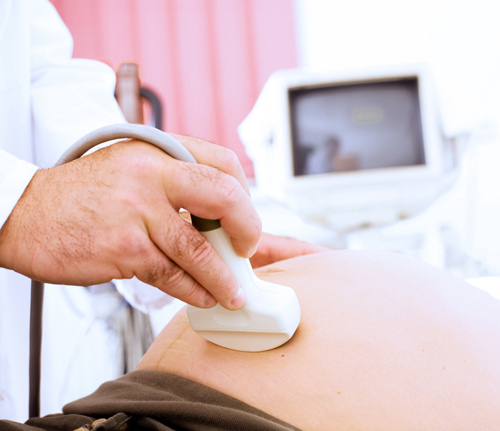
photo by Panama Health
Availability of Treatment
Something that’s important for expats to understand about Panama’s healthcare system is the disparity between the well-trained, well-meaning physicians and their ability to meet wide-ranging needs with the limited resources available to them.
Collectively, Panama’s hospitals have all the know-how and equipment they need. Individually, they may be unable to treat some of the more unique situations that might arise.
So the good news is that, whatever your condition, there’s probably a hospital that specializes in it. The bad news is that you will need to be more proactive in choosing your physician than you may be used to.
Inconsistencies in Care
Another common frustration among expats is the inconsistency among Panama’s healthcare providers. We’ve mentioned the differences between public and private health care, but even among privately-owned facilities the care can often vary greatly.
A good recommendation is to consider this fact when planning your move to Panama. If you need a good pediatrician, make sure you like the ones located near the area where you plan to relocate. If you have a heart condition, you may want to consider meeting with the nearest cardiologist before you sign on the dotted line of a bill of sale on a remote property.
A good idea is to ask around for recommendations on physicians. Again, because Panamanian doctors aren’t subject to a lot of the same scrutiny as those in the U.S., it can’t hurt to do your research. Don’t take for granted that they can be trusted simply because they’re physicians.
In addition, while many physicians may spend the better part of an hour with you alone in their office discussing your health concerns, there are also a few (especially those in public hospitals) that seem to hardly slow down to give you the time of day. If you’re concerned with being left in the dark regarding your health conditions, it’s best to consider your options ahead of time.
The language barrier is often another area of concern for many expats. While many doctors speak English, not all do. A visit to the hospital administrator’s office can quickly answer the question of whether the hospital offers a translator and whether those services are included in the hospital fees.
Health Insurance
Although many would-be expats are probably beyond tired of hearing health insurance debated in their home country, it’s nevertheless something they’ll need to consider when shopping for their Central American retirement home.
The good news is that there are many affordable options available. Even some U.S. health insurance plans are accepted in Panama.
Locally, there are HMO plans, which offer total reimbursement of services from in-network providers, as well as international plans, which allow patients to obtain treatment anywhere including places outside of Panama.
Many private hospitals also offer membership plans, which give participants hefty discounts on procedures performed at that facility only.
Cost of Healthcare
When comparing the different aspects of health care in Panama, low costs are another big plus for the “Pro” column.
Prices are drastically less than those of first-world countries, with procedures costing as little as one half to one fourth of the cost of what they would run in the U.S. While this may seem absurdly low, the ratio of health care costs to wages is quite proportionate, since many Panamanians earn around $400 per month.
One major reason for the low cost is that the overall health care system is far less litigious than in many other countries. With fewer frivolous lawsuits to threaten their livelihood, doctors pay less for malpractice insurance. The savings are passed on to the patient.
For instance, a visit to a specialist costs about $50. A trip to the ER runs around $100, which is less than a U.S. co-payment for the same visit. Procedures such as MRI’s are a mere $500, and a facelift can be performed for only about $1,700. Prescription drugs also cost less, and many medications that must be dispensed by a pharmacist in the U.S. are available over-the-counter in Panama.
photo by Panama Health
As a result of the low costs, insurance is also much cheaper for a good amount of coverage. As previously mentioned, public hospitals offer free routine care, but those who can afford private facilities will likely choose to pay the minimal cost instead.
Medical Tourism
Because of the low costs of treatment and the many attractions the area has to offer, Panama is becoming a hotspot for medical tourism. Many foreigners travel to the country to undergo expensive or even elective procedures, since they can be obtained at such a great value. Additional benefits are its proximity to and ease of access from the U.S., as well as its use of the U.S. dollar as its currency.
In addition to the low cost and high quality of Panama’s health care, foreigners are also clueing in to the fact that it’s just not a bad place to recuperate. Its many spas and resorts are quite conducive to the recovery process, making it awfully easy to turn your medical procedure into a much-needed vacation.
Medical tourism companies make the process a simple one by arranging for practically every aspect of the trip. They can book everything from air travel to hotel accommodations to the procedure itself. As this segment of the tourism industry continues to grow, it’s sure to have only positive effects on the quality of the health care system as a whole.


Photo: Sal Falko
There are many factors to consider when visiting or relocating to Latin America. The question of health insurance is an important one to answer before you get there.
Do I need to purchase private health insurance?
First you’ll need to decide if you even need to purchase private health insurance. This will depend largely on the length of your proposed stay and the coverage offered by your current health insurance in your home country. Many U.S. health insurance policies do not cover any medical treatment obtained outside the United States. However, there are some that do.
Still others may cover only emergency medical treatment or air evacuation back to the U.S. Even in situations where U.S. policy coverages do extend, the out-of-network rate usually applies. Plus you’ll likely need to pay the bill yourself up front and then get reimbursed later, which could be a real headache for major expenses.
It’s important to read up on your policy and understand what coverage it provides. Don’t just assume you’re protected once you leave. Travelers can also obtain temporary health insurance that will help in the event of an emergency while they’re out of the country.
Some countries even offer free emergency health insurance to tourists for a limited time while they’re within the country’s borders. Panama is one. The coverage is good for 30 days and is only available to those who enter through Tocumen International Airport.
What if I plan to relocate permanently?
For those who plan to reside extensively or even permanently in another country, you’ll likely need to seek private insurance. If you already have a policy, start by finding out if it (or another policy with the same company) will be of any assistance.
Be aware that Medicare and many other government programs are not available to those residing outside the U.S. Nor is medical evacuation back to the States.
There are a few expats who choose not to carry private health insurance for a variety of reasons. Some countries may have government-sponsored health insurance that is available to foreign residents (although it might not offer patients the same comforts and freedoms of private insurance).
Some expats choose to self-insure their medical expenses. This is a viable option for many, since the cost of medical treatment in Latin American countries is often a fraction of what the same procedure would cost in the U.S. However, it’s best reserved for those who are in good health and who also have the financial solvency to bear the burden of any medical expenses should the unthinkable happen.
Where do I go to look for health insurance?
If the extent of your experience with health insurance in your home country was seeing the line item where it was debited from your paycheck each week, you might want to consider the advice of a qualified insurance specialist. Find an agent in your destination country who represents multiple companies and can research all of them to recommend the policy that is the best fit for your needs.
On the other hand, if you feel like you have a good understanding of how this stuff works, you can also shop and compare on your own. There are many companies who offer health insurance policies that are tailored for expats. Some popular choices are Global Health, Aetna, HCC, Bupa, IMG, and Seven Corners, to name a few.
What factors do I need to consider when shopping for health insurance?
-
Cost – While cost is certainly an important thing to compare when shopping for health insurance, make sure you consider all the aspects of it. Not just the premium. Look at the cost to benefit ratio, as lower premiums often mean lower limits or higher copayments. Also find out if it has annual percentage increases or any other hidden costs.
-
Coverage Area – Will your new plan cover you if you travel outside your destination country? Or if you return to the U.S.? Examine the terms carefully to see where your coverage extends. There are a lot of worldwide policies available. For a bit of a savings, you can also find global policies that specifically exclude the U.S. Because its health care costs are some of the highest in the world.
-
Plan Features – Make sure you understand all the ins and outs of your new coverage. Does it cover only in-network providers, or will you have the freedom to choose? You’ll want to ensure that the limits are adequate. They may apply per year or over your lifetime. There may also be individual limits on specific services such as air evacuation. See if your policy covers things like repatriation, the return of mortal remains in the event of a person’s death.
-
Pre-existing Conditions – If you have any, make sure your new policy will cover them. It’s not uncommon for certain health problems to be excluded under a new policy or to require additional premiums.
-
Payment Format – Many international policies don’t pay via direct billing like they do in the U.S. Many policies may require you to pay the charges up front and file for reimbursement.
- Fine Print – Read your policy carefully before you sign on the dotted line. International health insurance can be tricky, and you don’t want to find out the hard way that an expensive procedure you need isn’t covered. The fine print may spell out details such as when coverage expires, benefits levels that are lowered after a certain age, or situations that might cause your premium to increase (like filing excessive claims).
One ambition that most of us share is to live a long, happy, and fruitful life. The life expectancy of the average U.S. citizen is 78.2 years, and many people hope to spend ten or fifteen years of their life in retirement.

Photo Credit: Sushicam
For a growing group of individuals, living overseas is emerging as an attractive option for this period of their life. Exciting terrains such as Central and Latin America are brilliant options for retired expats, and communities of like-minded individuals are popping up in countries like Nicaragua, Costa Rica, and Ecuador.
For many of us, the idea of moving abroad in our twilight years is something that sounds a bit scary. However, there is evidence to suggest that traveling, and even living overseas, could make your brain younger. In other words, taking the plunge and making your expat dreams a reality could turn you into a super ager!
How Can You Become a Super Ager?
Scientific researchers have spent years looking into the secret of a long and active life, and they are starting to make discoveries. Susan Krauss Whitmore, a Professor of Psychology, recently wrote an article for the Huffington Post titled How To Be A 50 Plus Brain ‘SuperAger’.
In the article, Krauss Whitmore writes:
Researchers are well on their way to discovering the elements of what they call successful cognitive aging, in that they stay above the norm on tasks that require memory, planning and general knowledge. They take advantage of what neuroscientists call brain or cognitive “plasticity.”
The idea of brain plasticity is best described as how quickly our brain is able to react and change to new experiences. Every time we experience something new, our brain has to reorganize its neural pathways in order to accommodate the new information it’s gained.
The more easily our brains are able to do this, the more active our brains will be as we get older. However, if our brains are under-stimulated, they lose the ability to create neural pathways as easily, and therefore lose plasticity.
Because of this, there’s an argument that the harder we work our brains, the more prepared they will be to stay active and intelligent as we age. Many older people take steps to do puzzles or mind teaser games to promote this effect, but travel can work just as well – and it’s a lot more fun.
How Does Travel Help?
When we travel, we open ourselves up to many new and diverse experiences. We see new things, learn about new cultures and histories, and taste new types of food. All these things mean that our brains need to retain their plasticity to keep up.
There is also a key argument to say that changing your routine can be very good for maintaining the plasticity of your brain. Instead of staying in the same city and visiting the same places, traveling further afield can provide very valuable mental stimulation.
How far you choose to travel depends on how adventurous you are. Some of us might benefit from spending a weekend break in the next state, whereas others may decide that their retirement is the perfect opportunity to visit the further afield places that they’ve always wanted to see.
If you dream of buying a retirement property in Antigua, Guatemala or Cuenca, Ecuador, you may find that your new life there could make your brain scientifically younger.