



Sam Shall
Expats head down to Central America for the scenic beauty, the year-round spring-like weather and the low cost of living that makes these countries a prime retirement spot.
But now something new is drawing them in, the promise of world class health care at extremely affordable rates. And with such a short commute from Central America to the U.S., what could be better for North American expats?
For many people, choosing to travel overseas to receive medical treatment is basically a no-brainer (especially after the recession) and medical tourism is experiencing a new wave of popularity.
But does quality of Medical Treatment have to be sacrificed?
In short, no, the treatment you receive abroad can be just as good as the treatment you would have received back home and in fact, many expats claim that the treatment they received abroad was superior, with lower costs and shorter waits.
Recognizing the opportunity and getting on board with medical tourism, many of America’s top health care branches are expanding out to include countries that are known to be popular retirement spots and well-known insurers like Blue Cross are putting their own medical tourism programs into action.
So where in Central America can expats find the best health care?
1) Ecuador
First on the list is Ecuador and Cuenca in particular.
According to former U.S. hospital administrator Alex McClellan, Cuenca, Ecuador, may just be the newest medical tourism hot spot. And having worked in the medical tourism industry for years, in countries like Mexico, India, and China, McClellan knows a thing or two about the industry.
In Cuenca, expats can expect to pay around 7-10% of what they would have paid for medical procedures back home, without having to sacrifice quality.
A heart bypass that would cost $130,000 in the U.S., will cost closer to $10,000 in Cuenca and a hip replacement priced at anywhere from $43,000 to $51,000, only $8,000.
With price differences like that, it’s no wonder retirees are looking to Ecuador for the perfect spot to settle down.
2) Mexico
Next up is Mexico. Originally a popular spot for medical tourists due to its close proximity to the United States, Mexico now boasts many great medical facilities like Angeles Health.
The largest private hospital network in the country, Angeles Health has over 23 hospitals, 2,000 beds and 200 operating rooms, all staffed by 11,000 trained health care professionals.
Because of this, Angeles Health has become a sought out spot for medical tourists and the U.S.-based Angeles Health subsidiary is constantly setting up treatments for North American medical tourists.
3) Costa Rica
Already one of the most popular expat destinations in Central America, the high standard of health care that can be accessed in Costa Rica is just icing on the cake for many expats.
In Costa Rica, expats can receive the medical attention they require, in one of the many private accredited hospitals and again, the prices are much, much lower than back in the states; 50-70% lower in fact and the wait time for treatment or surgery is virtually non-existent, something that definitely cannot be said about the U.S.
While cosmetic and dental procedures were the most common medical tourist lures in the past, today many other surgeries and medical treatments are being performed, bringing in even more expats and medical tourists.
4) Panama
Each year, Panama is drawing in more expats with its beaches, weather and excellent business climate, but now, foreigners are coming for the health care system as well.
Many world class health care facilities can be found across Panama, each staffed with medical professionals trained to use the latest technology.
- Clinica Hospital San Fernando: is Panama’s first private hospital and is known for its excellent inpatient pharmacy.
- Centro Medico Paitilla (affiliated with Cleveland Clinic): can be found in the center of Panama City and is a great choice for tertiary care.
- Hospital Punta Pacifica: is a John Hopkins-affiliated hospital and offers exceptional treatment for minimally invasive cardiac surgery, general surgery, neuro-surgery, and urology procedures.
When expats leave North America behind in search of the perfect retirement spot, their Medicare and private health insurance can’t be brought with them.
Fortunately the boom of medical tourism that is rushing through Central America at an incredible rate is making it possible for expats to get quality health care without having to fly back home.
If you are thinking about moving down to Central America, to live out your retirement years in tropical bliss, consider Ecuador, Mexico, Costa Rica, or Panama.
These countries can give you the best of both worlds, the paradise you crave, coupled with the first world medical facilities you need to make you feel safe and comfortable.
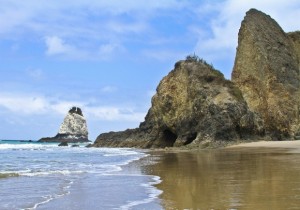
Sitting on the northwest coast of Latin America, Ecuador is a gem of a country that has a lot to offer for expats and tourists alike. The country sits right on the equator, which means that the Ecuador climate benefits from a glorious twelve hours of daily sunshine all year round.
Ecuador has a large coastal area, which means that you can expect to see a plethora of stunning beaches and clear waters. The country is also home to two chains of the Andes Mountains and a large area of rainforest, which adds a whole extra dimension to the country’s scenery.
If the sunshine and the scenery aren’t enough to tempt you, what about the cost of living? Ecuador has been named as one of the cheapest countries in the world to live in. If you are thinking about retiring to this part of Latin America, this is brilliant news. It’s estimated that a couple can live very comfortably in Ecuador for less than $2,000 per month.
Because the equator runs right through Ecuador, some of the country is in the southern hemisphere, while some is in the northern. This, along with the different terrains in the country, means that those that are living in one part of the country will have a very different weather experience than those that are living in another.
If you’re deciding which part of Ecuador to visit, either short- or long-term, you’d be wise to make climate part of your decision process. The Ecuador climate is made up of a number of distinct micro climates that separate into four main zones:
- La Costa – Coastal Lowlands
- La Sierra – Andean Mountains
- El Oriente – Amazon Region
- Galapagos Islands
Which of these four zones you choose to visit will have a big impact on what your Ecuadorian trip will look like; as well as how you’ll cope with the weather!
La Costa (Coastal Lowlands)

The area along the coast of Ecuador is referred to as La Costa, or the coastal lowlands. The coast borders onto the Pacific Ocean, and is very beautiful. A particularly great thing about Ecuador’s coastal region is its variety.
If you are looking for beach towns with great night life and varied activities, you have plenty to choose from. Equally, if you’d rather visit a quiet area with unspoilt beaches, Ecuador can offer that too.
It’s in this coastal region of Ecuador that the country’s biggest city is based. Guayaquil is a sea port with a population of around 2.35 million people, which makes it the most populated area in the country. Guayquil is a popular area with tourists, as the heat and the proximity to the coast give it a relaxed, almost Caribbean feel. The city has undergone a great deal of development in recent years, and it now boasts some new parks and museums.
As far as the weather goes, things can get a little hot and humid in the coastal area of Ecuador! Here, the weather is about what you probably expect from the Ecuador climate: truly tropical with temperatures usually between 80 and 90 degrees Fahrenheit. There is a rainy season in this region, which occurs between December and April. During this time, you should expect torrential downpours to disrupt your day!
La Sierra (Andean Mountains)

La Sierra, or the highlands of Ecuador, are situated in the centre of the country. It’s here that you’ll find the two chains of parallel Andes mountains. There are some famous sites to see here, including Chimborazo, which is the highest mountain in the region and an extinct volcano, and Cotopaxi, which has the honor of being the second highest active volcano in the world.
This region of Ecuador has a much cooler climate than other parts of the country. This is due to the altitude of the mountains. You may be interested to know that the snowline in the Ecuadorian mountains is at about 5,000m, which is lower than the snowline in nearby Bolivia and Peru. In other words, if you’re planning a mountain climbing trip: you’ll need to pack some serious cold weather gear!
Ecuador’s capital city of Quito sits in this region, at 9,350 feet above sea level! In fact, Quito is the highest capital city in the world to house the administrative, judicial and legislative functions of its country. The historic center of the city is extremely well-preserved, and many tourists make the trek up to Quito to see it every year. Another draw of the area is a museum and monument that mark the location of the equator, which is known locally as la mitad del mundo, or “the middle of the world.”
If you choose to visit La Sierra, you’ll enjoy warm days and chillier nights. Expect the daily temperature to be around 75 degrees fahrenheit, and the nightly temperature to be around 50. There is little variation in temperature all year round, though there is a rainy season and a non-rainy season. April is the wettest month here, while the dry season is from June to September.
El Oriente (Amazon Region)

Beyond the Andes mountain ranges sits El Oriente, the Amazon region. This lowland rainforest is tropical, and very low lying. This area is made up mainly of wilderness, and much of the area is virtually unexplored. El Oriente is estimated to account for almost half of Ecuador’s land mass, but only around 5% of the country’s population live here.
Despite this, tourism has risen dramatically in this region over recent years. The many rivers in the region are perfect for kayaking and rafting, and as such the area tends to attract some of the more adventurous of Ecuador’s visitors!
The wildlife in El Oriente is another draw for tourists. The variety of birds that live in this region is incredible, and there are many tours and trips that will help you get a glance at them.
This area has the sort of climate you would expect for an equatorial region. It is hot and humid with steady rainfall throughout the year. In fact, it rains during most months here, though it is usually a bit drier in August, December, January, February and March. Just like in the coastal regions, temperatures in this part of Ecuador are normally expected to be between 80 and 90 degrees Fahrenheit.
Galapagos Islands

When you hear about the Galapagos Islands, you probably think about their connection to Charles Darwin. All those years ago, Darwin chose to do so much of his research on the islands because of the large variety of unique species that make their home on the island. Today, the island is still home to that impressive variety of species, and the island is visited by a large number of people every year who want to experience it for themselves.
If you’re planning a trip to the Galapagos Islands, the climate you find there might surprise you. The group of islands sit almost right on the equator, and as such we expect it to be a very hot and humid place. However, this isn’t the case! The cool waters of the Pacific Ocean stop the island from getting too hot, and the climate here is actually very pleasant.
The climate in this part of Ecuador is made up of low rainfall and almost no extremes. The average yearly temperature ranges between 66 and 90 degrees Fahrenheit.
Which climate is right for you?
With four very different micro climates within Ecuador, it can be difficult to decide which one is right for you. Whether you’re deciding which part of Ecuador to visit for a holiday, or whether you’re thinking about settling here for a longer period of time: it’s really important to bear these climates in mind.
However long you plan to stay in Ecuador, climate will have a big impact on your daily life here. It’s important to research this fully before you commit to a region. You may love the sound of the tropical weather in the coastal and rainforest regions of the country, or the spring-like climate of the highlands might be more your thing.
Whichever area you decide is right for you, you can be sure you will have a great time. Ecuador is a country with people and cultures as diverse as its weather, and there are many experiences and adventures to be had there.
And if you get tired of the climate wherever you are? Don’t worry. There’s an old Ecuadorian adage that it’s possible to experience all four seasons in the country in the space of a day: so you won’t be stuck with it for long!
Knights Bridge
Expat and real estate developer Park Wilson talks about the best Panama visa and residency options and why they’re the main ones he’d recommend to someone wanting to relocate to Panama.
Park: I’ve been an expat in Panama for about 6 years now, and one of the questions I get asked a lot is which visa is the best for other expats to pursue. Obviously, this can vary from one individual to the next, based on their specific needs. But, from my own experience and from talking to tons of other expats who have gone through the process, I could easily narrow it down to two that I think make the most sense and the non-option that has made the most sense for me.
The Pensionado Visa. And the one for Nationals of Specific Countries (NSC).
They both have their pros and cons, but in my opinion these two have the best benefits and require the least amount of effort. Here’s a little more information, including the pros and cons of each.
Pensionado Visa
The Pensionado Visa is an option designed for pensioners of all ages and comes complete with a neat little bundle of discounts and advantages for its recipients. You’ll have to jump through a few extra hoops to qualify, but the end result can really be worth it. Here’s the skinny on this visa.
Qualifications
-
Monthly income of $1,000 for life from a guaranteed source such as a pension or annuity
-
Or income of $750 per month and a $100,000 minimum investment in Panamanian real estate
-
An additional $250 monthly income for each dependent child
Benefits
-
50% off on recreation and entertainment such as movies, theaters, sports, etc.
-
50% off hotels Monday through Thursday (30% off on weekends)
-
50% off passports
-
30% off public transportation like buses, trains, and boats
-
25% off airfare
-
25% off restaurants (15% off fast food)
-
25% off electrical, telephone, and water service
-
20% off doctors and specialists
-
20% off prosthetics and other personal assistance devices
-
15% off hospitals and private clinics
-
15% off dental and optometry services
-
10% off prescription medications
-
tax-free importation of household goods, up to $10,000
-
tax-free importation of a vehicle, or tax-free purchase of a local vehicle, every 2 years
The Pensionado visa also allows expats to obtain a cedula, Panama’s national identification card. It also makes them eligible for permanent residency, but not citizenship.
Some Drawbacks
While most would say it’s worth it, the Pensionado visa can be a lot of trouble to obtain. And not everyone gets it. The process takes about 6 months and requires a hefty amount of paperwork and may require you to continue to prove solvency.
Another problem is that the Pensionado visa restricts you from having a job. You can own a business that you operate, but otherwise Panama historically frowns on foreigners coming in and taking jobs away from Panamanians. So, if you don’t want the hassle or if you plan to seek outside employment, the Pensionado visa may not be the one for you.
No worries. You’ll get to enjoy most of the same discounts anyway once you reach retirement age.
Nationals of Specific Countries Visa
The other visa that I would highly recommend is one that was recently made possible in order to attract much-needed skilled labor to accommodate Panama’s growing economy. It’s quick, painless, and fairly easy to qualify. And it has the added benefit of allowing you to hold a job or start a business. It’s required in fact. Here are the qualifications for the visa offered to nationals of specific countries (NSC):
Qualifications
-
$5,000 in a Panamanian bank (plus an additional $2,000 for each dependent)
-
One of the following:
-
evidence of investment in Panamanian real estate
-
proof of ownership in a Panamanian business or corporation
-
or a letter and contract of employment from a Panamanian company
-
Oh, and one more thing. You have to be coming from one of these 47 countries “that maintain friendly, professional, economic, and investment relationships with the Republic of Panama”:
Andorra, Argentina, Australia, Austria, Brazil, Belgium, Canada, Chile, Croatia, Cyprus, Czech Republic, Denmark, Estonia, France, Finland, Germany, Greece, Hong Kong, Hungary, Ireland, Israel, Japan, Latvia, Liechtenstein, Lithuania, Luxembourg, Norway, Malta, Monaco, Montenegro, Netherlands, New Zealand, Poland, Portugal, San Marino, Serbia, Singapore, Slovakia, South Africa, South Korea, Spain, Switzerland, Sweden, Taiwan, United Kingdom, United States, or Uruguay.
Also eligible are applicants’ dependent spouses, children under 18 (or between 18 and 25 if they’re students), dependent parents, and family members with disabilities.
Benefits
The NSC visa doesn’t have any discounts or other monetary perks like the Pensionado. Its main attractive feature is that it gives you the freedom to work, and requires a very minimal investment.
Another perk is that, because the need for workers is great, Panama’s current administration is really cranking these visas out fast. And, it’s immediate permanent residency. No renewals. No waiting. Recipients can also apply for citizenship after 5 years, something that isn’t possible with a lot of visas.
That’s why a lot of folks are calling this one the “fast track” visa. It’s great for young entrepreneurs who might not otherwise be able to afford to make such a move.
Some Drawbacks
I really can’t think of a negative thing to say about this visa. Other than the fact that it isn’t right for someone who doesn’t have the $5,000 investment or doesn’t want to have to work. Other than that, it’s a great opportunity for ambitious would-be expats.
The Non-Visa Option
Another option, or you could call it a non-option, is not to apply for any visa at all. This is actually what I’ve been doing, and it has worked out quite well. You see, U.S. citizens are automatically given a 6-month visa upon entering Panama. And there’s no limit to the number of times you can be granted this visa.
So, because I live so close to Costa Rica, it’s really no trouble at all for me to hop over the border, stay for a few days, and then head back to Panama where I get another 6-month visa. This option is fairly common. I know a lot of people who do it.
Bottom Line
If you have the guaranteed income and are ready to enjoy a retirement lifestyle, go with the Pensionado visa. The benefits are worth it. If you have less of an initial investment and want to build a business or career in a place that better rewards your efforts, the specific countries visa is your ticket.
Then again, if you don’t mind some occasional travel, then don’t get a visa at all. There are plenty of options, or non-options, available. Find the one that’s right for you.
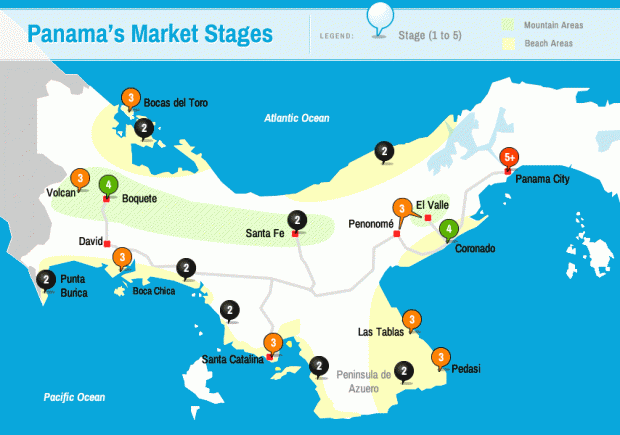
Sometimes the real estate market in countries like Panama appears to be flat out insane.
Prices don’t make sense. Some places that hardly have any infrastructure have expensive land. How in the world do you move forward with any rational decision in a market like that?
These are the questions that led us to come up with our work on the stages of land development in Central America. If you don’t yet understand this concept, you are playing with fire when evaluating whether or not you are getting a “good deal.”
Good, now that you understand the concept of Market stages, how do you apply it to Panama?
Start by using this map as a starting point to learn the stages of the different areas in Panama.
Is it an exact model of the country? No. Is it accurate enough to help you make smarter decisions. Absolutely.
P.S. Here is a bigger version of the map.

Click for Larger Version
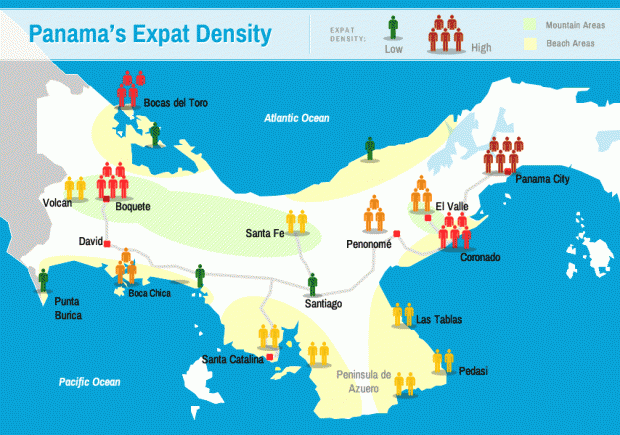
If you’re considering buying property in Latin America, it’s easy to see why Panama would be at the top of your list. With affordable real estate, loads of investment incentives, and favorable tax laws, it’s a great place to live and invest.
But, while narrowing your search down to Panama is easy, what comes next is much harder. With such variation among its various cities, the task of deciding EXACTLY where to buy property can be daunting, especially as an outsider.
Use this map to learn the names of the areas where expats live in Panama and narrow your search.

Click for Larger Version


Magellan Missed Out on the True Peaceful Sea
History tells us when Magellan began his search across the Atlantic Ocean for a trade route to the Spice Islands by going around South America, he became impressed with the large, peaceful body of water he encountered on the other side, naming it the Pacific. With Portuguese Brazil his first landing point, Magellan didn’t really know the Riviera Maya Mexico on the Caribbean.
The impression you receive when gazing at the Caribbean for the first time is that this incredible sea is like blue glass. The warm waves barely nibble at the shore making it seem more like an unbounded lake than an ocean body.
The Caribbean’s Natural Shelter
The Caribbean owes its placid nature to the Great Mesoamerican Reef, which shelters the mainland coasts from most storms. This reef system begins at the tip of the Yucatan Peninsula, and extends down to the Bay Islands of Honduras. The Great Mesoamerican Reef is the home to more than 65 species of stony coral, as well as over 500 species of fish and 350 species of mollusk. The vigorous bio-diversity includes the world’s largest group of manatees, as well as a number of endangered or protected species.
About the Riviera Maya Mexico
Originally called the Cancun-Tulum corridor, the Riviera Maya Mexico snuggles along the coastline of Quintana Roo, in the Yucatan Peninsula, where it basks in the uninterrupted miles of glittering white sand beaches, an amazing bio-diversity, and exposure to an ancient, technically advanced civilization.
The Riviera Maya Mexico has something for everyone. It is a favorite area for scuba diving, jet skiing, and snorkeling. For the adventurer, there are more serious pursuits.

Natural Wonders of Aktun Chen
Deep in the rain forest of the Riviera Maya Mexico, close to Tulum, is the incredible natural park, “Aktun Chen”. The Mayan name means cave with an underground river inside. There are three cenote caves at the park, with million year old stalagmites and stalactites and crystal clear water pools. For wildlife lovers, there are spider monkeys, white tail deer, wild boars, iguanas and flocks of brightly colored birds.
Cenotes, which are naturally forming sink holes, sometimes containing water, sometimes not, are found throughout the Riviera Maya Mexico. The Yucatan Peninsula is flat; so flat, it sometimes appears the only separation between land and water is the color and the towering palm trees. This creates an absence in surface rivers. They sink underground, revealing their presence only in the swirling holes dotting the landscape. Cavers have discovered a thrilling adventure in descending into the dry cenotes, that usually contain a sparkling pool of water at the bottom, delicious for swimming and for examining further underground pieces of paradise in the tunnels cut by the rivers.
Archeological Flavor
While sun-bathing on the beach is delicious, the biggest tourist attraction in the Riviera Maya Mexico is the Mayan ruins. Its ancient architecture rivals the best in Mediterranean history, stunning the viewer with its mastery of building and design, its astonishing understanding of hydraulics, its exquisite art and the massiveness of its enterprise.
Although a huge number of the Mayan ruins are still covered with growth, making it difficult to comprehend the full system of canals, roads, observatories, business and social establishments, an appreciation of their elaborate civilization can be found at Chichen Itza.
The Temple of the Jaguar
Located close to Merida, but within a day’s drive of Cancun, Chichen Itza is one of the most popular tourist destinations. The excavation site measures a mile from west to east, and approximately a mile and a half from north to south, revealing a number of buildings, some pyramids, temples, and an observatory.
Reaching the flattened summit of The Castle, a pyramid 75 feet tall, is a labor of love. At the top is a temple. In the middle of the temple is a jaguar, painted red and gleaming with inlaid jade and turquoise. Perhaps it’s just the cool shade from the sun, but you feel suddenly transformed to another dimension. The little jaguar, staring brightly, seems real, and his quizzical look seems to ask why you entered his domain.
The Highly Advanced City of Coba
The tallest pyramid in Riviera Maya Mexico resides in Coba. Reaching over 125 feet in height, a hike to the top reveals dozens of structures still moldering under jungle growth and the accumulation of sand and earth brought by the winds of time.
The most remarkable aspect about the area, however, is the remnants of a road system that had once covered the entire Yucatan Peninsula. The roads were raised, ran in a straight line, and included ramps and intersections.

The Castle by the Sea
A visit to the Riviera Maya Mexico ruins really isn’t complete without dropping into Tulum. Completed in 1,200 A.D., Tulum was a busy port and trading center during the Post Classic period. The greatest appreciation lies in the beauty of the architecture. Set precisely on the coastline, with the sea rolling close to its walls, it creates both a romantic and strategic setting. The Castillo, built on the highest point of the site, is believed to have been a lighthouse or a marker for seafarers. It has a watch tower vantage point, with views in every direction.
Life at Its Fullest
The traveler to the Riviera Maya Mexico is as versatile as the many natural wonders and modern services the Yucatan Peninsula has to offer. You’ll find anthropologists and biologists rubbing shoulders with adventure seekers, naturalists, cavers and scuba divers. For the more social, there are dazzling night spots, cozy beach clubs, and broad avenues filled with shops and restaurants.
A final touch to add to the Riviera Maya Mexico experience is visiting a spa. Located throughout the region, the Mayan spa has become a favorite destination among travelers. As much a cultural experience as a treatment, the temazcal – or house of steam – incorporates a shaman, ritual chanting and herbal remedies. The treatment may involve covering yourself with mud to help draw out the toxins. The benefits are said to include ridding toxins, cleaning the nervous system, relaxing muscles, reducing fat and stimulating the digestive and respiratory systems.
The Unforgettable Appeal
With a coastline like no other and an egg-shell sea in front of it, those features alone are enough to set up lawn chairs all over the Yucatan Peninsula. The wild bio-diversity that includes rain forest and cenotes, the open plain feeling, are the bonus features, adding dimension and versatility to the region. The ruins give silent testimony to the fact that at least two thousand years ago, a people saw the potential of this equatorial zone. They built a civilization with technologies we are only just now beginning to understand and appreciate for their precision and functional applications. Although remnants of this civilization are scattered throughout Central America, none so far have been found quite as spectacular as the giant pyramids and elaborate city hubs on the Riviera Maya Mexico.
BattenKill Canoe
Retirement used to mean that your best days were behind you. The word itself conjures up images of senior citizens gathering for breakfast every morning at the same local cafe or meeting up for their weekly game of bridge.
Retirees were those who had resigned themselves to their fixed income and holed up at home to live out the rest of their days in peace. The more well-to-do might spend a month or an entire season in Florida in a mobile home park, or maybe even a condominium. But most just counted down the days until they got put in a home and lost their last final shred of dignity.
Those days are over.
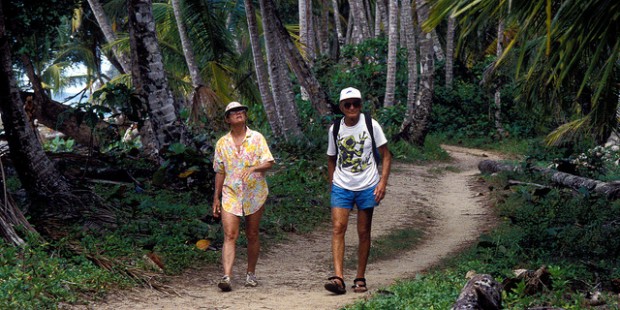
Today’s retirees are not content to waste away playing checkers and reading their AARP magazine. They’re adventuresome, fearless, and all the more vivacious because of the gusto with which they’re approaching their retirement years.
For many, retirement means something very different these days than it did even a decade ago. Those uneventful, sedentary lifestyles are being replaced with travel, exploration, and sometimes even a new start in another context.
Retirees are traveling and moving overseas more than ever before.
Travel among retirees is at an all-time high. The travel industry has recognized this demographic as a vital segment of their customer base and has begun catering to the mature traveler.
And the travel itself even looks different. Today’s retirees are less likely to spend their vacation on a crowded tour bus being shuttled from one city to the next. Many are taking a more DIY approach, planning their own adventures and steering clear of the more cookie-cutter travel experiences.
Since much of the current retired generation has traveled extensively during their working years, many are now targeting locations that are a little farther off the beaten path. If they traveled to a well-known European city years ago, they may decide to visit its lesser-traveled neighbor when they return. Multi-generational travel has also grown in popularity, as many retirees want to see the world with their children and grandchildren in tow.
In addition to their short-term travel, more Americans than ever are retiring overseas. It’s unclear just how many, but a reported 350,000 Americans receive their Social Security checks in countries outside the U.S. And in a recent study by Travel Market Report, an estimated 3.3 million baby boomers plan to retire abroad.
So what’s causing this trend among current retirees?
Maybe they’re born with it.
Americans who are currently entering retirement age are part of the “baby boom” generation, which includes those born between the years of 1946 (following the end of World War II) and 1964, when more babies were born than in any previous period in history.
While there are a number of suggestions as to why this boom occurred, many speculate that it was the result of a spirit of anticipation of future comfort and prosperity that led postwar families to want to have more children. Young couples in those days desired something better than their Depression-era parents had, and they wanted their children to have an even better life than they themselves planned to enjoy.
No doubt baby boomers came into this world with an inborn sense of optimism and an inherent drive to surpass all expectations. And this characteristic is evident in their travel and retirement decisions. Today’s retirees have a spirit that is not afraid.
Could it be a culturally-driven thirst for adventure?
In today’s world, it seems like everyone has a “bucket list.” A mental inventory, or maybe even one they’ve put down on paper, of all the things they want to do before their time is up. Add to this the fact that nearly every prime time network has a whole lineup of reality television shows set in remote destinations and featuring a slew of death-defying challenges and adventures.
There are travel magazines, travel-themed TV shows, and even entire networks tailored to those who have a desire to see the world and experience other cultures. As a result, retiring baby boomers are more aware than ever of the options that are available to satisfy their wanderlust.
Cross-country RV trips to the Grand Canyon are being replaced with 14-day cruises to Grand Cayman. And instead of weekend trips to Florida with the family, they’re heading to Peru to hike Machu Picchu with their kids and grandkids. And they’re hanging in there with the spryest of them.
Maybe it’s the calm and contentment.
As people age, studies show that their enjoyment comes less and less from the anticipation of some future event and more so from relishing the here and now. And many retirees feel like traveling to or living in another country can greatly affect their enjoyment of their current state.
For many, it means spending time outdoors and enjoying the serenity and peacefulness that nature has to offer. This may be why so many of today’s retirees choose to visit or relocate to areas with milder climates and undisturbed natural habitats.
Spending time in another location better enables retirees to avoid common stressors, like political dissatisfaction or financial worries. The absence of stress has been proven to improve health and decrease one’s risk of illness, particularly heart disease.
For this reason, many retirees are embracing the possibility of enjoying a stress-free lifestyle in those all-important latter years. Many are finding this decision to be hugely beneficial.
Or is a lack of money prompting baby boomers to retire overseas?
Still another possible reason today’s retirees may be choosing to travel and especially live overseas is the fact that they can enjoy a much lower cost of living, without sacrificing any of their quality of life.
Living in the States these days is not cheap, especially for those in retirement. The recent global financial crisis did quite a number on the pocketbooks of many American families. Many suffered severe hits to their 401k’s (an average of 18 years worth of gains). Home prices also fell 23% from 2007 to 2010.
Not everything is down, though. On the contrary, taxes have never been higher. And the average 65-year-old couple will pay $240,000 in out-of-pocket medical expenses over the rest of their lifetime, versus $160,000 a decade ago.
It’s no wonder that, in a recent Retirement Confidence Survey conducted by the Employee Benefit Research Institute, only 14% of employees were “very confident” they’d have enough money to live comfortably in retirement.
As many retirees are learning, this comfortable retirement can much more easily be found overseas. Housing costs are much lower than the U.S. average. Good health care, often as good as can be found in the U.S., can be obtained for a fraction of the cost.
Expats can often enjoy a pedestrian lifestyle, buy fresh produce from local markets, and enjoy excellent meals at local restaurants for much less than they would pay in the U.S. for the same cuisine. Add to that the abundance of inexpensive activities they can participate in, especially in more-established villages or those with a large tourist or expat presence.
And with today’s technology it’s even easier and cheaper than ever to stay connected to family back home. So, there’s one less barrier to breaking free and spending their retirement the way they’ve always dreamed.
No matter the reason, they don’t seem to be slowing down.
Whatever it is that’s prompting them, baby boomers are changing the face of retirement as we know it. The travel industry is certainly taking notice, as many of the biggest names in the industry have launched campaigns tailored towards retirees.
Interestingly, quite a few foreign countries are also jumping on the bandwagon. Between foreigner-friendly tax laws and special discounts for retirees, many nations are welcoming both tourists and expats with open arms. See for yourself some examples of what these countries are doing. A little research can help you decide if overseas retirement could be right for you.


Johny Chunga
There are many things you could say about Salinas, Ecuador. And comments from first-time visitors often fall all over the spectrum, from fabulous to formidable. And everything in between.
Indeed, to say this resort town is polarizing would be a gross understatement. It’s a place of stark contrasts, from its reception by travelers to its weather to its varying influx of tourists as the seasons change.
We’ll give you the lowdown about what there is to love and hate about this South American beach community, but first here are the facts about Salinas, Ecuador Real Estate.
Overview
Salinas is located 90 miles from Guayaquil, a bustling port city and Ecuador’s largest. The beach is divided in half by a jetty, which houses the Salinas Yacht Club. To the north is Salinas Beach, and south of the jetty lies Chipipe Beach which has a little bit more of a family atmosphere.
It’s visited mostly by Ecuadorian families who come down for the weekend. However it also draws some of Ecuador’s elite, particularly those who come to the yacht club. It’s also popular among newlyweds and could be equated to a Hawaiian honeymoon for an American couple.
The Good
First things first. There are some really great things about Salinas, Ecuador. Best of all would have to be the price tag. Salinas offers some decent amenities at a lower cost than you’ll find almost anywhere.
You can get a hotel room for $30 per night, a steak dinner for $6, and as much fish or shrimp as you can eat–prepared any way you want it–for $3 at the market. Even property prices are reasonable, as a 3-bedroom/3-bath condo (with a maid’s quarters) in one of the impressive high-rise buildings will only set you back about $130,000.
Note, you’ll probably only want to use that condo during November through January when the weather is gorgeous. Not so much the rest of the year. But we’re getting a little ahead of ourselves…
The good news is that you shouldn’t have any trouble renting your place out to some Ecuadorians who live in the surrounding areas. Many like to visit Salinas in June to September, when their kids are out of school.
Rounding out the “good” list, Salinas also offers a lot of water sports and activities. At least during the peak season, which is generally December through April. You can charter a boat for game fishing or whale watching. Adventure companies offer skydiving and parasailing. You can also try surfing or wakeboarding.
The Bad
As we mentioned, the weather in Salinas, Ecuador is really, really nice during the high season. As a result, tourists flock to it in droves. It looks like Miami in that sunbathers literally line every square inch of the beach. Well, except the part just off the promenade that’s littered with millions of painful, sharp broken seashells.
In addition to the crowdedness, or as a result of it, it’s incredibly noisy. And dirty. Cars crawl along the crowded streets, bringing in even more tourists. Street vendors line the malecon, the beachfront esplanade, hawking everything from souvenirs to shrimp on a stick.
Hosts of businesses and brands also line up to capitalize on the opportunity to market to thousands of visitors all crammed into one place. Inflatables and advertisements are everywhere, and virtually every exposed surface in town has someone’s logo plastered on it.
The Ugly
So, that’s Salinas, Ecuador in the peak season. What’s the off-season like?
Polar. Opposite.
The crowded, bustling beach is virtually empty, and the place turns into a ghost town. And all for good reason. The beautiful weather of the busy season is replaced by chilly temperatures, and the sky is overcast almost every day. This often comes as quite a shock to unsuspecting tourists, many of whom have gone so far as to describe the scene as “depressing.”
Many visitors to Salinas are also disappointed in the availability and quality of shopping and dining. This sparseness is even more exaggerated during the off-season when a lot of businesses that cater to tourists don’t operate.
There isn’t even a decent supermarket in Salinas, as the nearest one is 10 minutes away in La Libertad. This presents a bit of a problem, since safety can be a bit of a concern the farther you venture from the beachfront resort area.
During the peak season, the tourist area is patrolled by a whole battalion of police officers and private security guards. But the area farther from the coast is industrial and impoverished-looking. Again, quite the contrast from the glitz and glitter of the coast.
Then again, much of Ecuador’s coast is undeveloped. So, the amenities and infrastructure are about what can be expected for a city this size.
Salinas, Ecuador Summary
Salinas is a really great deal. But it’s only a great deal if you’re prepared to deal with overcrowded beaches, underwhelming food options, and nothing but tumbleweeds blowing down the street in the off-season.
If you’re looking for a serene, tropical paradise where you can lie undisturbed on the beach and enjoy the scenery year-round, this isn’t it.


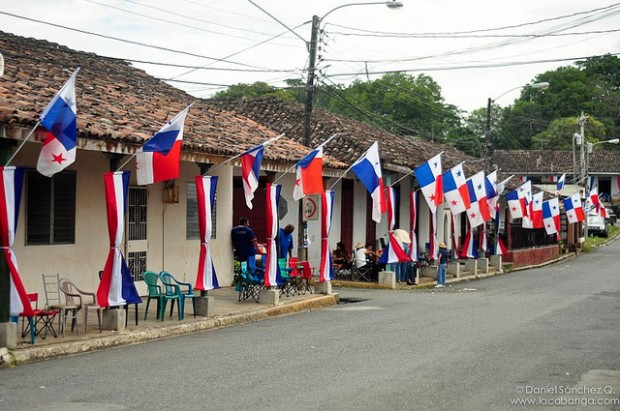
Las Tablas, Panama is a tiny town in Central America that’s being touted by some as one of Panama’s up-and-coming areas. While it may be true that there is some opportunity to find a Central American getaway at an affordable price, there are a lot of important factors for you to consider.
As with any decision, the choice to relocate to or buy a property in a particular area of Latin America depends 100% on you and the things you value most. It’s important to weigh out all the pros and cons and find the area that best lines up with your lifestyle.
But it’s hard to do that when you’re thousands of miles away, trying to research dozens of options on a 17″ monitor.
There’s no substitute for checking out a city or a property firsthand, but here are some important attributes about Panama Real Estate in Las Tablas, and some of their possible implications for you. Hopefully this information will help you make an educated decision about whether it could be a viable option for your retirement.
1. Location, Location, Location
If you’ve ever bought a house, talked to a real estate agent, or even watched more than 5 minutes of one of those house-hunting television shows, then you probably know the 3 most important factors in real estate: location, location, location.
Where is Las Tablas?
Las Tablas, Panama, lies near the eastern Pacific coast of Panama’s Azuero Peninsula. Note, we said the city is “near” the coast. Not on the coast. That’s important to understand because many marketers are promoting the area as being a beachfront area.
It’s not.
It’s actually nestled into a rural area and surrounded by farms and ranches. In fact, the city serves as the hub where locals from the surrounding agricultural areas go into town to do business. It’s also the capital city of the Los Santos province.
What’s it like?
Since Las Tablas is close to the Pacific Ocean, it has a hot, tropical climate. However, because it’s surrounded by farmland instead of rainforests, it’s somewhat less humid than many of its coastal neighbors.
What’s it near?
Although Las Tablas, isn’t directly on the coast, there are some decent beaches nearby. Uverito is about 10 minutes away, and Pedasi, with its relatively untouched expanses of beach, is a 45-minute drive.
It is also strategically located near a few cooler mountainous areas. For instance Cerro Canajagua, which offers some really nice views of the Pacific Ocean and the entire peninsula, is about 35 minutes away.
One thing Las Tablas is not near, is a major city. Panama City is almost 4 hours away by car, although nearby Chitre does offer a flight to the capital city. After a 15 minute drive, the flight to Panama City is about 35 minutes.
In summary
While Las Tablas, Panama, does offer some great attractions (i.e. mountains and beaches) relatively nearby, the town itself doesn’t have a whole lot to offer in terms of scenery. This can be good or bad, depending on what you’re looking for.
Because Las Tablas is missing that immediate proximity to a must-see geographic feature, property prices are relatively low. You can get a bargain if you’re willing to drive a ways to get to the beach or mountains or some decent shopping.
If you’re looking for a short walk to the beach or the convenience of driving into the city for the afternoon, you might want to keep looking.
2. Uncharted Territory
Most would-be expats understand the need to settle some important questions before they start their property search overseas (e.g. urban vs. rural, mountain vs. beach, etc.). Another important aspect to consider is the level of development of a particular area, which often translates into how saturated it is with other expats.
Who lives in Las Tablas, Panama?
Las Tablas, Panama, has roughly 25,000 residents. But few of them are expats. What this means is that the local businesses aren’t in the habit of bending over backwards for foreigners.
That doesn’t mean they aren’t friendly. Quite the contrary! The natives, called tablenos, are very courteous working-class people who take a lot of pride in their city. However, not a lot of them speak English, and you can expect all signs and menus to be in Spanish only.
How developed is it?
Las Tablas, Panama, is still off the radar of most foreigners. As a result, it isn’t overrun with new developments like many of the more popular destinations. For this reason, the city’s Spanish culture is all still completely intact. There’s a quaint town square, and all the buildings are Spanish-colonial style with red tile roofs and ornate ironwork.
The infrastructure is good, but not the best you’ll find. The town has a supermarket and a hardware store. There are Internet cafes and an adequate offering of banks, shops, and clinics. It’ll have what you need, but not all the same conveniences you might find in a place with a more established expat community.
And again, expect the doctors and other professionals to speak Spanish and be accustomed to dealing with Panamanians. You’ll also come up empty-handed when searching the supermarket for even the most common U.S. products.
What’s there to do?
Las Tablas, Panama, has restaurants and bars, and even a tiny casino (read: a few slot machines and a bar). But that’s about it. The real attraction in this Central American city is the authentic culture.
Most notable of all the native festivals the city celebrates is Carnival. Once a year the town comes alive with excitement as Calle Arriba (Uptown) and Calle Abajo (Downtown) compete to host the biggest and best celebration, complete with food, music, fireworks, games, and even a Carnival Queen.
In summary
Las Tablas, Panama, is the perfect destination for someone who wants to be close to tourist attractions, but not too close. Someone who wants a few modern conveniences, but not a McDonald’s on every corner.
If you’re fine with speaking predominantly Spanish and living like a local, then you should definitely look into relocating to Las Tablas, Panama. If you feel more comfortable living in a place where a lot of the people look and talk like you, then keep looking.
3. You Can’t Beat Panama
If there’s one really great thing that can be said about Las Tablas, it’s the fact that it’s located in Panama. From its pleasant climate to its stable, growing economy and favorable business and tax laws, this Central American nation consistently dominates every study done on the best places to retire.
The cost of living, the price of housing, the benefits to foreigners…it’s all good. Panama has a lot of really great destinations that offer a variety of different perks. This is just one of them.
What’s so great about Panama?
This Central American nation has made it very clear that they want expats to move there. Their list of visa and residency options is ever-expanding. Choices also include the Pensionado Visa, which offers discounts on everything from restaurants to airfare to medical procedures.
Speaking of health care, Panama’s is top notch. Many doctors, especially those in Panama City, are English-speaking and trained in the U.S. And health care costs are only a fraction of what you would pay in the States for the same services.
In fact, Panama is becoming a hub for medical tourism, as people are traveling from all over the world to have expensive, or even elective, procedures performed for far less money. This is made easy due to the fact that Panama is so easily accessible. Its location makes it convenient for travel throughout the Americas (although Las Tablas itself is a little further off the beaten path).
In addition to the quality of its health care, Panama boasts some excellent infrastructure. Its airports, roads, and utilities–while already good–are also in the process of receiving a $15 billion facelift over the next several years.
Panama also uses the U.S. dollar as its official form of currency, eliminating any exchange risk for foreigners. Its favorable tax laws enable expats to have the possibility of paying no taxes, in some situations.
Is this true throughout Panama?
So, Panama sounds great. But can you enjoy these same conditions throughout the country? In some cases, yes. In others, not so much. Obviously, things like visas and tax laws don’t vary from one city to the next. You’ll still get quality health care. But you might have longer waits and less options, especially if you’re at a public clinic. You’ll also have to travel to see most specialists.
Infrastructure is another place where you might see a difference in more remote areas. Roads and public transportation will be less prevalent and reliable. As will utilities and other conveniences.
What about the cost of living?
The cost of living in Panama is already good. The cost of living in Las Tablas, Panama, is really no better. You can enjoy a full lifestyle, including several nice dinners each week, for between $1400 and $1600 per month.
Rental rates, for a modest 3-bedroom/2-bath house (furnished), is between $300 and $500. For those wanting to buy a home, you can get the same size home for under $70,000. However, that will get you a typical Panamanian home with small, closed-off rooms. If you want a larger, more open-concept American-style home, expect to pay in excess of $100,000.
In summary
There’s a lot to love about Panama. And there’s a lot to love about Las Tablas, Panama. Just don’t assume they’re interchangeable. A lot of sources cite the benefits of living in Panama when they’re describing why you should move to Las Tablas. However, there are a lot of other options that have the same perks, but may offer more bang for your buck in terms of location, activities, infrastructure, etc.
The cost of living in Las Tablas is low. But it isn’t the lowest in Central America, or even in Panama. Property listings are cheap. But they’re not rock-bottom. If you’re going to sacrifice comfort and convenience, make sure you’re really getting a bargain.
Las Tablas, Panama, has a lot of things going for it, and it’s a great opportunity for the right would-be expat or investor. There are those who would love to call this quaint, undiscovered village home. If you think you might be one of them, explore your options to find the choice that’s best for you.


That First Taste of Free Air
You feel it the moment you step out of the airport, and are busy cruising down the highway to your destination. It’s not just in the traffic that crosses double yellow lines or ignores stop lights if the road is clear. It’s in the vehicles themselves; sometimes crowded to the maximum, with luggage tied to the top, sometimes appearing to be tied up just to keep the vehicle together.
Maybe you’ll notice a truck filled with workers or one that has a hammock swinging lazily in back, with the occupant blissfully taking in the sunlight. The buses lumber by, so packed, passengers cling to the door frames. If you brave one of these second-class, local buses, you might feel you’re in a barnyard. Chickens squawk from crates packed under the seat, and there might even be a goat or a lamb that somebody’s transporting to the market.
It’s a reminder of how America was before seat belt laws and strict traffic regulations, before traffic citations became profitable. If you have someplace to go, nobody cares about the means you use of getting there.
Slowing Down
Outside the city hubs, vehicles are relatively sparse. The most common mode of transportation is by bus. Pedestrians, farmers pushing along a few cows, wash women with piles of clothing on their heads are not an uncommon sight along rural roads.
This daily life, so unencumbered by appointments and punching a clock, begins to seep into you. You find yourself hurrying less and relaxing more, spending time doing those things you’ve always dreamed of doing, but never found the time or the opportunity. You begin to think about your new found freedom, that began with a freedom from worry.
The Economic Race
It seems odd that so many of the citizens who are immigrating from the United States into Central America are doing so out of a longing for freedom, but sadly enough, as a country founded on the liberties of all people, it has become a system of rules and regulations designed to give advantages and privileges to some, while penalizing and suppressing the many.
That hectic pace felt so distinctly in urbanized America is the desperate measure of a people determined to keep their heads above water. The American dream for many married couples, of a fine little home and a two-car garage, can’t possibly be realized unless both are working and they take out a twenty year loan. Those over sixty who had been planning to enjoy the benefits of their golden years, find their retirement or social security checks just aren’t enough, and take on part-time jobs for which they are over-qualified, but too financially distressed to refuse.
Then there are the young singles, working hard and studying for a degree that may not be very helpful for finding work. Jobs that had once taken an associate’s degree, now take a master’s, and debt-strapped students wallow in student loans.
When Life Becomes Stifling
The opportunities once offered in America don’t seem so plentiful anymore. Innovation, imaginative ideas, are either swallowed in a maelstrom of bureaucratic paperwork, or take a long time to mature, making the process uncomfortable for non-entrepreneurial types. For every proposal, no matter how universally beneficial, there is opposition. The red tape ticks away at finances, valuable time, and eventually, motivation.
America can barely breathe. You cannot even build a porch for your house, on your own property, without permits and inspectors. In some communities, there are agreed-upon house colors, and regulations concerning what you may have in your yard. You may discover you don’t even have a right to grow a garden instead of a water wasting lawn. The attempts to create a uniform standard of living within specified zones has swept away the concept that one’s home is one’s castle. The spirit of these rules makes sense, they are for the benefit of environment, home prices, and people’s safety, but in today’s world the rules are wielded like weapons against creativity and individuality.
You’re as Free as Your Neighbor
The migration into Central America is made up of people who have grown weary with asking for permission. The safety net hovering over American social affairs feels more like an entrapment net, encumbering freedom of travel with security checks and invasive techniques, such as airport scans and cell phone tracking.
Homes and small businesses are regulated with so many expensive codes and mandatory health care. The U.S. constituents are strapped with so many liability laws, they become nervous about allowing the neighbor kids to come over and play on a trampoline.
Coping with Drawbacks
The expats have had to make some adjustments. In an area where there is little to no regulation, cities can turn ugly fast, while everybody builds whatever they want and a smorgasbord of buildings go up. If your neighbor wants to begin his day at six in the morning, banging away at his new addition, and you want to sleep until seven, it’s best to just roll over with your pillow.
While the cities offer the modern conveniences, the farther away you are from them, the fewer commodities, such as super consistent electricity, paved roads, libraries, and U.S. foods you’ll find. You may find a lower quality in many of the common household tools, such as for gardening or carpentry.
There is a role reversal once you are an expat. You are suddenly a minority in a foreign country. You’ll feel subjected to the same type of scrutiny as given any minority. You may get pulled over just because you look like a gringo. If you are aspiring to become a global citizen, this actually aids in perspective. Outside the dynamics of the western world, you are a minority.
You Still Feel Freer than You Did in the United States
There is an enormous amount of satisfaction in living and breathing freely, without the rigid controls over an over-regulated government. It’s a learning experience in getting along with others of different cultural backgrounds and lifestyles. It allows you ample opportunities for evaluating your own beliefs. It teaches you resourcefulness with the tools and materials on hand.
For the health-oriented, it becomes advantageous to acquire a taste for the native foods. This isn’t too hard, considering the volume of fresh tropical fruits and delicious sea fare that abound in Central America’s market. Not only do you benefit from the organics, but buying local is cheaper than the shipped-in U.S. market.
The Growing Family of Expats
Families make up a vital force in the expat community. Sometimes, they come down for a year to absorb the cultural setting or as a reprieve from restrictive American life. Sometimes, they arrive with more permanent intentions in mind.
The challenge for these families, if they remain within a residential area removed from the major cities, is finding good schools. But like pioneers, they draw upon their own resourcefulness, enjoying the opportunity to educate their children in the manner they feel is best, maybe even starting their own school.
As We Look Forward
It is, in every sense, a type of pioneering. The expats that settle in Central America don’t hate their country. They hate the limits placed on their abilities to make conscious choices. They no longer wish to be treated like a kid, they trust their own ability to decide what is best.
They know this freedom comes with a price. They are moving into a different culture with different customs. They must depend on their own abilities to cope with change, to problem solve, to develop good relationships with others, but it’s all part of the excitement, the adventure. These are the stimuli for growth and development, the fundamentals of increased awareness, and the reward is an evolving society, ready to explore the new boundaries of individual rights and harmonious communities.
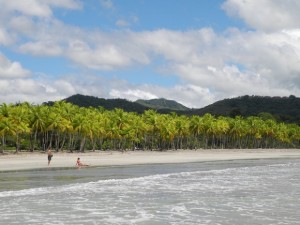
With hundreds of miles of pristine beach, Costa Rica is home to some of the most incredible beaches in the world. Here is our list of the best beaches in Costa Rica, which are not only some of the most beautiful, but also those with adventurous activities, wildlife, and often complete solitude.
Playa Cocles

Sean
The jungle beach town of Playa Cocles in the South Caribbean is easily one of the best places to live or visit in all of Costa Rica. The stunning jungle-backed beaches stretch for miles with barreling waves for surfers, incredible wildlife for nature lovers, and deserted patches for those seeking relaxation.
The neighborhood hosts a world class yoga studio, several spas, a Costa Rican chocolate café, and an incredible variety of international restaurants. The Caribbean flavor from nearby Puerto Viejo, a short two miles away, trickles in and it’s not uncommon to hear Reggae or eat coconut curry stew on the road.
Cocles will definitely rank as one of the best beaches in Costa Rica for those desiring true jungle immersion with a strong expat community focused on healthy living and those brave enough to surf the epic waves.
Manuel Antonio

Xiao Zhuli
Manuel Antonio may be the most popular beach in all of Costa Rica. It certainly has a reputation for being an American tourist destination, and the many expensive Americanized restaurants reflect that.
However the beautiful beaches in the national park are some of the most stunning in the country and teeming with wildlife. Spotting iguanas, coati, sloths, and all four species of monkeys is likely inside the park and often on the beach. During migration season you can see whales and dolphins offshore. Other outdoor adventures like parasailing, ziplining, and horseback riding are also available.
If you can’t stand the crowds, come during the very beginning or end of the dry season to enjoy sunny days and beautiful sunsets on relatively empty beaches.
Playa Samara

Daniel Stanberg
Playa Samara is one of the most beloved beaches in all of Costa Rica. Laid-back hotels and restaurants line the horseshoe bay, yet the shore remains empty, offering solitude and relaxation. The relatively flat sea is perfect for kayaking, fishing, paddleboarding, or learning to surf. Nearby wilderness beaches are perfect for exploration.
The town has an expat presence with sushi bars, Italian restaurants, and Canadian-owned hostels, but maintains its small town authenticity. Fishermen are everywhere selling their fresh catch on the shore. Delicious sodas (Costa Rican cafes) pile plates high with rice and beans and seared seasoned carne.
It is a great place for families, expats looking to invest in a business, vacationers, and backpackers.
Playa Guiones

Chris Gold
If you enjoy surfing and yoga, expect to arrive in Playa Guiones and never leave. The town, which is in the Nosara region of the Nicoya Peninsula, sits on a white sand horseshoe bay with excellent waves for beginner, intermediate, and advanced surfers. The many surf schools and board rentals make learning and practicing very accessible.
The Nosara Yoga Institute in Playa Guiones put Costa Rica on the yogi map and now several studios and yoga retreat centers reside in Playa Guiones and nearby beaches.
Beyond yoga and surf, there is plenty to do in Playa Guiones. The town has lovely cafes and restaurants and the expansive beach makes for great walks. Every evening at sunset the town gathers on the shore to watch the epic sunsets.
Nearby Playa Rosada and Punta Pelada are also beautiful and can be walked to from Playa Guiones.
Manzanillo

Diana
The intimate beach coves hidden in the wildlife refuge of Manzanillo are some of the most beautiful beaches in Costa Rica, if not the world. Turquoise water crashes on the golden sand, dramatic cliffs offer stunning views, and the lush jungle filled with animals spans for miles. Take a nature hike, snorkel the reef, or simply relax.
For added adventure, take a tour through the jungle spotting howler monkeys and sloths, hike to the viewpoint for amazing views of the crashing waves and nearby beach coves, then climb into the coral caves where bats seek refuge.
The town is a small distinctly Caribbean fishing village with a few local Caribbean restaurants and cabinas. Popular Puerto Viejo Limon and the many beach towns near it offer options for other restaurants and lodging and are a bike or short bus ride away.
Pavones

Arturo Sotillo
The black sand beaches in Pavones are some of the most dramatic on the Pacific Coast. Glowing frothy green sea kisses the dark shimmering black shore for an incredible contrast. The surrounding wilderness will make you feel like you’ve reached the end of the earth and the sunsets are positively spectacular.
Beyond its beauty, Pavones is famous for its long left point break. Grab a surfboard and ride the wave that put this town on the map. If you’re more of a swimmer, a cool, clear water river runs for miles from the hills down to the beach. Climb to the top and take inner tubes down, jump off the bridge with locals, or simply cool off and explore.
Restaurants and accommodations are inexpensive and locally owned and even with the influx of surfers the town maintains its Costa Rican charm.
Playa Barrigona

Massie
This beach is so beautiful, even Mel Gibson owns property here. Scenic country roads connect Playa Barrigona with nearby Samara making it an undiscovered but accessible place to visit. The sand is white with a pink hue and at low tide you can climb large stretches of sand dollar-covered rocks. Olive ridley turtles come from all over to lay their eggs on the shore during the rainy season, making it a very special place ecologically as well. The riptides are strong so take care with little ones and do not go out swimming.
San Juanillo

Enrique Balsevicius
A short drive from the popular surf beach Playa Guiones in Nosara, is the secret white sand beach of San Juanillo. Fishing boats rock on the turquoise sea and millions of shells wash up on the shore. Explore the massive rocks or float in the clear water. The town itself is quite small and authentically Costa Rican.
Playa Uvita’s “Whale Tale”

CostaRicaProperty
The area of Uvita is famous for its incredible marine life and frequent whale spottings, but few know about the secret “whale tale” beach. During high tide the shore is completely submerged, but as the tide recedes a beautiful sandy peninsula reveals itself for relaxation and exploration.
Playa Carrillo

M.Prinke
The peaceful palm tree-lined horseshoe bay of Playa Carillo on the Nicoya Peninsula might be as close to paradise as it gets. The white sand beaches and calm water makes it a perfect beach for relaxation and sunbathing. Boating and fishing are also quite popular due to the calm sea. It is also possible to spot crocodiles in the nearby river. The town has restaurants and accommodations, but travelers will find a larger community in the nearby town of Samara, which is a pleasant hike or a short bus ride away.
Best Beaches in Costa Rica?
The answer really depends on you. Do you have a favorite beach that we’ve missed?
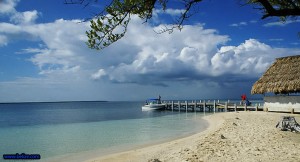
Belize is know for its amazing barrier reef, its culture and spectacular flora and fauna; with so much to do it’s no wonder visitors can get overwhelmed, especially when planning a trip to Belize on a limited budget.
Good News! There are plenty of things to do in Belize that are free or affordable. What follows is by no means an exhaustive list, but these are our suggestions of what you can see and do on a small budget.

Photo: A. Grandel
1. Placencia Peninsula
Stretching across a 12-mile-long peninsula, Placencia boasts a myriad of nature reserves and underwater oases along with postcard-perfect vistas. Rent a bike, about $12 for the day, and cruise the peninsula like a native Belizean or spend a bit more money and go on a kayaking manatee spotting tour.
2. Lamanai
Lamanai is a 960-acre Mayan site perched on the New River Lagoon in northern Belize and boasts the most masked Mayan crocodile art in Belize. Located in the Orange Walk District, the Lamanai temple complex sits atop the western bluff of the New River Lagoon and is surrounded by unbeatable rain forest vistas. Entrance fee: $10.
3. Hol Chan Marine Reserve
Hol Chan Marine Reserve is the oldest reserve in Belize. Encompassing three square miles, this densely populated aquatic zone is a sanctuary for stingrays, eels, and sharks, among other creatures. Separated into four parts, the mangroves, the reef, the sea-grass beds, and Shark Ray Alley, the reserve has flourished as a hot spot for scuba divers and snorkelers. Entrance fee: $5.
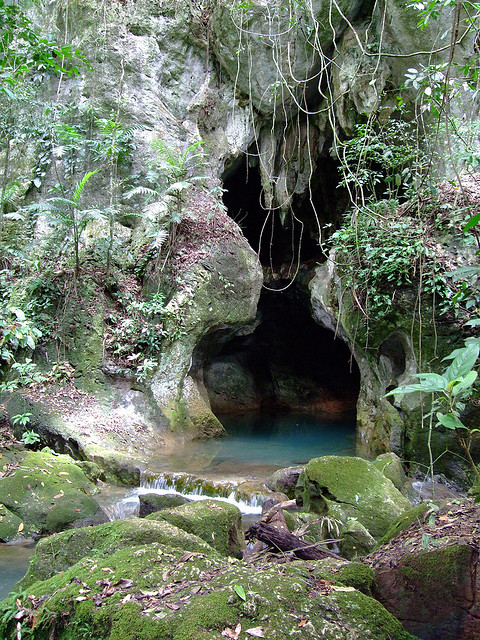
Photo: Viva Team
4. Toledo District
Go explore the southern district of Belize with a visit to Toledo, a dense rain forest region, and Belize’s up-and-coming eco-hotspot. Known by the locals as “the forgotten land” it is the least visited destination in Belize. What to do here: swim inside caves, discover sinkholes and waterfalls, or go a bit more deeper into the jungle and rediscover untouched Mayan ruins. Swimming the Blue Creek Cave, Toledo’s most popular destination, will set you back about $100 on a professional tour.
5. Belize Zoo
Stroll around this 29-acre zoo and you might think you’ve trespassed into a jungle. The zoo is small, but well worth a visit. You can see the different Belize cats such as Jaguar, but one word to the wise: Arrive early to beat the midday crowds. $15 per adult and $5 per child.
6. Belize City
The country’s business epicenter, splits into two distinct areas: the North and the South. Fort George lies to the north, an upscale neighborhood with the city’s landmark, a lighthouse overlooking the harbor. Most of the action in Belize is oriented around the city’s peninsula, which extends outward to the Caribbean Sea and peers over the northern cays. You’ll likely want to spend minimal time in the inner city and instead use the area as a base for exploring nearby rural rainforests, cays, and Mayan ruins. Fort George Lighthouse excursion: Free.
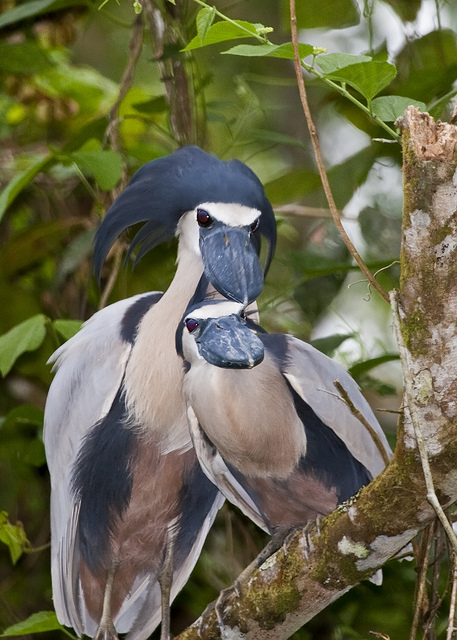
Photo: Becky Gregory
7. Cockscomb Basin Wildlife Sanctuary
The sanctuary contains 12 nature trails that span across 20 miles. It was a former cat sanctuary. Lather yourself with insect repellent. The moist environment serves as a haven for annoying mosquitoes and tiny flies. Entrance fee: $5.
8. Caracol
The largest Mayan ruins, Caracol has recently received attention as the site of discoveries that have contributed to new understanding of the Maya. Located deep in the Chiquibul Forest and only seven miles from the Guatemalan border, it is much larger than nearby Tikal but is not as extensively restored. Entrance fee: $7.50 per person.
9. Tropical Wings Nature Center
The Tropical Wings Nature Center is Belize’s only Butterfly zoo where you will find interactive exhibits covering the ecology, flora, and fauna of Belize. Take a walk along a nature trail, grab a bite to eat, or spend the night at this eco-friendly resort. Entrance fee: $10.
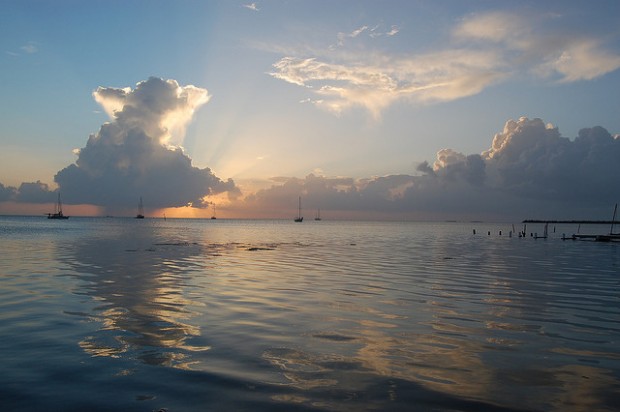
Photo: Josie A.
10. Sunset at Caye Caulker
The sunsets are amazing here in Belize, but they are spectacular at Caye Caulker. After a long and lazy day, the best thing to do is grab a cocktail and sit on the pier and watch the sunset. Cost: Free.