


Martha de Jong
If you’ve done much reading about the state of the Panama economy, you probably already know that it’s “stable” and “growing” and “pro-business” and maybe even “foreigner-friendly.”
But what’s the basis for these types of claims? What is it that really drives Panama’s economy, and how is it performing during some globally tough economic times?
Panama Economy Overview
Panama has a dollar-based economy that is heavily dependent on the services sector. Namely logistics, banking, tourism, and of course the Panama Canal. In fact, services account for over ¾ of the nation’s Gross Domestic Product (GDP).
With an estimated GDP of $30.68 Billion as of the end of 2012, Panama’s economy is the third largest in Central America and the fastest growing, racking up a whopping 10.7% increase last year (its second consecutive double-digit growth rate). GDP per capita is around $9,444 and has more than doubled over the past decade.
The general composition of Panama’s GDP is 79.1% services, 16.6% industry, and 4.3% agriculture. Transport and communications make up the biggest chunk of the service arena, followed by property and services, commerce, and financial services. Here’s a breakdown of all areas and the percentage of GDP they represent:
Private Education .7%
Social Services/Private Healthcare .8%
Fishing 1.1%
Mining/Quarrying 1.4%
Utilities 2.8%
Farming, cattle ranching, hunting, and forestry 3.2%
Real estate, corporate, and rental activities 5.2%
Manufacturing 5.6%
Construction 5.8%
Financial intermediation 8.2%
Banking 8.6%
Wholesale and retail 14.6%
Transport, storing, and telecommunications 26.4%
The Panama Canal
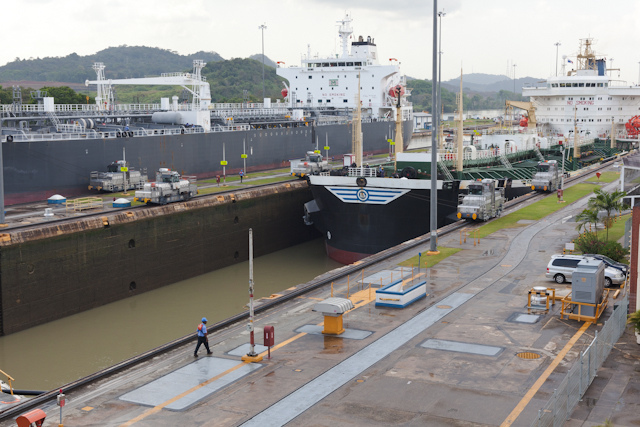
It’s interesting to note that the Panama Canal itself accounts for only 4% of the nation’s GDP. However, due to the multiplier effect, its impact is much farther-reaching. Take into consideration, for example, expenditures by canal employees. Their income in turn fuels businesses such as grocery stores, restaurants, schools, and other businesses. As a result it’s estimated that the existence of the canal generates approximately 30% of the country’s GDP.
The Canal is currently undergoing a $5.5 billion expansion that will more than double its capacity. Begun in 2009, this expansion has already contributed greatly to the nation’s economic growth. Transport, storage, and communications increased by 15.3% in 2010. Port operations during that same time frame also rose by 25.2% due to the increased movement of 20-foot containers.
With the completion of the expansion scheduled for 2014, additional growth is anticipated. Some estimate that 40% of the $5.5 investment will be recouped in the next 5 years.
Tom Geibel
Imports/Exports
Approximately 65.2% of Panama’s GDP is exported, in the form of both goods and services. The $12.52 billion that is exported annually is made up of bananas, shrimp, sugar, coffee, and clothing which ship mainly to the U.S. (13.1%). Other recipients of these goods include South Korea (12.5%), Honduras (10.2%), Japan (9.3%), India (7%), Canada (4.4%), and Mexico (4.2%).
Panama imports roughly $15.18 billion each year, which includes fuel products, medicines, vehicles, iron and steel rods, and cellular phones. These come from Japan (23.5%), China (23%), Singapore (18.1%), the U.S. (13%), and South Korea (6%). Because it imports more than it exports, Panama has a negative trade balance, or trade deficit, of -12.7%.
Debt
Panama’s ratio of public debt as a percentage of GDP is a relatively low 39.2%. This number is down drastically from 66.2% in 2005, due to fiscal consolidations by the current administration. Panama’s Standard & Poor’s bond rating is BBB. It also received a Moody’s credit rating of Baa2 with an outlook of Stable. This positions Panama among the highest ranking emerging markets, alongside Mexico, Brazil, and Peru.
Inflation
Panama’s inflation rate, which has been as high as 6.82% several months ago, was down to 4.1% as of March 2013. This rate fluctuates greatly in Panama’s dollarized economy, since the country lacks the ability to implement policy or adjust exchange rates to counteract rising consumer prices. Panama’s inflation rate has generally averaged around 5.24% for the past 5 years.
Unemployment
Panama’s unemployment situation is a unique one. Although generally low (it’s hovered around 4.2% for the past 3 years), it’s also unbalanced. While Panama experiences a surplus of unskilled labor, it also has a shortage of skilled labor.
Efforts are currently underway to address this problem. Millions are being invested into education to build a strong, skilled labor pool. In the interim, the country is welcoming business professionals from other “friendly” countries to come to work or start a business in Panama. This is quite a shift, since Panama has historically taken great care to prevent foreigners from taking jobs away from Panamanians.
Business Climate
Panama continues to rank higher and higher on surveys citing the best places to do business. It recently appeared at #57 on Forbes’ list of Best Countries for Business. Panama also ranked 40th (out of 144 countries) for Global Competitiveness per the World Economic Forum.
World Bank and the International Finance Corporation ranked it #72 (out of 183 countries) on a list of Best Countries for Doing Business. The same survey scored it as #11 for Trading across the Border, #23 for Starting a Business, and #32 for Getting Credit. However, it fell to #113 in the same survey for Registering Property and #119 for Enforcing Contracts.
Panama was also given a rank of #71 by the Wall Street Journal and the Heritage Foundation on its Index of Economic Freedom. It scored a 62.5 on the index, where 100 = totally free and 0 = totally repressed. This survey measured freedom in a variety of areas. Panama’s lowest scores were the result of governmental corruption and political interference in the judicial system.
Economic Challenges
Like any developing nation, Panama has and will continue to face a myriad of economic challenges. Many are merely the flip side of the same coin that has led to its economic growth. For instance, Panama’s economy is extremely open. As a result, it is highly susceptible to external factors. Fluctuations such as a decreased demand for exports to the U.S. or a smaller flow of capital into Panamanian banks could have huge implications for the nation’s economy.
Panama is also plagued by high poverty and inequality of income distribution (the second worst in Central America), so it has a tremendous need for sustained growth that is socially inclusive. As previously mentioned, the country has begun to address the issue and is currently investing heavily in its educational and vocational programs.
This brings us to the issue of government spending. As it grows, Panama will continue to struggle with the need to strike a balance between investing in more and better improvements while also maintaining good fiscal management and eliminating corruption from the projects it undertakes. While these enhancements are warranted if Panama expects to keep up with other major players in the areas of tourism and banking, the nation will have to be prepared to take measures to sustain its economy, such as raising taxes.
Outlook
In terms of its economic outlook, Panama has a lot of good things going. Its recent $15 billion investment into infrastructure has and will continue to fuel many investment opportunities. Airport expansions will bring more visitors to the country. Better roads and methods of transportation will ease companies’ ability to do business within the country. Additional utilities, such as water, power, and phone service, will add value to real estate.
Panama recently signed Free Trade Agreements with the U.S., Canada, and the European Union. Proposed mining projects will also give the economy a boost. Not to mention the Canal, which will more than double its capacity with the current improvements.
If Panama continues to post 10%+ growth, it could soon be poised to earn its slot as the largest economy in Central America. If you’re considering investing or starting a business in Central America, find out more about Panama and the options it offers.
More Numbers
Just in case there’s some other piece of information you’d like to know, that we haven’t already covered, here are a few more statistics on Panama’s economic profile (as of 2012):
Gross Domestic Product (Purchasing Power Parity) $55.8 billion
GDP per capita (PPP) $15,300
Population 3,571,185
Population below poverty line 29%
Investment 30.1% of GDP
Taxes and other revenues 26.5% of GDP
Budget Deficit or Surplus -2.9% of GDP
Commercial bank prime lending rate 6.6%
Market value of publicly traded shares $10.68 billion
Industrial production growth rate 10.9%
Current account balance -$4.191 billion
Reserves of foreign exchange and gold $3.314 billion
External debt $13.13 billion

Honduras 3 Count, where we bring you 3 Honduras stories that you shouldn’t miss.
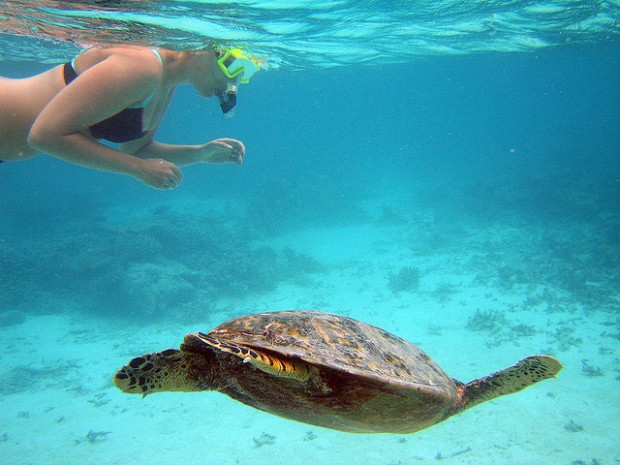
Photo: Christian Steen
1. Wow! 130 Spots to Snorkel in Roatan
Roatan is surrounded by a barrier reef that lies approximately 300 feet from the shoreline and that brings you a wealth of snorkeling spots, more than 130. These amazing spots, along with a maze of underwater sunken treasures, make the island a diver’s or snorkeler’s paradise.
2. What Kite Surfers Can Teach Us About Honduran Culture
A small island named Guanaja in Honduras features near perfect waves and breezes…ideal for kite surfing. This little island, and its inhabitants, are completely disconnected from the rest of Honduras, and in some ways, the rest of the world. Here, tourism is still in its infancy, which made it the perfect place for a group of kite surfers to gear up, tackle the waves, and discover Honduran culture along the way.
3. Finding the Hidden Mountain: Cerro Las Minas
Cerro Las Minas is the highest mountain in Honduras and relatively unknown. Two hikers from Distan Peak take on the challenge of finding Cerro Las Minas and reaching its peak. They went in expecting a jungle experience, but found it was more like a long walk in the park.
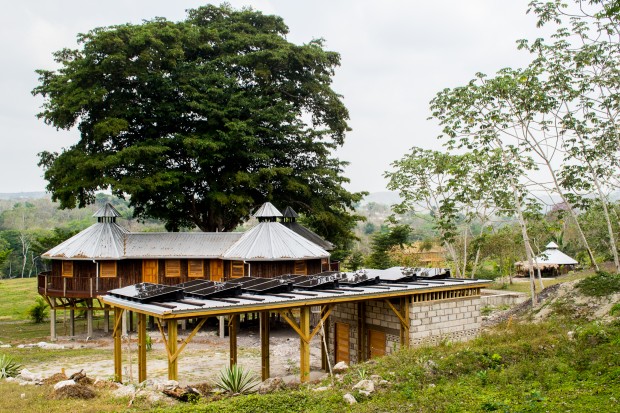
Gaia’s Way Estate is a unique residential development in Belize focusing on completely eco-friendly homes. Each is setup for Living off the Grid, with low environmental impact, using rain water catchments and solar panels to provide each with its own power and water.
Viva Tropical took a deeper look at Gaia’s Way Estates sustainability success through an email interview. Here are their thoughts on going off grid and why:
Gaia’s Way Estate www.facebook.com/JCariddiPhotography
Why was off grid power chosen?
Off Grid Power was chosen because it is Environmentally Friendly, Low Impact, and It is essentially the wave of the Future. Self Sustainability is the Vision of Gaia’s Way. The properties are set out as 3/4 to 1 Acre of highly fertile soil as to provide for sufficient living space, and room to have your own orchard, small garden, and a few livestock.
Were there any environmental factors like winds, shade, water, etc. that make this site unique in terms of using off grid power?
The area Gaia’s Way was established has natural terracing allowing for easier planning for home construction, and all homes are designed to collect solar power on their roofs. The idea is for all the solar generators to eventually feed into the grid, and essentially sell excess power. The main power grid is located only 300 ft. away from the Property.
Grid Power being only 300ft Away from the Property, it will be easy to Connect to the Grid to Excess Power, and in Turn earn Credits with the Power Company.
Sometimes money can be saved by using local techniques to build, were any of these techniques used in the project?
All the houses have been designed off of Ancient Mayan housing designs. Local palmetto (A Local Savannah Palm) is used for siding, making for really cool and bug resistant homes. We also use Caliche (Natural White Lime Plaster) which was also used by the Mayans for their homes, and temples.
It has a High Silica content that makes it water resistant. Caliche, being white reflects sunlight, and in turn keeps the homes cool, without the need for Insulation.
These homes are Built Green/Eco Friendly, by using recyclable materials, farmed lumber, and only using hardwoods for finishing, uniquely designed metal roofs to be able to collect rain water for home use.
The builder designer used her knowledge of Mayan construction and 40 years of experience, to design Mayan styled homes. All house designs are original to Gaia’s Way Estate.
Gaia’s Way Estate www.facebook.com/JCariddiPhotography
How did you source your solar power and what brands and products were used?
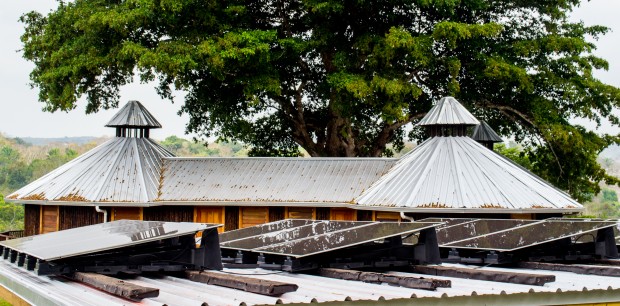
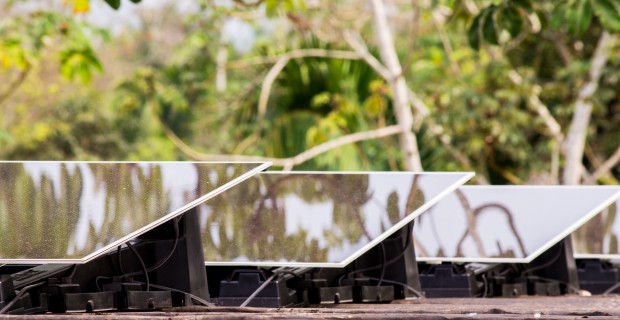
We searched for the best company to provide us with the most Efficient, High Yield, Solar Panels along with an Inverter System to Convert the Power to a More Efficient AC 110V Backbone, with a Variety of Packages that deliver different outputs to provide the freedom to Maintain Luxury with Self Sustainability.
We use a Variety of Brands, but Exclusively at Gaia’s Way Estate, we would Recommend one of our Newer German CIGS Thin Film Panels, that are Highly Efficient, being able to capture more sunlight during cloudy weather than most conventional panels today.
Who is off grid living for?
Off grid living is for anyone who wants to be Self Sustainable, Environmentally Friendly, and easily live off of a fixed income.
Gaia’s Way Estate www.facebook.com/JCariddiPhotography
How much power is there per dwelling? What kind of appliances are powered in this community?
Each solar system is set up for an individual needs and wants.
We recommend the use of Gas Water Heater, Gas Refrigeration, and Gas Stove/Ovens. The Natural Gas is produced here Locally in Excess.
Do you need a back up generator?
Small backup generators are recommended for Servicing of Batteries.
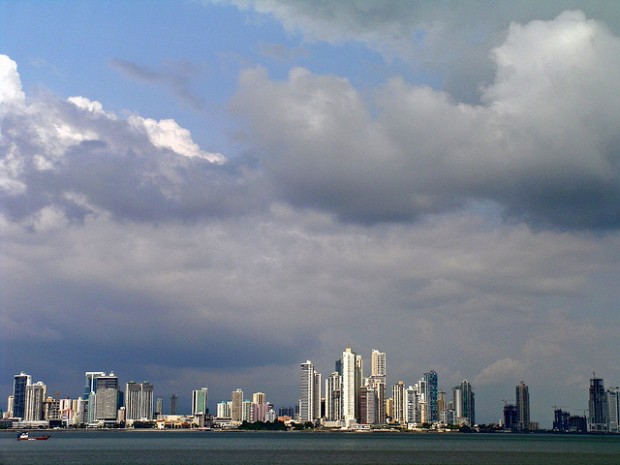
Panama City, Panama
At the heart of Central America, which ties together North and South America and the Pacific and Atlantic Oceans is a small, quirky country being hailed as the next “Singapore of Central America” – Panama.
Panama is the fastest growing economy in 2013 for Latin America
This that has many experts comparing it to Singapore, another rag-to-riches success story.
But Panama isn’t booming just because of lucky geography, it’s booming because of smart free-market, investment-friendly policies which have sharpened its advantages:
- Panama’s currency is the U.S. dollar. This makes investing in the country easy.
- Banking and communication services are world class.
- Panama launched a five-year, $13.6 billion investment plan, focusing on schools, hospitals, sewerage, roads, and metro transit system.
- Panama’s import tariffs are among the lowest in Latin America. Also, the country has received foreign direct investment worth nearly 9% of GDP.
- Panama is a well-regarded tax haven and its banks offer a high degree of privacy.
- There is no tax on interest earned from bank accounts for locals or foreigners. There are no corporate or personal taxes on offshore activity. Residents pay no local taxes on their foreign-earned income.
- The result: an economy that’s grown at an 8% or more clip over the past five years.
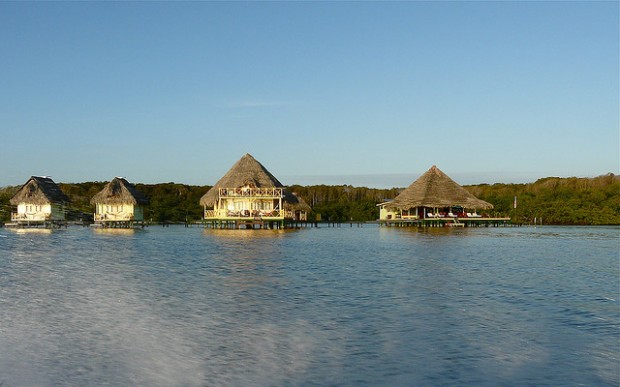
Bocas del Toro, Panama
Booming Expat Paradise
Panama earned the number 2 spot on Forbes’ The 10 Best Countries to Retire to in 2013 who say:
“Panama is just plain easy, Panama City is a vibrant, cosmopolitan city with great restaurants, and excellent hospitals. It’s a banking and commercial hub so you find a real international community there. Panama is committed to attracting foreign retirees and offers the world’s best incentive program to do so, making it convenient and easy to get residence there.”
Things will cost you significantly less in Panama than what you’d expect back home. “A budget of $1,700 to $2,500 a month, housing included, would see you eating out, perhaps with a housekeeper a couple days a week, movies a few times a month, and so on.”
Panama Canal and Ports
A construction boom is also changing the landscape of Panama City. Office towers go up as fast as men can build them, including the Trump Ocean Club and Latin America’s first Waldorf Astoria hotel. But let’s not forget the work being done to double the capacity of the Panama Canal.
The Canal’s annual revenues have grown to over $2 billion (7.5% of GDP). Traffic and revenue were up about 25% in 2011. This produced a ripple of growth in many related businesses, such as insurance, ship maintenance and repair, trade finance, and banking. The canal and Panama’s business-friendly regulations have expanded big insurance, finance, and legal offshore industries.
Last year, the free-trade zone in Colón – on the Atlantic end of the canal – and Balboa, Panama’s Pacific-side trade gateway, became Latin America’s two busiest ports. These two ports are set to explode soon after the canal’s $5.25 billion expansion project is completed in 2014. This is one reason Colón’s become the regional base of firms like Procter & Gamble (NYSE: PG)… Two-thirds of the traffic through the canal is coming from or going to America.
Get ready for more growth. Panama is booming.
Nicaragua 3 Count, where we bring you 3 Nicaragua stories that you shouldn’t miss.

Photo Credit: Mareana
1. Pressed for Time? 6 Quick Ways to Enjoy Nicaragua
Nicaragua is fast becoming one of the “go-to” destinations for eco-tourism today. And one visit reveals a multitude of surprises for new-to-the-country visitors. But if you don’t have a lot of time to travel, here are six, quick ways to enjoy Nicaragua:
- Tackle two kinds of surfing.
- Hug a Güegüense statue.
- Get lost in a low-stress local market and come away with a keepsake.
- Throw a pot during an escorted Morgan’s Rock excursion.
- Walk on the wild side – visit a national park.
- Chow down on fresh, local food at bargain prices.
2. New Study Reveals Nicaragua Is a Great Place to Invest
A report from Financial Times shows Managua, Nicaragua is leading the way in Latin America with one of the best laid out strategies for foreign direct investment. Financial Times FDI Intelligence division ranks Managua third in the hemisphere behind Montreal and Toronto in the category of strategy for attracting Foreign Direct Investment. Managua was the only city in Central America to rank in the top ten in the investment strategy category, according to the American Cities of the Future 2013/14 report.
3. The One Thing Nicaragua Did Right for Tourism
Nicaragua has reduced its minimum amount of investment required to receive tax exemptions to $25,000 as a means to opens up big opportunities for those interested in investing in the nation’s ever-expanding tourism sector. The new tourism investment minimums to enjoy tax incentives are raising a cloud of excitement among small tourism entrepreneurs who hope to collect the medium and long term benefits of this new condition, with improvements mainly in the infrastructure business.
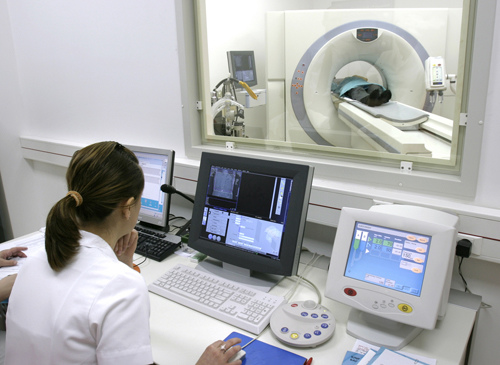
Healthcare is just one of the many aspects that a would-be expat might, and should, take into account when researching the retirement destinations they’re considering. Those hoping to relocate to Panama can go ahead and breathe a cautious sigh of relief.
While the country’s healthcare system is certainly not without its flaws, many expats have actually cited it as one of the best things about living in Panama. However, like almost anything else in Central America, it can vary greatly depending on where you go.
As a general rule, the best facilities and physicians are located in Panama City. However, some other areas are starting to catch up. For instance, Hospital Chiriqui, which treats many expats from the mountain haven of Boquete, provides an even better level of service than many in the city.
It is a smaller facility and may not be equipped to treat certain specialized cases, but is quite capable for most procedures.
Private Hospitals’ Healthcare
Panama boasts several state-of-the art private hospitals, many of which are associated with renowned facilities in the U.S. Punta Pacifica, located in Panama City, is considered the most technologically-advanced hospital in Latin America and is affiliated with the Johns Hopkins Hospital in Baltimore, Maryland.
The hospital is equipped with features such as videoconferencing capabilities to allow for information sharing and education.

Punta Pacifica Panama – photo by Maleg
Panama City is home to three other major hospitals, and there are two modern facilities in David as well. Still others are scattered throughout the country. Because the nation is small, it’s difficult to find yourself more than one to two hours from a modern hospital. The more heavily populated areas are also home to other health care providers such as dentists and eye doctors.
Public Hospitals’ Healthcare
Panama also has a number of public hospitals, which are funded by the Ministry of Health and the Social Security System. (Read: They’re nearly free.) However, those who can afford private health care often choose to go that route for various reasons.
The reason many expats do not opt to obtain services from public hospitals is because they can be a bit of a toss up. At best you may have to wait a few extra weeks for an appointment and may not get the same specialized attention you receive at a private facility. At worst you may wait hours to be admitted to an ER, only to deal with staff members who are tired, overworked, or rude.
But don’t let the few negatives turn you away from this viable option. For every understaffed facility with outdated equipment, there is another public hospital with modern technology and physicians who will take as much time with you as you need. Our recommendation is that, if you plan to take advantage of Panama’s public hospitals, check them out in advance. Make sure you understand what you’re getting into before you find yourself in a situation where you need urgent care.
Medical Professionals
One of the highlights of the Panamanian healthcare system is the quality of its medical professionals. The doctors are well trained, often in the U.S., and most are bilingual. The quality of medical care you’ll receive rivals that of many hospitals in the U.S., Canada, and Europe. This isn’t due to any regulatory standards being imposed by the government. But it doesn’t seem to matter.
While nurses do not receive the same level of training as those in the U.S., expats describe both them and the physicians as having an attitude of compassion that is not often seen in their first-world counterparts. In fact, the personal attention they receive from their doctors often comes as a shock to those unaccustomed to such dedicated care.
As opposed to U.S. physician visits where you’re usually worked over by a nurse and then visited briefly by a doctor who whisks in for two minutes before rushing off to see another patient, it’s not uncommon for a Panamanian doctor to spend 30 minutes to an hour with you in his office.
In addition to this one-on-one attention, you may be given your doctor’s home or even cellular phone number, as well as his or her home email address. While this easy access shouldn’t be abused, it’s not at all uncommon for a physician to allow patients to contact him or her after hours for pressing issues.
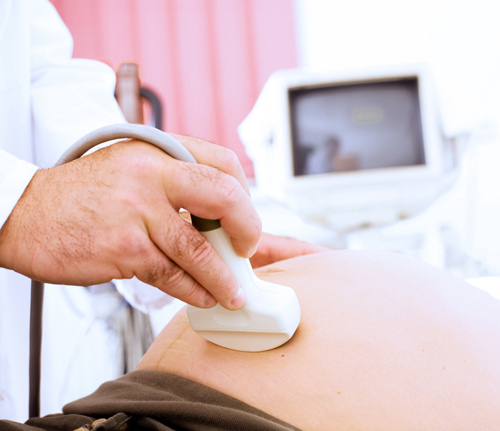
photo by Panama Health
Availability of Treatment
Something that’s important for expats to understand about Panama’s healthcare system is the disparity between the well-trained, well-meaning physicians and their ability to meet wide-ranging needs with the limited resources available to them.
Collectively, Panama’s hospitals have all the know-how and equipment they need. Individually, they may be unable to treat some of the more unique situations that might arise.
So the good news is that, whatever your condition, there’s probably a hospital that specializes in it. The bad news is that you will need to be more proactive in choosing your physician than you may be used to.
Inconsistencies in Care
Another common frustration among expats is the inconsistency among Panama’s healthcare providers. We’ve mentioned the differences between public and private health care, but even among privately-owned facilities the care can often vary greatly.
A good recommendation is to consider this fact when planning your move to Panama. If you need a good pediatrician, make sure you like the ones located near the area where you plan to relocate. If you have a heart condition, you may want to consider meeting with the nearest cardiologist before you sign on the dotted line of a bill of sale on a remote property.
A good idea is to ask around for recommendations on physicians. Again, because Panamanian doctors aren’t subject to a lot of the same scrutiny as those in the U.S., it can’t hurt to do your research. Don’t take for granted that they can be trusted simply because they’re physicians.
In addition, while many physicians may spend the better part of an hour with you alone in their office discussing your health concerns, there are also a few (especially those in public hospitals) that seem to hardly slow down to give you the time of day. If you’re concerned with being left in the dark regarding your health conditions, it’s best to consider your options ahead of time.
The language barrier is often another area of concern for many expats. While many doctors speak English, not all do. A visit to the hospital administrator’s office can quickly answer the question of whether the hospital offers a translator and whether those services are included in the hospital fees.
Health Insurance
Although many would-be expats are probably beyond tired of hearing health insurance debated in their home country, it’s nevertheless something they’ll need to consider when shopping for their Central American retirement home.
The good news is that there are many affordable options available. Even some U.S. health insurance plans are accepted in Panama.
Locally, there are HMO plans, which offer total reimbursement of services from in-network providers, as well as international plans, which allow patients to obtain treatment anywhere including places outside of Panama.
Many private hospitals also offer membership plans, which give participants hefty discounts on procedures performed at that facility only.
Cost of Healthcare
When comparing the different aspects of health care in Panama, low costs are another big plus for the “Pro” column.
Prices are drastically less than those of first-world countries, with procedures costing as little as one half to one fourth of the cost of what they would run in the U.S. While this may seem absurdly low, the ratio of health care costs to wages is quite proportionate, since many Panamanians earn around $400 per month.
One major reason for the low cost is that the overall health care system is far less litigious than in many other countries. With fewer frivolous lawsuits to threaten their livelihood, doctors pay less for malpractice insurance. The savings are passed on to the patient.
For instance, a visit to a specialist costs about $50. A trip to the ER runs around $100, which is less than a U.S. co-payment for the same visit. Procedures such as MRI’s are a mere $500, and a facelift can be performed for only about $1,700. Prescription drugs also cost less, and many medications that must be dispensed by a pharmacist in the U.S. are available over-the-counter in Panama.
photo by Panama Health
As a result of the low costs, insurance is also much cheaper for a good amount of coverage. As previously mentioned, public hospitals offer free routine care, but those who can afford private facilities will likely choose to pay the minimal cost instead.
Medical Tourism
Because of the low costs of treatment and the many attractions the area has to offer, Panama is becoming a hotspot for medical tourism. Many foreigners travel to the country to undergo expensive or even elective procedures, since they can be obtained at such a great value. Additional benefits are its proximity to and ease of access from the U.S., as well as its use of the U.S. dollar as its currency.
In addition to the low cost and high quality of Panama’s health care, foreigners are also clueing in to the fact that it’s just not a bad place to recuperate. Its many spas and resorts are quite conducive to the recovery process, making it awfully easy to turn your medical procedure into a much-needed vacation.
Medical tourism companies make the process a simple one by arranging for practically every aspect of the trip. They can book everything from air travel to hotel accommodations to the procedure itself. As this segment of the tourism industry continues to grow, it’s sure to have only positive effects on the quality of the health care system as a whole.
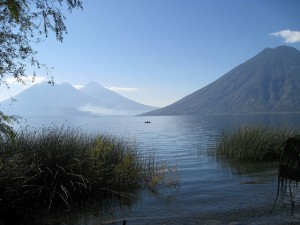
Nicknamed the Land of Eternal Spring, Guatemala is stepping into the spotlight and becoming a prime retirement location over past favorites like Costa Rica and Mexico.

Photo Credit: German Perez
With ideal weather, stunning views, and a great location (just a short plane ride from the U.S.), it’s not hard to see why expats are flocking to these countries to retire.
So what is it about Guatemala, located at the southern point of Mexico that has expats choosing it over other, arguably more popular countries in Central America?
Guatemala is Peaceful and Quiet
According to Travel Market Report, roughly 3.3 million American baby boomers claim that they intend to retire abroad, and as an increasing number of these expats set their sights on Central America, popular spots like Costa Rica and Mexico are becoming heavily populated.
But for those looking for solitude and serenity, Guatemala can provide them with an option that is a little more off the beaten trail, without sacrificing the wonderful weather and gorgeous landscapes that drew them to Central America in the first place.
Guatemala has a Lower Cost of Living
Due to the low cost of living, Guatemala can offer expats the best of both worlds, a beautiful place to retire, at a fraction of what they would pay to live the same life back home in the states.
In fact, it is estimated that people can live comfortably in Guatemala for only $1000-$1500 a month, and according to Guatemala real estate agent Glen Wilson, people living in Guatemala will only spend $2-$3 an hour on cleaning and gardening services, $6-$10 for fresh produce at the local market and their utilities will rarely go over $200 a month.
It sounds almost too good to be true.
Guatemala offers Affordable Real Estate
If renting isn’t for you and your heart is set on purchasing property in Central America, Guatemala real estate is very affordable. Depending on location, a fully furnished three bedroom home in Guatemala can be bought from the low $200,000 to $300,000 on average.
Also, unlike some other Central American countries, the process of purchasing property in Guatemala is not too complicated and they even make it easy for expats to secure visas. Of course, it is recommended that you rent a place for a few months before you buy (it will cost you around $200-$250 a month to rent an apartment on average); that way you can be absolutely certain that Guatemala is in fact the place for you.
Expat Hotspots:
Lake Atitlan

Photo Credit: Ourownpath
Considered one of the most picturesque lakes on the planet, Lake Atitlan can be found behind a border of mountains and volcanoes just 75 miles from Guatemala’s capital, Guatemala City.
Expats come to Lake Atitlan not only for its perfect weather and breathtaking views, but also for its rich culture. The lake is surrounded by twelve indigenous villages that are still alive with Mayan tradition.
If you choose to make Lake Atitlan your home, you can expect to spend your days hiking, fishing, kayaking, and soaking in the thermal springs that feed down into the lake.
And if you are looking for a little more excitement, Lake Atitlan also has few nightlife options as well.
Antigua

Ward Oliver
Located just thirty minutes from the Guatemala City airport, beautiful Antigua is one of the top travel destinations in Central America, and it isn’t hard to see why.
Founded in the early 16th century, much of Antigua was destroyed by an earthquake in 1773, but today many of the primary buildings remain preserved as ruins.
So enjoy the spectacular view of Volcan de Fuego and Volcan de Agua as you stroll through the colorful cobblestone streets and colonial ruins, brush up on your Spanish at one of the many Spanish schools, or why not try your hand at yoga.
With more affordable real estate and a lower cost of living compared to Costa Rica, it’s not surprising that more and more expats are heading for Guatemala so they can retire comfortably without having to stretch their pensions thin.
If warm days and cool nights, mountainous landscapes, and a slower pace of life are all things you seek, you just may have found a match in Guatemala. So take a trip down, visit Lake Atitlan and Antigua and keep your eyes peeled for that perfect spot to call home.
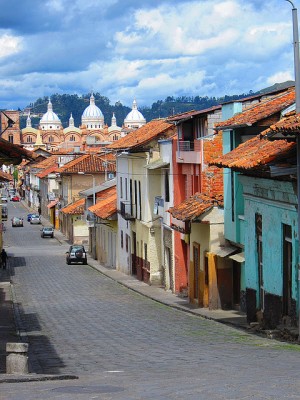
Ecuador 3 Count, where we bring you 3 Ecuador stories that you shouldn’t miss.

Photo Credit: C. Ramblur
1. Cuenca – the Next Expat Paradise?
In recent years, Cuenca Ecuador has experienced a record number of retirees from parts of the developed world such as the USA and Canada, who are chasing the media coverage praising the country for its beauty and low cost of living. BBC News takes an in-depth look at this boom and the effects upon the Ecuadorian people and culture.
Click to learn more about real estate, cost of living, healthcare, & residency in Cuenca
2. Ecuador Taps into Qatar’s Tourism Potential
Qatar could be a regional hub for South America-bound tourists, Ecuador’s Minister of Tourism Freddy Ehlers has suggested. The delegation presented key tourism offerings of the country such as the Amazon jungles, snow-capped volcanoes of the Andes, beaches along the Pacific coast, and the Galapagos Islands. Ecuador caters to tourists who are looking for adventure, special interest travel, or specialized tourism.
3. Ecuador’s Beaches: Why You Will Want to Pack Your Suntan Lotion
Travelers often go to Ecuador to see the Andes and to straddle the hemisphere. But if your desire is to experience more of the country than the mountains, head to one of Ecuador’s beaches. Depending on which beach you choose, you can find a party, a surfing paradise, or a relaxing escape from the chaos of the city.

Why Invest Offshore
U.S. citizens have always been a little shy about offshore banking, unless they’re in that upper income bracket, moving millions and even billions of dollars around, tucking them away in stable banks and tax shelter havens. Middle class America, with modest portfolios, are more hesitant, and prefer to keep their assets with a local bank, close to home, where they can keep an eye on things.
While the caution is understood, in recent years, many frustrated middle class investors and homeowners have noticed their carefully cultivated portfolios aren’t growing; or worse, are even shrinking.
Traditional Offshore Banking

The first offshore jurisdiction to come to the average person’s mind, is Switzerland. The Union Bank of Switzerland (UBS), located in Basel and Zurich, Switzerland, however, was among the European banks to suffer some of the largest losses during the subprime mortgage crisis, necessitating the general stable banking institution to generate large amounts of capital from outside sources.
Criticizing the enormous world bank’s policy of privacy to its investors, the U.S. government has pressured Switzerland into more information sharing among U.S. account holders, for the purposes of detecting tax evasion. The complaint, which was joined by several countries in the European Union, resulted in more stringent laws concerning U.S. and European deposits. Although Switzerland has agreed to more effective tax cooperation, opening an account in Switzerland can be difficult and expensive.
The power of the Euro faces as much uncertainty as the American dollar, with as many weaknesses in the banking structure. Investment in cargo ships has sent many of the banks reeling. A cargo ship valued at $150 million in 2009, will not fetch more than $40 million now. With the shipping industry going for bust, European banks are facing a potential loss of $350 billion dollars in loans.
Canadian banks are not much different than American banks. While somewhat more stable, growth rate for your investment is slow, interest rates on loans are high, stocks even higher, and the labor market has stalled.
The Japanese yen has crawled back into recession.
The Significance of the Emerging Nations
The BRIC nations; Russia, India, China, and Brazil, have been under the watchful eye of financial advisors and investors for several years. Leading investment banking institutions, such as Goldman Sachs, estimate that the economies of these four nations will be wealthier than most Western countries within fifty years.
Investing in an overseas bank, however, is a major step. It’s always best to visit the country you wish to invest in, and China, India or Russia seem a little extreme to most modest investors. However, Latin America is right next door.
Many of the Latin American countries have changed their policies to a more open and friendly relationship with U.S. citizens wishing to visit or invest in a little south of the border real estate. These once war-conflicted countries have enjoyed increased stability under democratic governments and responsible fiscal policies stimulating a burst in retail growth.
Although Brazil has dominated the economic market, the united efforts of the Central American countries to maintain favorable investment options, has created a surge in real estate options. High end investors led the charge, with interests in a second or third home on a tropical beach, but Central American investment can be started with as little as $1,000.
Panama and The Highlight of Central America
With so many beautiful countries to choose from, it can be difficult to decide which one you want to dedicate to for your offshore investment. They all offer spectacular views, good banking policies and a rich and varied culture. A Panama bank account, however, is one of the most desirable in the world today.
With over 80 international banks, it has been placed among the world’s largest banking sectors. Three of Panama’s banks were featured in the top 1000 world banks for 2012. The leading banks in Panama and their positions are:
- No. 524 Banco General
- No. 663 Banco Latinoamericano de Exportaciones
- No. 789 Banco Nacional de Panama
Living It Up in Panama
Besides an expanded canal that has brought millions of dollars in revenue to the Panama economy and a sophisticated modern city, there are several reasons for its increased popularity. There are no corporate or personal taxes on offshore activity in Panama. You will not be double-taxed on your assets. All income earned outside Panama will not be taxed.
There is no conversion rate to foreign currency, or foreign currency controls. Panama uses the dollar. While Spanish is the primary language, most bank tellers and managers speak English. It offers online banking service, international wire transfer, and check service.
Panama is the top banking center in Central America. Its free market and investment-friendly policies have attracted a wide clientele, from retirees to entrepreneurs, to expats and adventurers.
Panama gives immediate residency to foreigners from 22 countries that maintain friendly, professional, economic and investment relationships with Panama. The United States is listed among these countries. Immediate foreign residents have the right to work in Panama, establish a business and engage in professional and economic activities. After five years of living in Panama, they may apply for full citizenship.
Perhaps one of its greatest advantages is its close proximity to the United States. You do not have to wonder how your offshore assets are doing. You do not have to travel halfway across the world.
If you move to Panama, you do not have to abandon the loved ones you left behind. A short plane trip, a hop on the bus or a drive in the car, and you can visit them, or more likely, they’ll wish to come and visit you!
Panama continues to be the best place to invest in if you’re thinking of an offshore bank. With a stable economy, easy access to your account, as well as a close circumference to the U.S., there simply is no greater advantage than investing in Panama.

Nosara, Costa Rica is becoming increasingly popular among traveling surfers, because of its more laid-back, relaxed atmosphere than its bustling neighbor to the north, Tamarindo, while boasting world class surf almost all year long.
Most surfers visiting Nosara head straight for Playa Guiones, which is, hands down, one of the most consistent breaks in Costa Rica. Playa Guiones is a swell magnet and Punta Guiones (at the South end of the beach) juts farther out into the Pacific than many other points in Costa Rica. Which means Playa Guiones picks up both North and South facing swells bringing surfable waves over 300 days a year.
Like it so much you want to move here? So did others, and the result is a growing expat community. Thankfully, most seem intent on keeping development and over-building to a minimum.

Things are looking good for El Salvador. While it doesn’t make the list as potential places to live for most expats, this small country is on the rise. With a sound economy, reasonable tax rates, and some of the best surf breaks in Central America, it’s worth checking out.
Here are our top 6 locations to get you started.
1. Colonia San Benito District Three, San Salvador
San Benito is your choice for colonial inspired living inside the capital, San Salvador.

Photo Credit: Marlan Flores
2. Playa El Tunco, Pacific Coast
A beach front home and your surfboard await in El Tunco.

Photo Credit: R. Rea
3. Santa Ana, Central Region
Santa Ana is city life without the congestion.

Photo Credit: Mike Butler
4. Suchitoto, Central Region
Suchitoto is a sleepy colonial town, perfect for lazy afternoons in your hammock.
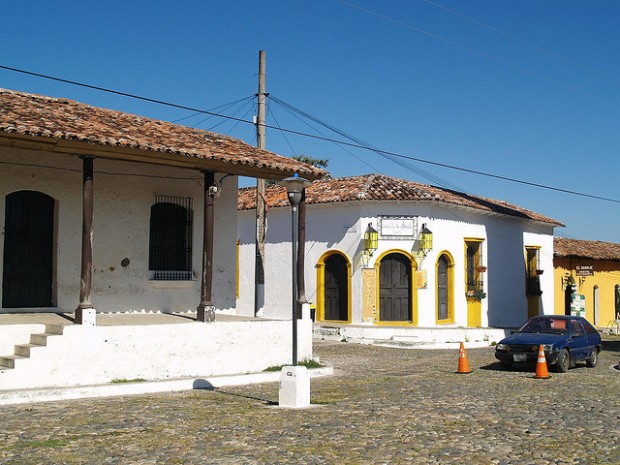
Photo Credit: Adalberto.H.Vega
5. Juayua, Mountain Region
With its cool mountain climate and small town town life, Juayua is a good choice.

Photo Credit: Garrett Ziegler
6. Playa el Cocal, Pacific Coast
Want a surfer’s life? Then there is no other place to live but at Playa el Cocal, where you have daily access to el Salvador’s famous surf break, Punta Roca.

Photo Credit: Pedruca
Have a favorite spot in El Salvador? Let us know in the comments section below.


Joshua Berman
Living next door to tourism giant Costa Rica and the up-and-coming Panama, and due to the common misconception that Nicaragua is still unsafe for tourists, this little country hasn’t been receiving the attention it deserves when it comes to expats.
While it is true that Nicaragua has been getting more attention in recent years, having been featured on the covers of some travel magazines, Nicaragua remains one of Central America’s least visited countries.
But according to Jennifer Taylor-Jones, the Vice President of Product Development at JetSet Vacations, this somewhat forgotten Central American gem just might be stepping into the limelight.
Why Nicaragua?
As expats continue to look towards Central America as a possible place for retirement, many are searching for the next big thing, and in 2013, Nicaragua just might be that thing.
Tucked between Honduras to the north and Costa Rica to the south, Nicaragua was not always the expat friendly, land-of-plenty that it is today.
So what is it about Nicaragua today that is drawing expats in?
A sense of discovery
Many are coming to Nicaragua to get away from heavily tourist concentrated areas. They like the idea that Nicaragua is still relatively unknown and that it has not yet been pegged as a tourist hotspot, a definite negative attribute to those seeking peace and serenity.
The wonderful aspects of Nicaragua have not yet been revealed to the public on a global scale and in a way, it can be theirs to discover.
But although expats want to go somewhere new, they still want to go somewhere that is safe and expat friendly. Today, Nicaragua fits both criteria.
Why now?
In recent years, Nicaraguan officials have been nominating significant funds in attempt to attract North Americans to their country. The end goal is to make Nicaragua the third most visited country in Central America behind Costa Rica and Panama.
Much of this money will go towards helping outsiders learn more about Nicaragua by educating them on the country’s current political and economical state, factors that have made tourists and expats wary about Nicaragua in the past.
In fact, according to a report published by the Financial Times, Nicaragua ranked third after Montreal and Toronto in the category of Strategy for Attracting Foreign Direct Investment.
And changes are being made. One expat lived in Nicaragua in 2007, and during that time, claimed that the road connecting San Juan del Sur to the Pan American highway was nearly un-drivable due to massive potholes. When she returned on a recent visit, she was welcomed by a smooth stretch of maintained pavement in place of the ripped up road.
Aside from the improved roads, she was also pleasantly surprised to find internet access across the country and that the capital city of Managua had expanded into an urban metropolis with everything and anything an expat could possibly need.
So what can an expat coming to Nicaragua for the first time expect today?
san-juan-del-sur-psd photogrpahy
Perfect weather, beautiful beaches free of colossal resorts, towering volcanoes (including the still active Masaya volcano), Lake Nicaragua (the largest lake in Central America), surfing town San Juan del Sur, and colonial cities like Leon and Granada.
And best of all, it won’t cost an arm and a leg to experience all that Nicaragua has to offer.
Budget friendly
Like many other Central American countries, the cost of living in Nicaragua is low and this is an obvious perk to any expat looking to retire on a budget.
Real estate in Nicaragua is extremely affordable. A colonial home in the city of Granada can be purchased for under $50,000.
Renting is also affordable, but of course prices will fluctuate depending on where in Nicaragua you choose to live. In San Juan, a relatively touristy area for Nicaragua, a 1-2 bedroom apartment can cost between $250-$600 a month, although, as the price goes up, things like utilities, internet, cable, and housekeeping are often included.
Covering rent, utilities, cable/internet, groceries, and entertainment, a couple could live comfortably in Nicaragua for around $1,200 a month, a meager amount when compared to prices back home.
On the other hand, a couple could live a simple life on as little as $750 a month and a life of luxury, including a spacious house and a maid, for around $2000.
Get there before the crowds do
As Nicaragua continues to gain recognition, it won’t remain unknown for long. If you have been thinking about heading to Central America, consider Nicaragua, the favored hot spot for expats in 2013. With all of the wonders of Central America, an exceptionally low cost of living, and a portion of the crowds, Nicaragua is the perfect spot to relax and live the laid back lifestyle that we all crave.