


Lake Chapala is home to an estimated 40,000 expats, with roughly half being from the United States. The region is actually a series of small villages, mostly on the north shore, with Ajijic being the crown jewel of the area in terms of artisans, charm, and amenities.
No matter which you choose to call home, there is a happy hum of activity in the area. What draws so many? Check out a few of the most compelling reasons retirees and families are moving to Lake Chapala:
- The most-developed expat/English infrastructure in Mexico.
- Affordable, top-notch medical care is available.
- Close proximity to a major airport.
- A lower cost of living.
- A sense of a real community.
Some say, Lake Chapala is a one in a million place with everything it offers. Of course, one size doesn’t fit all but if you’re looking for a paradise with a low cost of living, an established English infrastructure and activities, modern amenities, near-perfect climate, and a friendly community, a visit to Lake Chapala might be in order.


Magellan Missed Out on the True Peaceful Sea
History tells us when Magellan began his search across the Atlantic Ocean for a trade route to the Spice Islands by going around South America, he became impressed with the large, peaceful body of water he encountered on the other side, naming it the Pacific. With Portuguese Brazil his first landing point, Magellan didn’t really know the Riviera Maya Mexico on the Caribbean.
The impression you receive when gazing at the Caribbean for the first time is that this incredible sea is like blue glass. The warm waves barely nibble at the shore making it seem more like an unbounded lake than an ocean body.
The Caribbean’s Natural Shelter
The Caribbean owes its placid nature to the Great Mesoamerican Reef, which shelters the mainland coasts from most storms. This reef system begins at the tip of the Yucatan Peninsula, and extends down to the Bay Islands of Honduras. The Great Mesoamerican Reef is the home to more than 65 species of stony coral, as well as over 500 species of fish and 350 species of mollusk. The vigorous bio-diversity includes the world’s largest group of manatees, as well as a number of endangered or protected species.
About the Riviera Maya Mexico
Originally called the Cancun-Tulum corridor, the Riviera Maya Mexico snuggles along the coastline of Quintana Roo, in the Yucatan Peninsula, where it basks in the uninterrupted miles of glittering white sand beaches, an amazing bio-diversity, and exposure to an ancient, technically advanced civilization.
The Riviera Maya Mexico has something for everyone. It is a favorite area for scuba diving, jet skiing, and snorkeling. For the adventurer, there are more serious pursuits.

Natural Wonders of Aktun Chen
Deep in the rain forest of the Riviera Maya Mexico, close to Tulum, is the incredible natural park, “Aktun Chen”. The Mayan name means cave with an underground river inside. There are three cenote caves at the park, with million year old stalagmites and stalactites and crystal clear water pools. For wildlife lovers, there are spider monkeys, white tail deer, wild boars, iguanas and flocks of brightly colored birds.
Cenotes, which are naturally forming sink holes, sometimes containing water, sometimes not, are found throughout the Riviera Maya Mexico. The Yucatan Peninsula is flat; so flat, it sometimes appears the only separation between land and water is the color and the towering palm trees. This creates an absence in surface rivers. They sink underground, revealing their presence only in the swirling holes dotting the landscape. Cavers have discovered a thrilling adventure in descending into the dry cenotes, that usually contain a sparkling pool of water at the bottom, delicious for swimming and for examining further underground pieces of paradise in the tunnels cut by the rivers.
Archeological Flavor
While sun-bathing on the beach is delicious, the biggest tourist attraction in the Riviera Maya Mexico is the Mayan ruins. Its ancient architecture rivals the best in Mediterranean history, stunning the viewer with its mastery of building and design, its astonishing understanding of hydraulics, its exquisite art and the massiveness of its enterprise.
Although a huge number of the Mayan ruins are still covered with growth, making it difficult to comprehend the full system of canals, roads, observatories, business and social establishments, an appreciation of their elaborate civilization can be found at Chichen Itza.
The Temple of the Jaguar
Located close to Merida, but within a day’s drive of Cancun, Chichen Itza is one of the most popular tourist destinations. The excavation site measures a mile from west to east, and approximately a mile and a half from north to south, revealing a number of buildings, some pyramids, temples, and an observatory.
Reaching the flattened summit of The Castle, a pyramid 75 feet tall, is a labor of love. At the top is a temple. In the middle of the temple is a jaguar, painted red and gleaming with inlaid jade and turquoise. Perhaps it’s just the cool shade from the sun, but you feel suddenly transformed to another dimension. The little jaguar, staring brightly, seems real, and his quizzical look seems to ask why you entered his domain.
The Highly Advanced City of Coba
The tallest pyramid in Riviera Maya Mexico resides in Coba. Reaching over 125 feet in height, a hike to the top reveals dozens of structures still moldering under jungle growth and the accumulation of sand and earth brought by the winds of time.
The most remarkable aspect about the area, however, is the remnants of a road system that had once covered the entire Yucatan Peninsula. The roads were raised, ran in a straight line, and included ramps and intersections.

The Castle by the Sea
A visit to the Riviera Maya Mexico ruins really isn’t complete without dropping into Tulum. Completed in 1,200 A.D., Tulum was a busy port and trading center during the Post Classic period. The greatest appreciation lies in the beauty of the architecture. Set precisely on the coastline, with the sea rolling close to its walls, it creates both a romantic and strategic setting. The Castillo, built on the highest point of the site, is believed to have been a lighthouse or a marker for seafarers. It has a watch tower vantage point, with views in every direction.
Life at Its Fullest
The traveler to the Riviera Maya Mexico is as versatile as the many natural wonders and modern services the Yucatan Peninsula has to offer. You’ll find anthropologists and biologists rubbing shoulders with adventure seekers, naturalists, cavers and scuba divers. For the more social, there are dazzling night spots, cozy beach clubs, and broad avenues filled with shops and restaurants.
A final touch to add to the Riviera Maya Mexico experience is visiting a spa. Located throughout the region, the Mayan spa has become a favorite destination among travelers. As much a cultural experience as a treatment, the temazcal – or house of steam – incorporates a shaman, ritual chanting and herbal remedies. The treatment may involve covering yourself with mud to help draw out the toxins. The benefits are said to include ridding toxins, cleaning the nervous system, relaxing muscles, reducing fat and stimulating the digestive and respiratory systems.
The Unforgettable Appeal
With a coastline like no other and an egg-shell sea in front of it, those features alone are enough to set up lawn chairs all over the Yucatan Peninsula. The wild bio-diversity that includes rain forest and cenotes, the open plain feeling, are the bonus features, adding dimension and versatility to the region. The ruins give silent testimony to the fact that at least two thousand years ago, a people saw the potential of this equatorial zone. They built a civilization with technologies we are only just now beginning to understand and appreciate for their precision and functional applications. Although remnants of this civilization are scattered throughout Central America, none so far have been found quite as spectacular as the giant pyramids and elaborate city hubs on the Riviera Maya Mexico.
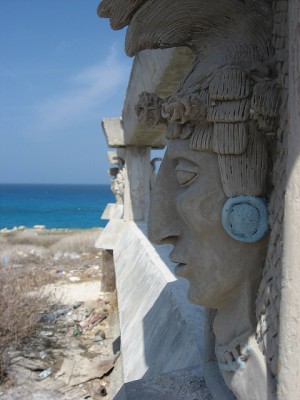
The stunning beaches of Cancun, Playa del Carmen, and Tulum have brought tourists to the Yucatan for years. Unfortunately the popularity of these white sand and clear ocean beaches have brought development which has all but spoiled some areas. It’s easy to associate Cancun with drunk college kids and high rise hotels.
Despite this reputation the Yucatan in Mexico is an incredible destination for beach lovers, outdoor adventurers, foodies, and culture seekers.
Here is why.

The Natural Wonders That Are the Cenotes
Few places in the world contain the incredible natural phenomenon that is a cenote, and the Yucatan is home to over 6,000. A cenote is a natural pool created below the Earth’s surface from the collapse of limestone. The water is crystal clear and glows blue or green. It is an incredible site that simply cannot be put into words.
Dos Ojos cenote is one of the most famous and is a short drive from Tulum. Tours are possible as well as self guided snorkeling and cave diving. Imagine swimming through water as clear as Aquafina among limestone stalactites.

The Beautiful, Undeveloped Islands
With crystal clear turquoise water for miles, perfectly combed white sand beaches, and incredible marine life, Holbox, Isla Mujeres, and Cozumel have all the allure of popular Caribbean islands but with Mexican culture and Latin American prices. Swim with whale sharks on Isla Holbox which has no cars, walk down the endless pristine beach on Isla Mujeres, and dive or snorkel at the second largest barrier reef in the world at Cozumel.

The Food
The food here is incredible. This is Mexico after all. If you stay outside of the all inclusive hotel zone in Cancun you will find amazing chile rellenos, sopas, and tacos for less than a dollar. In Tulum chicken stewed in mole or chile verde is served with steamed rice and freshly made tortillas. Walk along the winding colorful streets in Isla Mujeres to find whole roasted spiced chickens and perfectly charred corn. Cinnamon dusted churros, perfect tacos al pastor, and crispy crepes slathered in nutella are cheap and everywhere.

The Ruins
The Mayan ruins in Tulum are on a cliff overlooking a stunning backdrop of the Caribbean sea. Where else can you sip a Margarita on the beach then walk through the ruins of an ancient city?
Chichen Itza, located a few hours from Tulum, was named one of the new wonders of the world and with good reason. It was one of the largest Mayan cities, with an extremely diverse population, and remains relatively well preserved.


photo by Nick Chik
If you’re a would-be expat who’s searching, not for a promise of what a tropical destination could be, but for the world-class lifestyle it delivers today…look no further than the beaches of Puerto Vallarta, Mexico.
This popular retirement haven and tourist hotspot already has almost every luxury for which the other destinations yearn. At only a slightly higher price tag. Recently named one of the top overseas retirement options by the longtime former editor of International Living, Puerto Vallarta was also named AARP’s best place to retire internationally and was dubbed the world’s friendliest city by Conde Nast Magazine.
Puerto Vallarta’s Location
Puerto Vallarta lies on Mexico’s Pacific Coast at the junction of the states of Nayarit and Jalisco. Situated in Banderas Bay, the region is divided by the River Cuale. It sits at the foot of the Sierra Madres, so as you move inland its pristine beaches give way to quaint hillside villages.
The area shares the same latitude as the Hawaiian islands and enjoys an almost perfect climate. It’s mostly dry and sunny year round, with temperatures ranging from 80 to 85 degrees by day, which drop to between 55 and 65 degrees at night. Summers (roughly June to October) are hotter and more humid.
Another important factor to note about Puerto Vallarta’s location is that it is comfortably removed from most of the more dangerous cities in Mexico, many of which are in close proximity to the U.S. border and whose crime rates and drug trafficking are well documented by U.S. news sources.
Accessibility
A more appealing aspect of Mexico’s proximity to the U.S. is the ease of access for those who wish to make it their retirement destination. Not only could you inexpensively travel back and forth as needed, but you’d have no trouble convincing friends and family back home to come and visit.
Now given the fact that Puerto Vallarta offers the same or better amenities than many desirable U.S. cities, you might have some difficulty getting them to leave. Luckily you won’t have to go far to drop them off at the city’s own international airport, which has direct flights to many major cities across the U.S.
Development
While the climate and accessibility of Puerto Vallarta are great, they’re not what sets this desirable retirement destination apart from the rest. Unlike many similar tropical locations, this region does not claim to be up-and-coming. Puerto Vallarta, by contrast, has already arrived.
Thanks to decades of investment into the area by developers, as well as the Mexican government itself, the area boasts a highly developed infrastructure and many modern amenities. Its paved roads, power plants, high-speed internet, water treatment and distribution facilities, cable television and other features easily rival that of any U.S. city.
In addition, the area offers quality healthcare, including modern hospitals, highly-trained English-speaking physicians, and even those practicing alternative healing methods.

photo by risket O
Puerto Vallarta’s Cost of Living
So, exactly what is the price tag on this piece of Latin American paradise? You might be surprised to find out that you can get by on a mere $2000 per month in Puerto Vallarta and that decent housing can be found for as little as $700 monthly.
While this is still higher than the cost of living in nearby Panama, and certainly more than that of countries like affordable Ecuador, it’s considerably less than its U.S. counterparts. By comparison, this is a far cry from what you would pay for the same lifestyle in any U.S. city situated on the picturesque Pacific Coast.
Activities and Amenities
Essentially it isn’t the cost that should be compared to other retirement cities in Latin America. It’s the amenities. Few other places offer the same number of dining, entertainment, and other leisure options.
For instance, it would be absurd to imagine renting a boat slip in a California bay for as little as $100 per month. In addition to the high level of infrastructure and other conveniences, Puerto Vallarta boasts a wealth of options for your amusement.
With seven golf courses, numerous marinas, world-class dining, shopping malls, beachside restaurants and nightlife, there’s no shortage of things to do.
Due to its location, the region offers activities such as hiking, zip lining, horseback riding, and other attractions. Also available are opportunities for absolutely anything you ever wanted to do in the water. From snorkeling to surfing to fishing to boating to scuba diving…Puerto Vallarta has it all. Due to the established expat community, the area also has numerous cultural attractions such as museums, theaters, and festivals.
Puerto Vallarta’s Expat Community
Speaking of expats, Puerto Vallarta has its share. More American retirees relocate to Mexico than any other country. The influx of U.S. retirees has rendered the need for Spanish almost useless in Puerto Vallarta. In addition, the country, and Puerto Vallarta specifically, is also home to expats from nations across the globe.
The area is a melting pot of cultures, and has greatly benefited from their influence. Those who have gone before have only paved the way for the hosts of expats that are to come. For that, we thank them.

There are nearly 200 Mayan ruins sites you can explore in Mexico. Since the Maya of Mexico were the most advanced civilization of Mesoamerica, it’s worth putting a few of these ruins on your must-see list. Here are the top 5 Maya Ruins you should see when becoming an expat in Mexico.
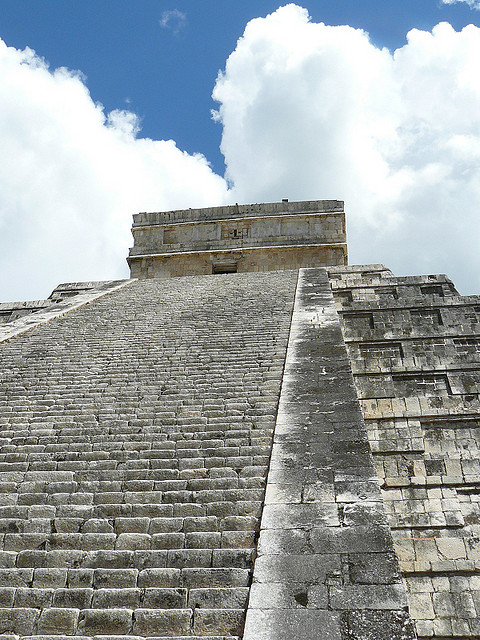
Chichén Itzá is Mexico’s most visited Mayan site.
1. Chichén Itzá – Take a day to tackle Mexico’s most visited Mayan Ruin.
Chichén Itzá is Mexico’s largest and by far the most tourist-filled of Mexico’s Mayan ruins. It features the Kukulkan Pyramid, named one of the new seven wonders of the world in 2007.
What to see: Carefully climb up one of the steep staircases of Kukulkan for a great view of the site.
Uxmal spans over 150 acres, and is home to one of the Maya’s most unique structures.
2. Uxmal – Home to one of the Mayan’s most unusual structures.
Spreading over 150 acres, Uxmal emerges out of harsh jungle land and is home to the massive Magician’s Pyramid. Its height and rounded sides make it one of the Maya’s most unique structures. What to see: Check out the site’s complex system of man-made wells. The structures sit at the entrance to the site, and to this day, mystify scientists.
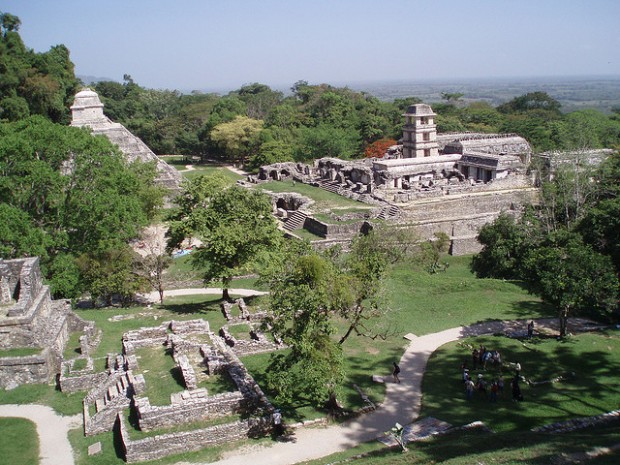
Palanque is known for its dense jungle growth and dramatic mountain setting.
3. Palanque – By far the most impressive of all Mexico’s Mayan ruins.
Palanque, surrounded by dense jungle forest in a dramatic mountain setting, its location in the savannah of Chiapas, is widely regarded as the most atmospheric and impressive of Mexico’s Mayan ruins. It was also named as a UNESCO World Heritage site. What to see: The Temple of the Inscriptions, named for the hieroglyphics found inside. Many of which are now on display at Mexico’s National Museum of Anthropology in Mexico City.

Spectacular Caribbean views await at Tulum.
4. Tulum – Where the Maya and Spanish Conquistadors first met.
Spectacularly located on a cliff overlooking the turquoise waters of the Caribbean Sea, Tulum is a Mayan settlement that flourished from around 1200 AD until the arrival of the Spanish.
What to See: Frescos located in The Temple of the Frescoes, directly in front of the Castillo, and used by the Maya as an observatory of the sun.
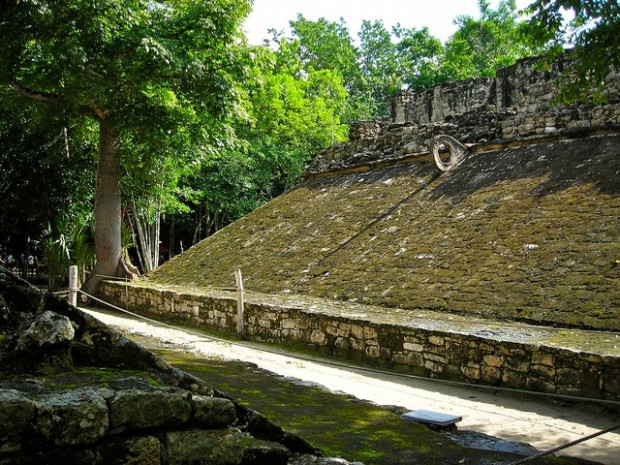
Ball court at Coba.
5. Coba – Home to over 6,500 structures to discover at your pace.
Much of Coba still remains to be excavated, but it is notable for its extensive system of ceremonial roads, remote jungle landscape and multiple pyramids, including the tallest in the Yucatan.
What to See: This vastly unexplored ruin is ripe for discovery through an intricate set of Mayan roads. In Coba, you are your own guide and can hike from mini-ruin to mini-ruin, but be warned, it takes about 3-4 miles of walking to each site and at least that many hours to explore most of Coba.
Want to learn more?
Here is an interview with Christopher Minster, Latin American History expert. He discusses the Maya, an ancient culture that developed reading, writing, and a complex society with Josh on Viva Tropical Radio. They also discuss their favorite ruins to visit.
Listen to the show
You can listen to the show using the player above or grab it and listen on the go via one of the following options:

The Travel 3 Count, where we bring you 3 travel stories that you shouldn’t miss.
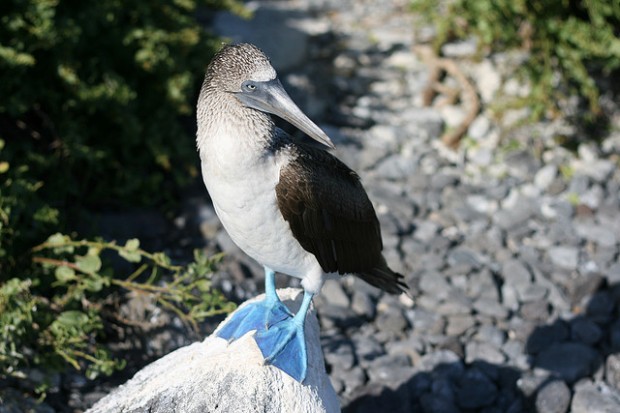
Ecuador’s Galapagos is a must see destination in 2013.
1. Destinations to Watch in 2013
First Up: Conde Nast Traveller’s destinations to watch in 2013 list includes some of Latin America’s gems. Here are the top Latin America destinations to watch in 2013.
- Panama. No longer just a place where ships pass in the night, Panama is the cool Caribbean destination of the moment.
- Mexico’s Mayan Riviera. The Mayan Riviera is set for a bounteous year in 2013.The vibe is deliberately hippy-chic, lo-fi by day and up-tempo at night and is a great place to stay for discerning travelers seeking barefoot luxury.
- Ecuador’s Galápagos Islands Galápagos is one of the most fascinating places on earth, an evolutionary melting pot. It’s already at the top of many wishlists, for the intrepid and for animal-lovers.
2. 21 Cheap Places to Visit… Where Does Latin America Come In?
Up Next. Want to travel, but don’t want to spend lots of money? These 21 cheap travel destinations let you get the most bang for your buck. Want to try it? Tim Leffel’s can help. His mission is to show cheapos how to find travel destinations they can afford.
Where is his favorite cheap spot in Central America’s? Ometepe, Nicaragua.
In Nicaragua, it’s a wide-open blank slate, because there isn’t much tourism outside of Granada and San Juan Del Sur. That means there are but a few nice hotels and restaurants and your main mode of transportation is mostly on chicken buses. But if you want cheap and exciting, Nicaragua is your choice.
3. 6 Must See Latin American Destinations
Finally: With over 7 million square miles to cover and 430 million people to meet between Central and South America, deciding where to start your Latin American adventure can be a little tricky, but with Bootsnall Travel Guide’s six must-see Latin American destinations, the planning just got easier.
- 1. Quito, the Amazon, and Cuenca – Ecuador
- 2. Rio de Janeiro and Iguazu Falls – Brazil
- 3. Lima, Cuzco, Lake Titicaca and Machu Picchu – Peru
- 4. Buenos Aires to Santiago via Bariloche – Argentina & Chile
- 5. La Paz, Sucre and more – Bolivia
- 6. San Jose to Panama City – Costa Rica & Panama
Adventure-lovers rejoice! These top sports are certain to deliver pure beach bliss, idyllic islands, curious creatures, and small towns packed with charm.
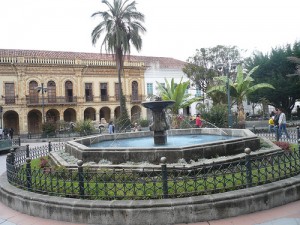

Cuenca, Ecuador Named Top Expat Destination for 2013
The world’s top retirement spot? In truth, it depends on you. There are many appealing options for a new life in retirement as an expat, as many people are now looking for ways to stretch their dollars. It makes sense, living expenses can be cheaper, cultural experiences richer and the lifestyle more satisfying as an expat.
The top retirement spots for 2013 have a variety of cultural offerings, climates, and lifestyles. Each destination is desirable in its own way, but they all offer something increasingly hard to come by at home: A good quality of life for a reasonable price.
Here is a guide to the best places to retire overseas in 2013:
1. Ecuador
Living on $1,600 a month including rent isn’t unreasonable in a place like Cuenca, Ecuador. Buying a house or condo near the water could cost you less than a quarter of popular U.S. destinations of similar climate. When you make the move, Ecuador allows you to import your household goods duty-free, and with its new, simplified visa process, it’s no wonder Ecuador tops the list as a best-value retirement paradise.
But for many, the true draw is the perfect climate. The nation lies on the equator. The beaches are tropical, but up in the Andes, the weather is mild and spring-like year-round. Best bonus yet, it’s one of the best countries for an expat business start-up.
2. Panama
In Panama’s capital city you can have all the U.S. comforts of a big city, including outstanding healthcare, restaurants, and daily activities. On a monthly budget of $1,700 to $2,500 a month you could eat out regularly, have a housekeeper come in a few times a week, and enjoy movie dates a few times a month.

View of Panama City skyline, a top expat destination for 2013
Panama’s major draw is its Pensionado (pensioner) visa, where qualified retirees achieve residence status fairly quickly. The program entitles visa holders to discounts on medical treatment, dining, movies, and more. Most expats in Panama regret they didn’t come sooner, as many say they chose Panama for the friendly people…its rainforest…plentiful beaches and the choice of secluded or city living lifestyles.
In Panama it’s possible to put a toe in the Pacific after breakfast and in the Atlantic before dinner…on the same day. There are cloud forests for bird watching, such as the resplendent quetzal, and even orchid gazing, all in the same weekend.
3. Malaysia
Malaysia is Asia’s Panama. That is to say, this country is a regional and a global hub, for trade, for business, and for culture. Malaysia is a multi-ethnic and multi-cultural country which attracts many tourists annually.
Penang, Malaysia offers expats an affordable living under $2,000 a month in what is considered “luxury housing” in the states. Here, an expat can eat out often and enjoy all the things the city has to offer along with top notch medical care at an affordable price.
Malaysian expats feel the country has everything. Its weather is a tropical 82 F all year round and its beaches, islands, and jungles are pristine. It has some of the region’s best street food, great restaurants, bars, shopping malls, and movie theaters—and it’s all affordable.
4. Mexico
Mexico’s colorful and vibrant culture does rank high with expats who live here…look deeper and Mexico has much to offer. Mexico is an easy, convenient choice for many expats who are seeking a first-world country at bargain prices. No wonder a million or more expats make Mexico their home.
Today’s Mexico offers modern highways and airports, cable and satellite TV, Internet, and many other items expats enjoy at home. Want your “big” U.S. lifestyle abroad, you’ll get it in Mexico with an overall cost of living at about half of what you’d pay in the U.S. or Canada.
And one of Mexico’s biggest pluses is its sheer size and variety. If you want beach, Mexico has thousands of miles of it—chic resorts, sleepy beach towns, and everything in between. Prefer cool, mountain scenery? Mexico has that, too. More likely than not, whatever you’re looking for in a retirement destination you will find it in Mexico.
5. Costa Rica
Costa Rica is where you go to live the lush life. It is lush with nature—misty rain forests, extraordinary wildlife, active volcanoes, and fabulous beaches—as well as such comforting amenities as malls, supermarkets, restaurants, museums, and social clubs.
U.S. retirees have flocked here for years, drawn by its mild climate, prosperity, literacy rate, health care, and, significantly, stable government. Another plus: Costa Rica’s commitment to a thriving natural park system that is second to none in Latin America. This is as biodiverse a country as you’ll find anywhere. The country offers micro-climates, meaning you can fine-tune your weather by moving up and down the hills.
Though not the bargain it was a decade ago, Costa Rica continues to draw moderate-income retirees, who meet the country’s requirement of income of $1,000 per month from Social Security or a pension. Best part, residence is easy enough that just about anybody can do it. Residents are eligible to join the universal health-care system, known as Caja. The cost, based on income, can be as low as $49 a month. After that, care is free.
6. Nicaragua
Want a budget-friendly retirement destination? Think Nicaragua. Geographically, the nation is blessed with two long coastlines and two big lakes, plus volcanoes, highlands, rain forest, and rivers. In this manner, it has everything Costa Rica and Panama have, but it’s less discovered and developed and available to adventurers and eco-travelers at bargain rates.
Property values have fallen significantly in this country over the past several years, thanks to Ortega’s re-election and then the global recession. As a result, you can buy one of Granada’s classic Spanish-colonial haciendas for $50,000 or less. A couple could live comfortably in this city on a budget of $1,200 per month.
Best of all, its lower cost of living does not mean you have to sacrifice the quality of life, in fact, it’s possible to live in Nicaragua with even more luxuries than you were accustomed to, simply because the prices are so low.
Retired Expat Communities
All these destinations have large expat communities, so doing your research can put you among other people like you; with similar interests. Learning a foreign language will probably be a requirement; but again if you have a sense of adventure, and don’t want the typical cookie cutter retirement this could be something new and stimulating.

Sayulita may be a growing tourist town, but don’t worry, it isn’t a tourist trap. This sleepy fishing village offers up incredible beaches, lush jungles and a taste of rural Mexico. Located on the Pacific coast of Nayarit, Mexico, this pueblo is slowly gaining popularity with expats, but more importantly, it’s packed with fun.
Here’s just a sampling of what you can do
- World Class Surfing
- Humpback Whale Watching
- Sea Turtle Releasing
- Sea Fishing
- Great Golfing
- Jungle Biking
- Boating
- Snorkeling
- Beach Lounging
- Eat a world famous Sayulita Fish Taco
Don’t worry, surfing and water sports isn’t all there is to do in Sayulita. But you will like it here if you’re into being outdoors. There are some nice trails to run, mountain bike, or just hike. You can even take a casual walk to your own private beach – great places to watch the sunset. Oh and don’t forget to try a fish tacos.